Begin with one question
Why Does Shorter Wavelength Mean Higher Frequency?
How do c = λf and E = hf connect wavelength, frequency, and photon energy?
Calculate three descriptions of one photon signal without treating the drawn wave as a flight path.
By the end of this lesson, you will be able to
Calculate three descriptions of one photon signal without treating the drawn wave as a flight path.
- 01Explain the central measurement behind “Why Does Shorter Wavelength Mean Higher Frequency?”.
- 02Use the lesson's symbols and units without dropping their physical meaning.
- 03Separate the direct measurement from calculation, model inference, and remaining uncertainty.
A fixed speed forces wavelength and frequency to trade
In vacuum, c = λf. The Greek letter λ (lambda) is wavelength in metres, and f is frequency in hertz. Their product must remain the exact vacuum light speed.
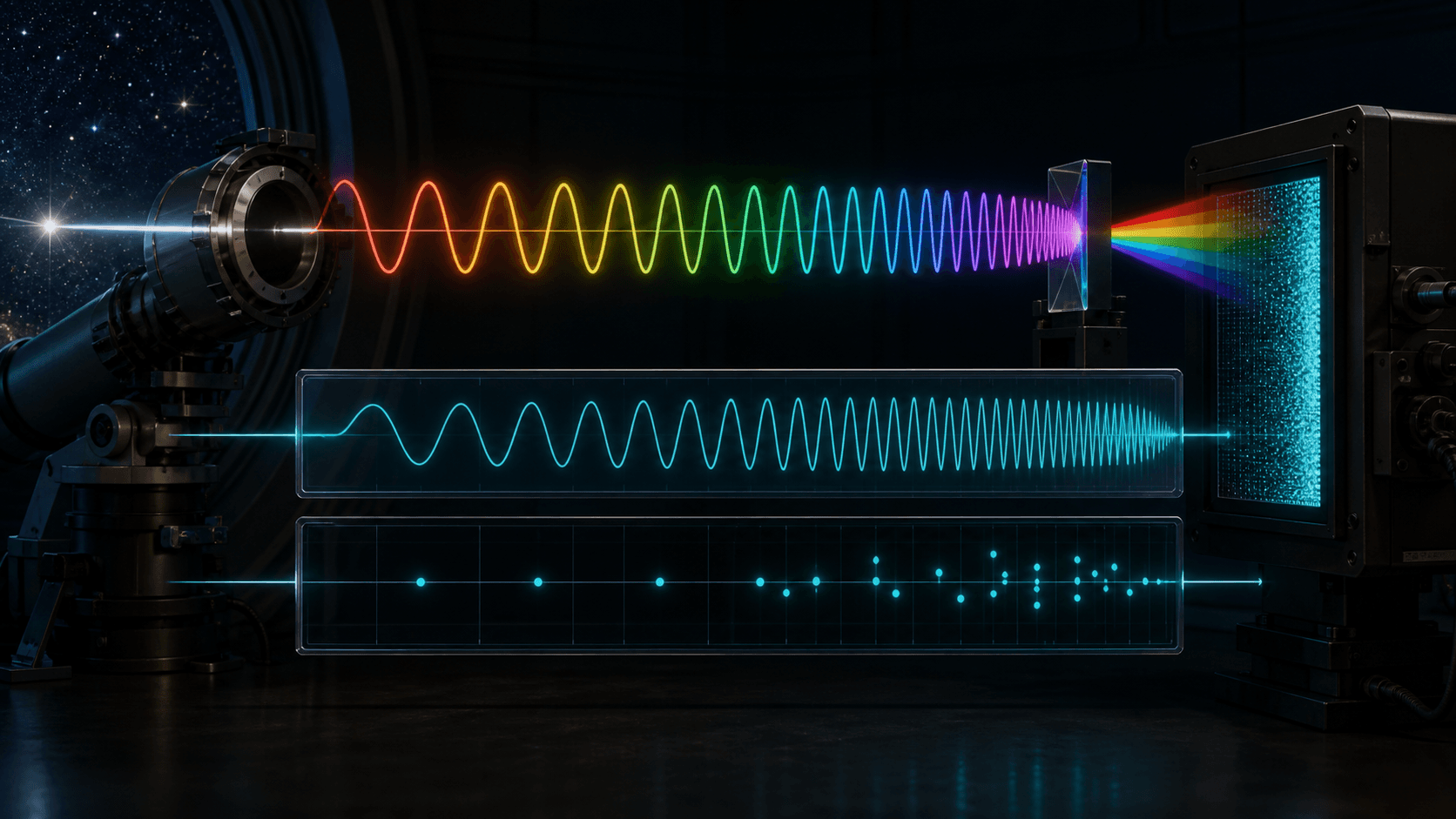
If the spacing becomes half as long, twice as many cycles fit into each metre of travel. At the same speed, twice as many cycles pass each second, so frequency doubles.
Frequency sets the energy carried by one photon
Quantum physics relates one photon's energy to frequency through E = hf. E is energy in joules, h is the exact Planck constant 6.626 070 15 × 10⁻³⁴ J·s, and f is frequency in hertz.
Higher frequency therefore means higher energy per photon. It does not automatically mean the whole beam has more total energy, because total energy also depends on how many photons arrive.
Work one 500 nm example from start to finish
Convert 500 nm to 5.00 × 10⁻⁷ m. Then f = c/λ = 299,792,458 m/s ÷ 5.00 × 10⁻⁷ m, giving about 5.996 × 10¹⁴ Hz.
Next E = hf gives about 3.973 × 10⁻¹⁹ J per photon. Divide by 1.602 176 634 × 10⁻¹⁹ J/eV to obtain about 2.48 eV per photon.
The drawn wave is not a photon trail
A sinusoidal curve is a graph of an oscillating electromagnetic field component. It is drawn against position or time so wavelength or frequency can be measured.
It is not a literal path followed by a tiny photon through space. The travel direction, field oscillation, and detector events must be labelled separately.
Calculate wavelength, frequency, and photon energy
Choose one signal and show every conversion from wavelength to frequency and energy per photon with units attached.
Keep the three equations on one evidence chain
Choose a wavelength. The explorer converts it to metres, calculates frequency with c = λf, then calculates energy per photon with E = hf while showing every unit.
The blue field pattern moves right to represent propagation. The motion is slowed dramatically and only compares direction and relative rhythm. It is not a true frequency scale or a photon flight path.
Once wavelength is measured, why divide first and multiply next?
The selected 500 nm visible preset gives the spacing between repeating positions in the field pattern: the wavelength. Light speed gives the total distance travelled each second. Dividing that total by the distance per repeat gives the number of repeats per second. Planck's constant then converts that rhythm into energy per photon.
- λ
- lambda, wavelength; spacing between repeats, in m
- c
- vacuum light speed, in m/s
- f
- frequency, repeats per second, in Hz
- h
- Planck constant, the fixed conversion from frequency to photon energy
- E
- energy carried by one photon, in J or eV
Why use c ÷ λ?
c is the total number of metres light travels each second. λ is the metres occupied by one repeat. Total metres divided by metres per repeat gives repeats each second.
f = 299,792,458 m/s ÷ 5.000e-7 m = 5.996e14 HzUnit check: (m/s) ÷ m = 1/s = Hz. Hertz means the number of repeats per second.Why use h × f?
Quantum physics tells us that photon energy rises by the same fixed amount for each increase in frequency. h is that fixed conversion scale.
E = 6.626e-34 J·s × 5.996e14 1/s = 3.973e-19 JUnit check: J·s × 1/s = J. Seconds cancel, leaving joules, an energy unit.- Hz
- hertz, 1 Hz = 1 repeat per second
- J
- joule, the SI energy unit
- J·s
- joule-second, the unit of Planck's constant h
- eV
- electronvolt, common for microscopic energy; 1 eV = 1.602 × 10⁻¹⁹ J
For 500 nm visible, the result is about 5.996e14 repeats each second and 3.973e-19 J per photon, or 2.48 eV. This is energy per photon, not the total brightness of the beam.
In vacuum, what happens if wavelength is cut in half?
Sources and evidence boundary
Vastward wrote this explanation independently and checked it against the official and research sources below. Each source supports a specific part of the evidence chain.
- Reviewed sourceAnatomy of an Electromagnetic WaveNASA ScienceOpen official source
- Reviewed sourceThe Electromagnetic Spectrum: Wavelength, Frequency, and EnergyNASA Goddard Space Flight CenterOpen official source
- Reviewed sourceMeet the ConstantsNational Institute of Standards and TechnologyOpen official source