Begin with one question
How Fast Is Light?
How do distance, travel time, and the exact vacuum speed of light fit together?
Use d = ct and t = d/c with Solar System examples and explicit units.
By the end of this lesson, you will be able to
Use d = ct and t = d/c with Solar System examples and explicit units.
- 01Explain the central measurement behind “How Fast Is Light?”.
- 02Use the lesson's symbols and units without dropping their physical meaning.
- 03Separate the direct measurement from calculation, model inference, and remaining uncertainty.
The vacuum speed of light is an exact defined value
In SI units, the speed of light in vacuum is c = 299,792,458 metres per second exactly. The symbol c names this vacuum speed; m/s means metres travelled each second.
Light travels more slowly through materials because the electromagnetic signal interacts with the medium. That does not change the defined vacuum constant c.
Distance, speed, and time form one calculation triangle
Use d = ct when time is known: distance d equals speed c multiplied by time t. Use t = d/c when distance is known: travel time equals distance divided by speed.
Units provide a built-in error check. Kilometres must be converted to metres before dividing by c in m/s, so the final unit becomes seconds.
Moonlight time is short enough to calculate directly
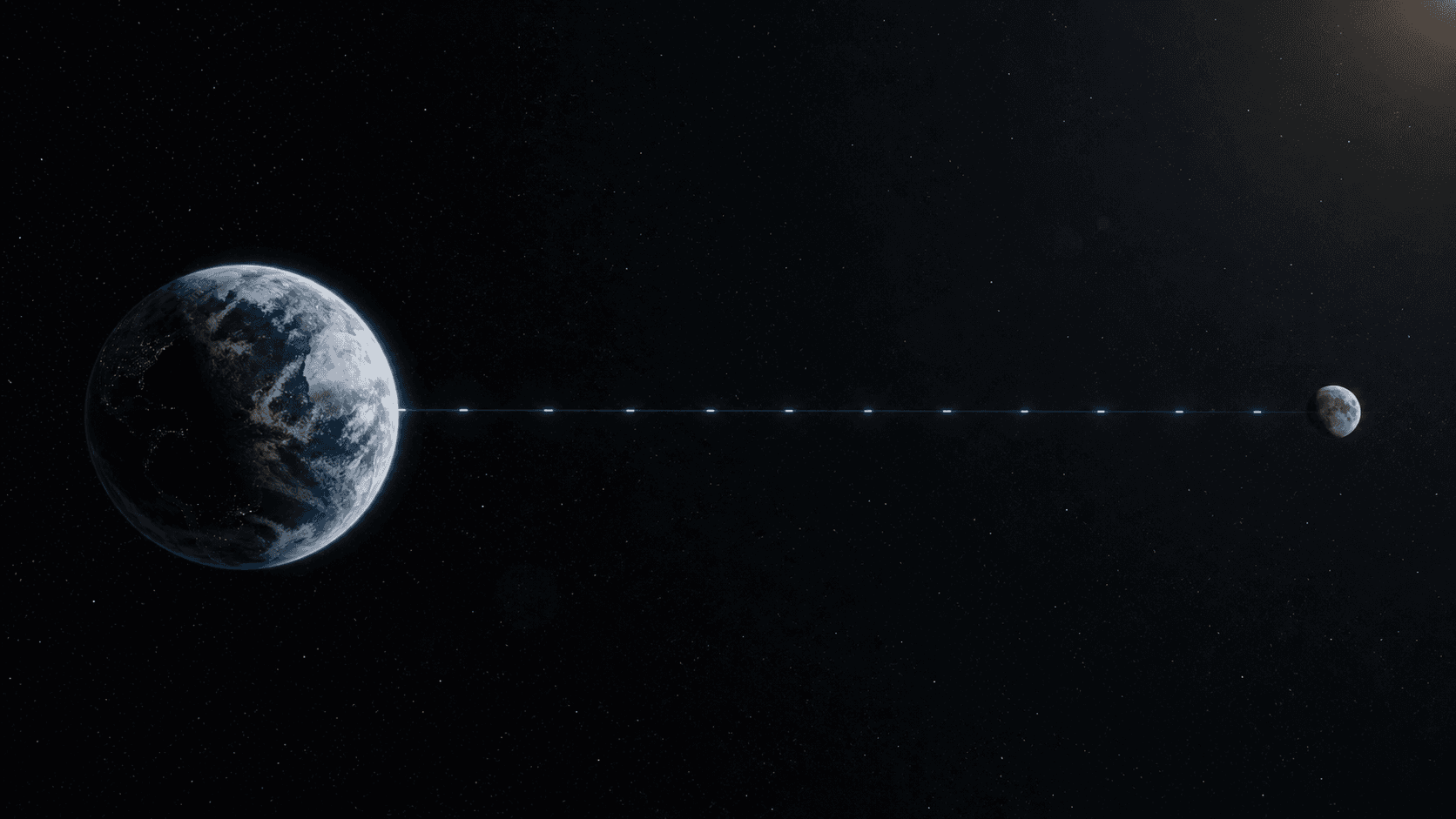
NASA lists the Moon's average distance as about 384,400 km. Convert it to 384,400,000 m, then divide by 299,792,458 m/s. The one-way light time is about 1.28 s.
A radio command and its reply need at least the outward and return journeys, so geometry alone produces about 2.56 s of round-trip light time before equipment delays.
Deep-space teams cannot control a spacecraft like a toy drone
A controller sees telemetry from an earlier spacecraft state. A command sent now will arrive later, and its confirmation needs another light-time journey back.
Mission procedures therefore separate predicted state, command transmission time, onboard autonomy, and confirmed telemetry time.
Calculate a deep-space signal delay
Convert distance to metres, calculate one-way light time, then predict the minimum round-trip delay.
Calculate the one-way delay before sending the command
Choose a route. The console converts kilometres to metres, divides by the exact vacuum light speed, and separates one-way travel from round-trip communication.
- Distance in metres
- d = 3.844e8 m
- One-way light time t
- t = d ÷ c = 1.28 s
- Minimum round-trip delay
- 2.56 s
Why divide the distance by the speed of light?
We know the total route length and how far light travels each second. Dividing the route by the distance travelled per second gives the number of seconds needed.
- d
- distance, the full route length
- c
- vacuum light speed, how far light travels each second
- t
- time needed to complete the route; it is not a place or receiver
Multiply by 1,000 first: 384,400,000 m.
m/s means metres per second: how many metres light covers in one second.
The units check the method: m ÷ (m/s) = s. Metres cancel, leaving seconds.
The minimum round-trip delay is not caused by light slowing down. The signal travels outward and back: 1.28 s × 2 = 2.56 s.
Why is the minimum round-trip delay about twice the one-way light time?
Sources and evidence boundary
Vastward wrote this explanation independently and checked it against the official and research sources below. Each source supports a specific part of the evidence chain.
- Reviewed sourceMeter: The SI Definition and the Speed of LightNational Institute of Standards and TechnologyOpen official source
- Reviewed sourceMeet the ConstantsNational Institute of Standards and TechnologyOpen official source
- Reviewed sourceMoon FactsNASA ScienceOpen official source
- Reviewed sourceCosmic DistancesNASA ScienceOpen official source