Begin with one question
Why Are Stars Born in Cold, Dark Molecular Clouds?
If darkness hides the cloud, how can astronomers tell that it may contain a future star?
Decode darkness, cold temperature, density, and wavelength choice before calling a cloud a stellar nursery.
By the end of this lesson, you will be able to
Decode darkness, cold temperature, density, and wavelength choice before calling a cloud a stellar nursery.
- 01Explain why cold dense pockets are promising sites for gravitational collapse.
- 02Connect the idea to an observable signal, measurement, or instrument.
- 03A dark silhouette is evidence of obscuring dust, not proof that a star is already forming.
Dark does not mean empty
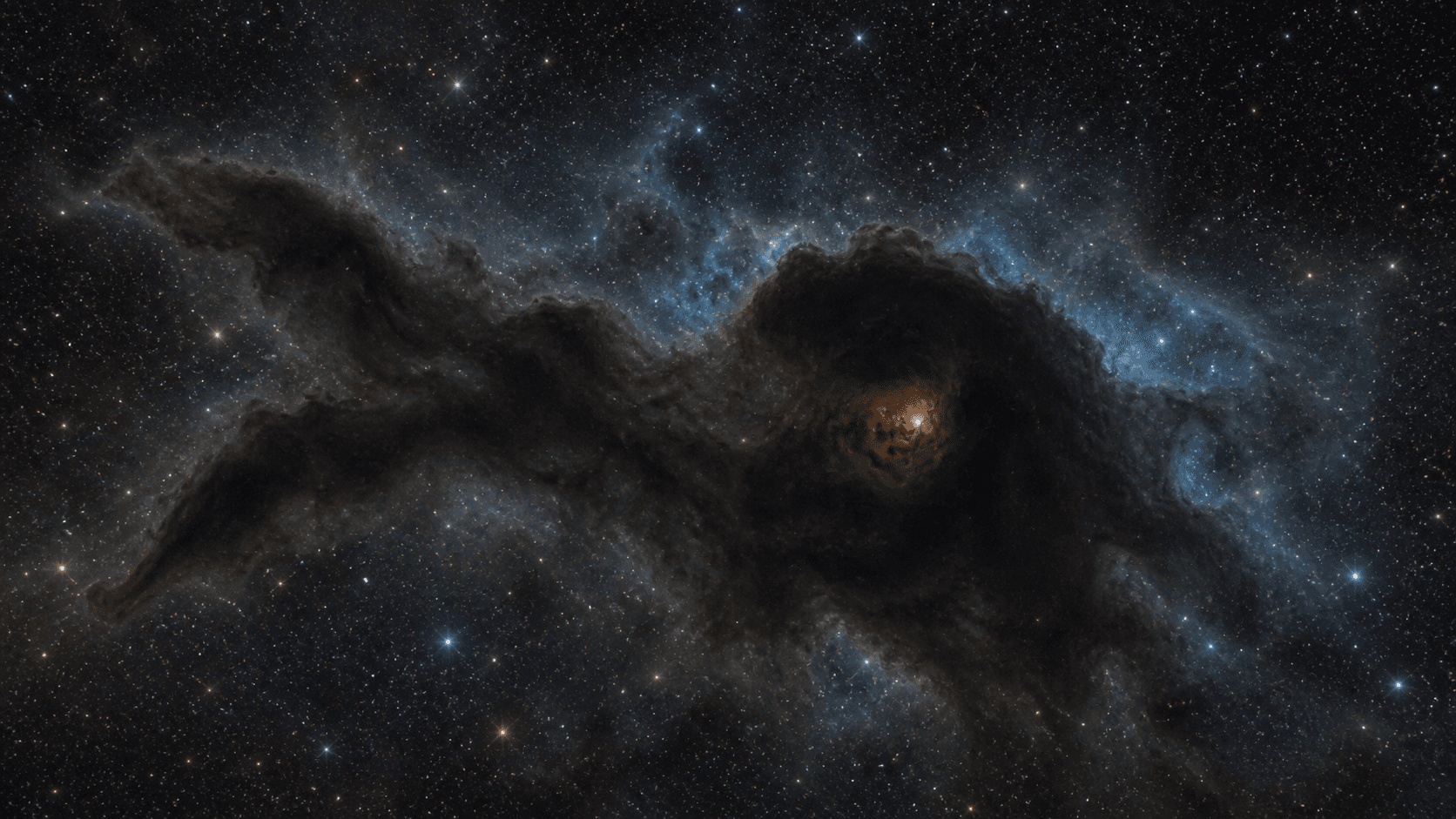
A dark patch in a star field can be a foreground cloud rather than an empty hole. Tiny dust grains inside the cloud absorb and scatter visible light from stars behind it, so the cloud appears as a silhouette.
That silhouette tells astronomers that obscuring material lies along the line of sight. It does not, by itself, prove that the cloud is collapsing or that a protostar already exists inside.
Cold gas gives gravity a better chance
A typical cold molecular cloud can be near 10 K. K means kelvin, the temperature scale used in physics; 10 K is about −263 °C. At lower temperature, particles have less random thermal motion pushing outward.
Cold alone is not enough. A cloud also needs a region dense enough for gravity to pull substantial mass together. Turbulence, magnetic fields, and surrounding pressure can still delay or prevent collapse.
Density asks how much matter shares the same space
Number density counts particles inside a chosen volume. In this lesson, molecules/cm³ means the number of molecules in one cubic centimetre, roughly a sugar-cube-sized volume. Raising the number while keeping the volume fixed packs more matter into the same space.
Astronomers do not count those molecules one by one. They measure molecular emission or absorption, dust emission, and extinction, then use calibrated physical models to estimate the cloud's density and temperature.
Change the wavelength to look inside
Visible light often shows a silhouette because dust blocks the background. Infrared measurements can reveal warmer embedded objects, while far-infrared and submillimetre observations trace cold dust. Radio and millimetre spectral lines can identify molecules and measure gas motion.
No single band sees everything. Astronomers align several measurements and ask whether a dense core, internal heating, infall, a disk, or an outflow is present before claiming that a star is forming.
Reveal a hidden stellar nursery
Change the number density and compare how the same cloud appears in visible light and in infrared or submillimetre measurements. Keep the evidence boundary visible.
Move from a diffuse cloud toward a dense core. The control changes a teaching model, not a live telescope observation.
- Number density (molecules in each cm³)
- 3,000 molecules/cm³
- Reference temperature (K = kelvin)
- 10 K
Dense core
A concentrated pocket appears inside the cloud. Gravity now has more mass to pull together in the same volume.
A dense core is a star-formation candidate, but kinematics and internal heating are still needed to test whether collapse has begun.
Visible light records a dust silhouette against background stars; infrared and submillimetre measurements reveal cold dust emission and concentrated structure. Size and brightness are teaching cues, not a calibrated image.
Swipe sideways on a small screen to inspect the full diagram and labels.
Why is a cold dense dark cloud considered a candidate stellar nursery rather than confirmed proof of a forming star?
Sources and evidence boundary
Vastward wrote this explanation independently and checked it against the official and research sources below. Each source supports a specific part of the evidence chain.
- Reviewed sourceStarsNASA ScienceOpen official source
- Reviewed sourceWebb's Star Formation DiscoveriesNASA ScienceOpen official source
- Reviewed sourcePiercing the Dark Birthplaces of Massive Stars with WebbNASA ScienceOpen official source
- Reviewed sourceGalactic Dust BunniesNASA ScienceOpen official source
- Reviewed sourceHow Herschel unlocked the secrets of star formationEuropean Space AgencyOpen official source
- Reviewed sourceNASA-Funded Study Explores Turbulence in Molecular CloudsNASA ScienceOpen official source
- Reviewed sourceHubble's Album of Planet-Forming DisksNASA ScienceOpen official source
- Reviewed sourceHow Newborn Stars Prepare for the Birth of PlanetsALMA ObservatoryOpen official source