Begin with one question
How does dust become a world?
What chain of collisions can turn microscopic grains into planetesimals and planetary embryos?
Trace sticking, accumulation, runaway growth, and differentiation without pretending every collision builds instead of destroys.
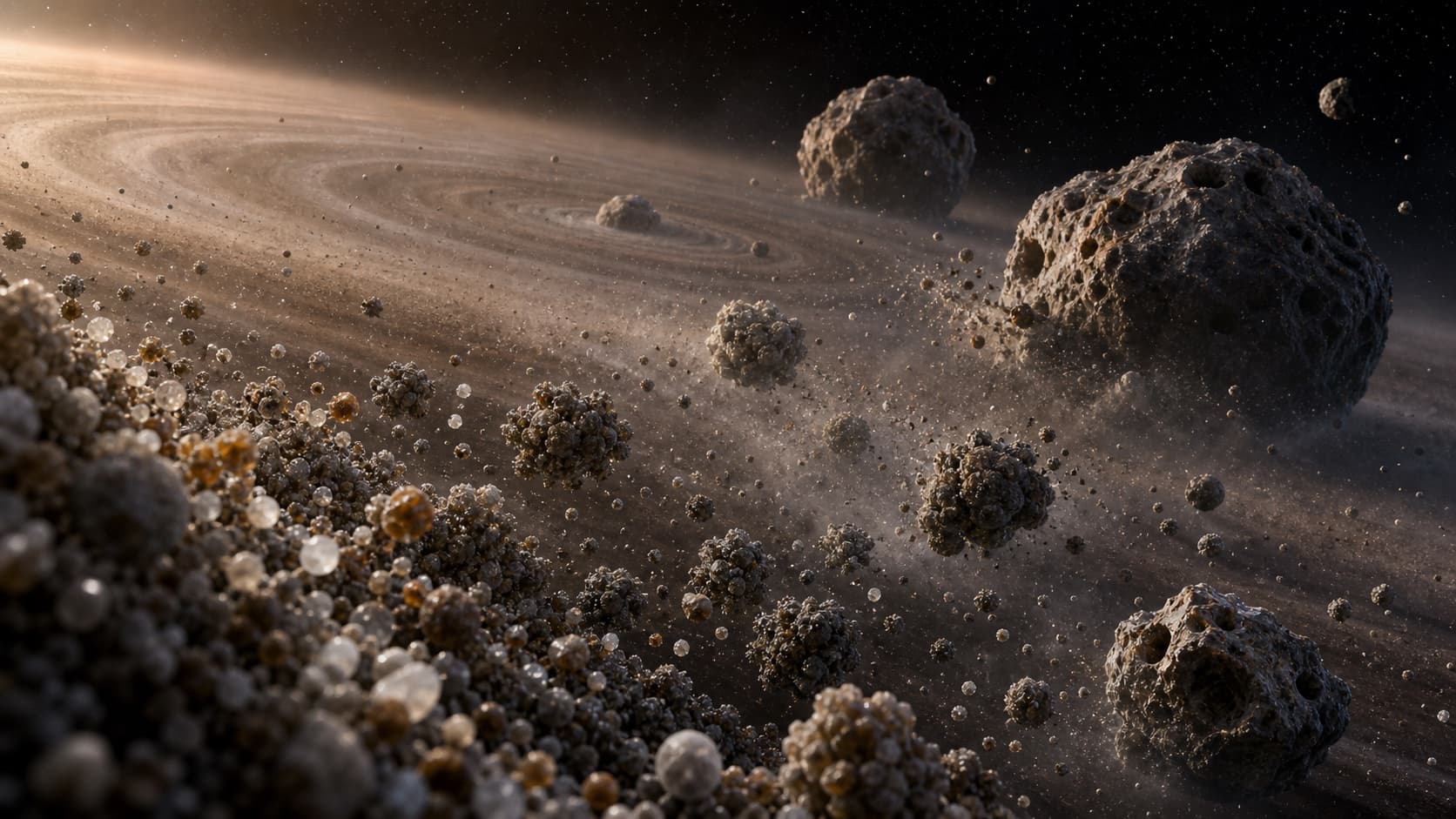
By the end of this lesson, you will be able to
Planet formation is a competition among growth, fragmentation, heat, and gravity.
- 01Order the major stages from dust grains to planetary embryos.
- 02Explain why growth is not guaranteed in every collision.
A planet begins with grains smaller than a human hair
A young disk contains gas and solid grains made from materials such as silicates, metals, carbon-rich compounds, and ice where it is cold enough. Tiny grains can meet through turbulence, settling, and slightly different orbital motion.
At the smallest scales, surface forces can hold gentle contacts together. The result is a loose aggregate, not a miniature solid planet.
Collisions can stick, bounce, or break the builders apart
Growth is not automatic. A slow encounter may allow porous grains to stick. More energetic bodies can rebound, compact, erode, or fragment. Material, size, porosity, gas, and impact angle all change the outcome.
This is why planet formation includes growth barriers. Researchers combine laboratory impacts, disk observations, meteorites, and numerical models to test how some material crossed those barriers.
Once bodies become large enough, gravity changes the contest
As concentrations grow into planetesimals, their gravity can attract additional material and focus nearby paths. Some bodies grow faster because a larger body can reach a wider feeding zone.
Planetesimal is the scientific name for a small body that helps build planets. Larger precursors are called planetary embryos. Many never become planets and can survive as asteroids, comets, or fragments.
Test a Planet-Building Collision
Change relative speed and decide when two builders stick, bounce, or fragment.
Change only the impact speed. Real outcomes also depend on size, material, porosity, spin, gas, and impact angle.
- Collision speed
- 0.8 m/s
- Nearest outcome regime
- Gentle contact can build an aggregate
Gentle contact can build an aggregate
The grains arrive slowly enough for surface forces and porous structure to keep them together.
At low relative velocity, adhesion can exceed the energy available to separate or restructure the contacting grains.
The two builders approach with the selected relative speed. Compare whether the encounter sticks, rebounds, or fragments.
Swipe sideways on a small screen to inspect the full diagram and labels.
Why can two planet-building bodies collide without producing a larger body?
Sources and evidence boundary
Vastward wrote this explanation independently and checked it against the official and research sources below. Each source supports a specific part of the evidence chain.
- Reviewed sourceHow Do Planets Form?NASA ScienceOpen official source
- Reviewed sourceAsteroids, Comets & Meteors: FactsNASA ScienceOpen official source