Begin with one question
Where is the Solar System's birth record?
If nobody watched the Solar System form, what evidence lets us reconstruct its beginning?
Start with plain-language clues, then learn the scientific names behind meteorites, atomic clocks, orbital patterns, lunar samples, and young planetary systems.
By the end of this lesson, you will be able to
The Solar System has no single birth photograph. A reliable history appears only when physical samples, measurements, patterns, and models agree within their limits.
- 01Identify several records that constrain different stages of Solar System formation.
- 02Explain in plain language how changing atoms let scientists calculate a rock's age.
- 03Separate a surviving sample, a direct observation, an analogue system, and a scientific inference.
- 04State what one piece of evidence cannot prove by itself.
The record is distributed across different kinds of evidence
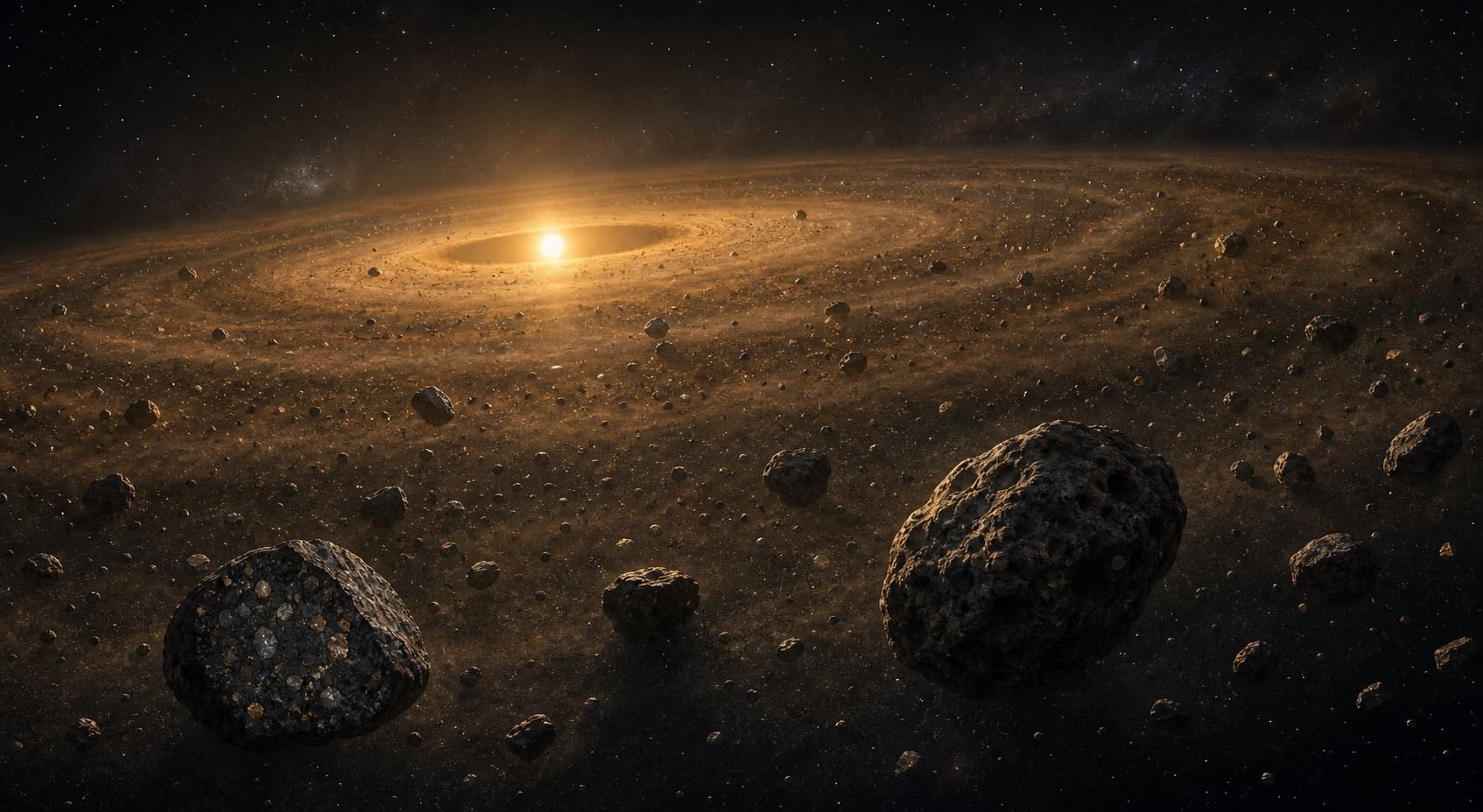
No camera recorded the formation of our Solar System. Instead, planetary scientists combine material that survives today with patterns that can still be measured. Primitive meteorites preserve some original planetary building materials, while the common direction and nearly shared plane of planetary orbits retain a system-wide clue.
Samples and orbital patterns answer different questions. A rock can preserve minerals, chemistry, textures, and the relative amounts of different atomic forms. The arrangement of many worlds can reveal the kind of rotating structure from which the system developed.
A rock has no birthday label. How can scientists calculate its age?
Begin with one familiar idea: the same chemical element can come in several atomic versions. They have the same number of protons but different numbers of neutrons. Scientists call these versions isotopes.
Some isotopes are unstable. Across a large population of atoms, the unstable version changes into another product at a predictable average pace. The starting version is called the parent isotope, the result is the daughter product, and the time required for half of the parent population to change is the half-life.
A laboratory measures how much parent and daughter material remains inside a carefully selected mineral. Scientists combine that ratio with the known half-life and tests of the sample's later history to calculate an age. In some primitive meteorites, pale mineral grains rich in calcium and aluminum have yielded the oldest measured ages for Solar System solids, near 4.57 billion years.
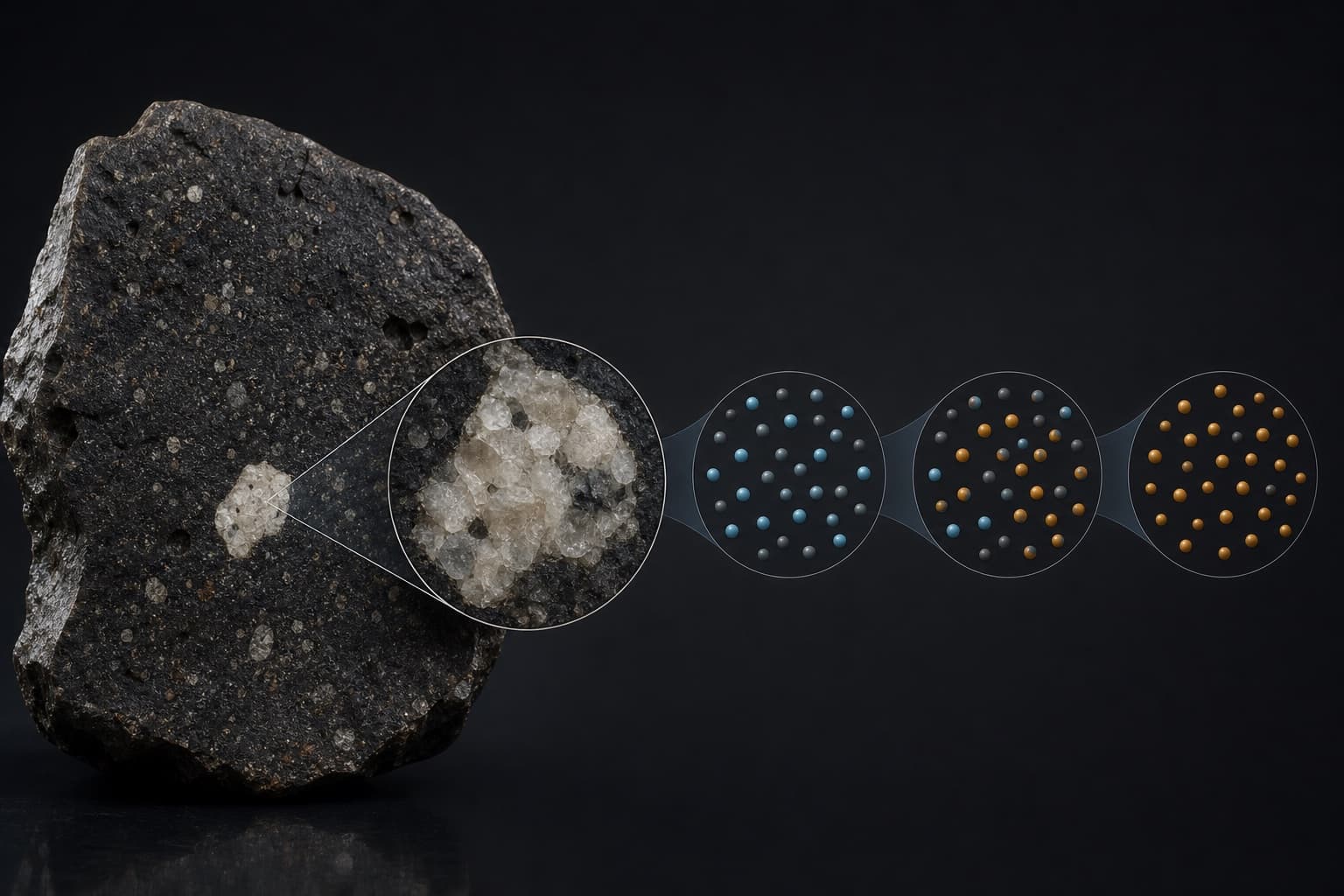
Educational schematic: the meteorite is real material; the magnified particle fields simplify the ratios measured in a laboratory.
Geologically quiet records can preserve older pages
Earth is easy to reach but difficult to use as a complete formation archive. Plate tectonics, melting, weathering, and erosion continually recycle or alter ancient material. Primitive meteorites and the much less geologically active Moon preserve records that active Earth has partly erased.
Apollo samples did not record the very first instant of the Solar System. They constrain a later chapter. Their ages, minerals, and chemical similarities with Earth support a hot, impact-related origin for the Moon tens of millions of years after Solar System formation began.
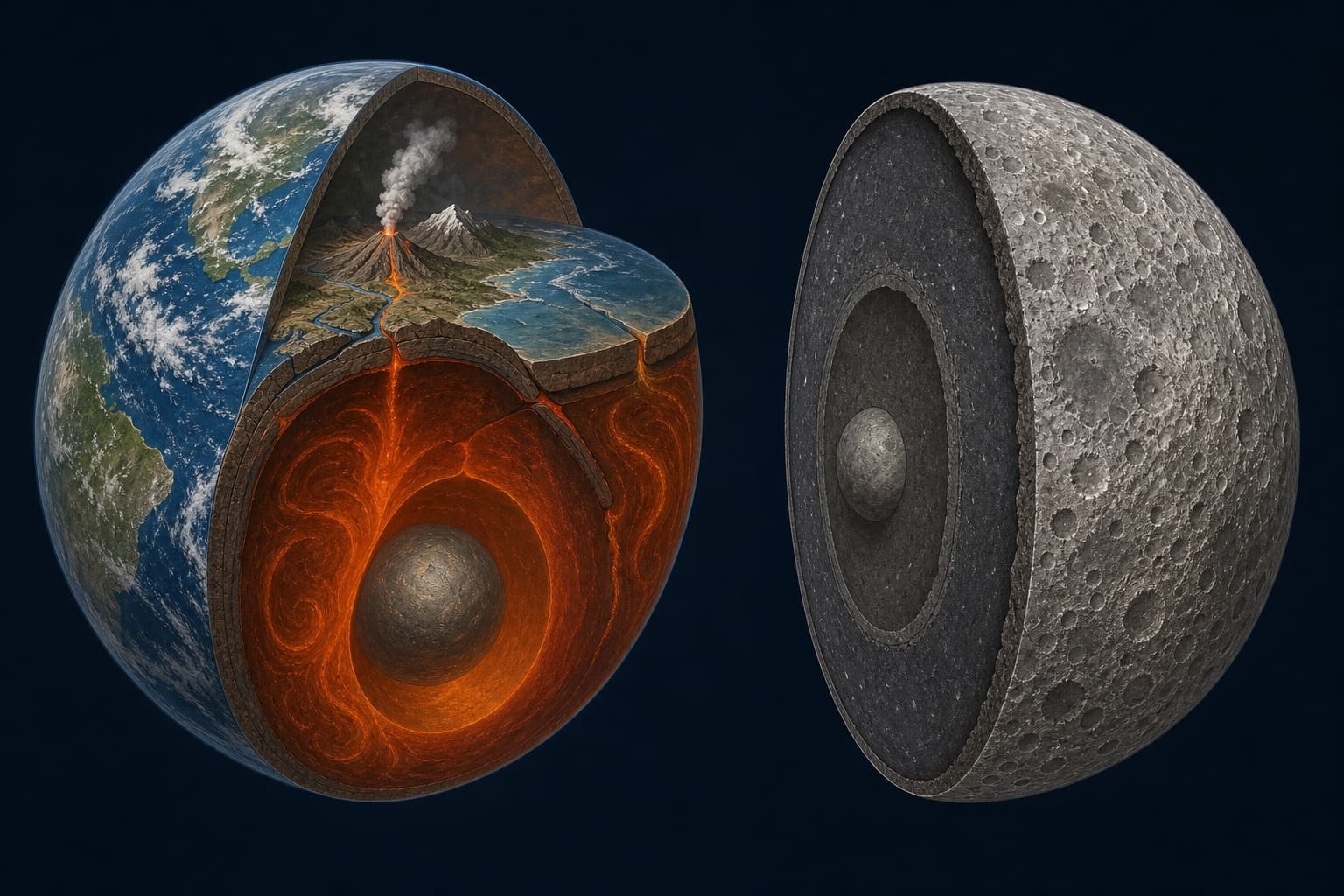
Educational schematic, not to scale: Earth's active surface and interior are contrasted with the Moon's quieter geological archive.
A young planetary system is an analogue, not a recording of our past
Astronomers directly observe disks around young stars, sometimes through resolved images and sometimes through excess infrared light from warm dust. These observations show that rotating planet-forming material exists around other newborn stars.
Those disks are not photographs of our Solar System 4.6 billion years ago. They are analogue systems. Researchers compare their structures with meteorite chemistry, present orbital architecture, and physical models to test whether a proposed formation process can explain several independent records at once.
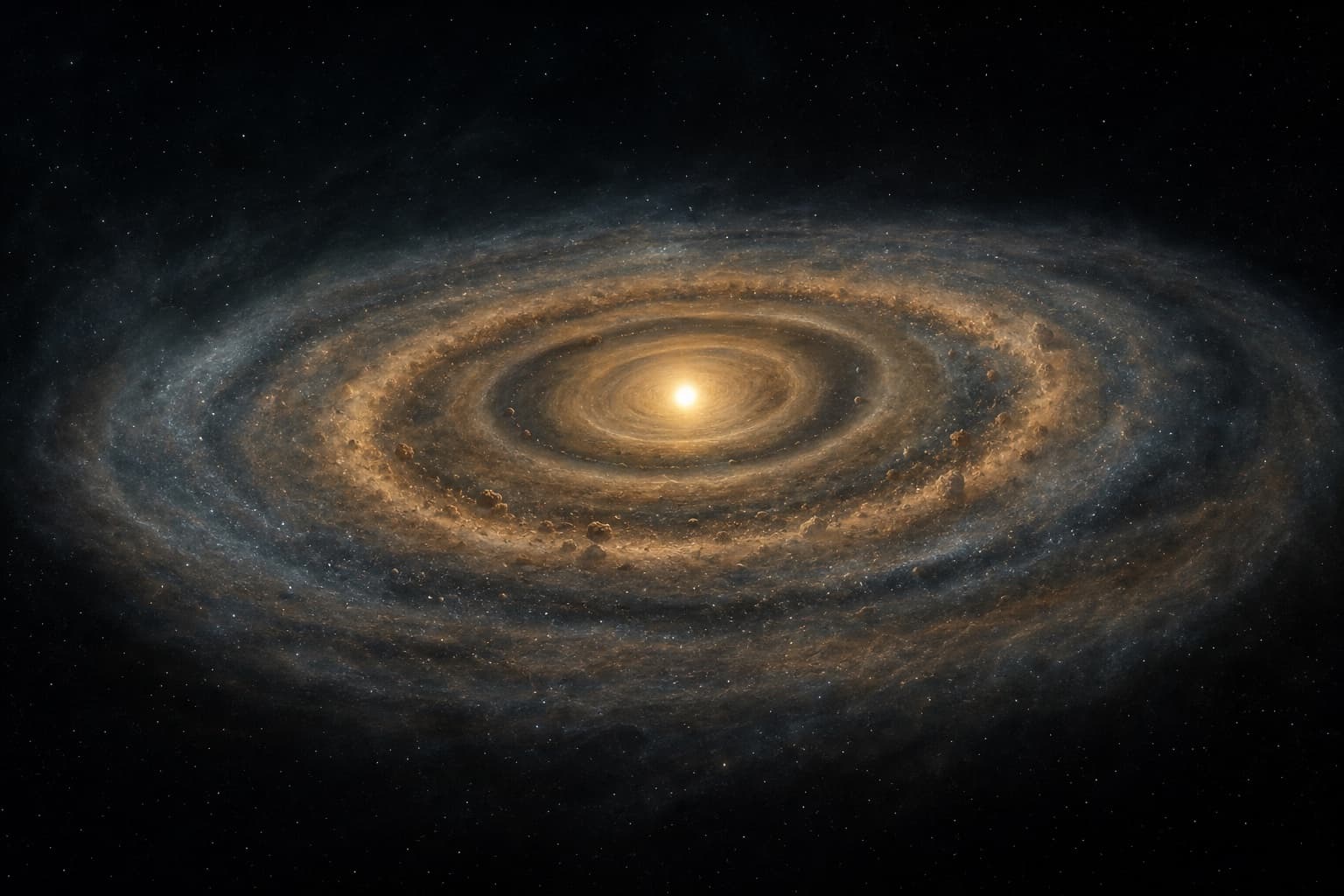
Artistic reconstruction: a plausible young planetary disk, not a direct photograph of our Solar System's past.
Reconstruct the Birth Record
Open five surviving records. For each one, trace what exists, what was measured, what it supports, and where its claim must stop.
First understand the change. Then learn its scientific name.
A rock does not run a clock. It can preserve atomic ratios that change at a known statistical pace. The laboratory measures those ratios, and scientists calculate elapsed time under conditions that can be tested.
- First, in everyday wordsThe same element can have several atomic versions
- Then, the scientific nameIsotopes
The versions have the same number of protons, so they remain the same element, but different numbers of neutrons give them different masses.
- First, in everyday wordsAn unstable version slowly changes into another product
- Then, the scientific nameParent isotope and daughter product
The unstable starting version is the parent isotope. The material produced by its radioactive change is the daughter product.
- First, in everyday wordsAfter a known interval, half of a large parent population remains
- Then, the scientific nameHalf-life
Half-life describes a predictable statistical pace across many atoms. It does not mean every individual atom changes on a personal countdown.
- First, in everyday wordsMeasure what remains, then work backward to elapsed time
- Then, the scientific nameRadiometric dating
Scientists measure parent and daughter ratios, apply the known decay rate, and test whether the mineral remained sufficiently closed before reporting an age.
The parent population becomes one half, then one quarter
- Starting reference100% parent remains
Use the original parent population as the comparison point.
- After one half-life50% parent remains
Across the population, half has changed into daughter product.
- After two half-lives25% parent remains
Half of the remaining half changes again, leaving one quarter of the original parent population.
Real dating uses specific isotope systems, equations, calibrated decay rates, mineral selection, and uncertainty analysis. This picture teaches only the core relationship.
Teaching diagram: eight markers stand for a large population of atoms. They do not show the path of individual atoms.What survives, what was measured, and what can it support?
The dates are a teaching scale, not one continuous observation. Select a record to see where it constrains the reconstruction.
- Cold gas begins to gather (molecular cloud collapse)Before the oldest dated solids
- The young Sun and a rotating disk (solar nebula)The proto-Sun and rotating disk
- The first solids whose ages can be measuredAbout 4.57 billion years ago
- Small bodies assemble (planetesimals and planetary embryos)During the first few million years
- Planets and Moon take shapeTens of millions of years later
Pale ancient grains inside a meteorite
Calcium-aluminum-rich inclusion (CAI)Heat-resistant minerals formed in the hot young disk. Some survive as pale grains enclosed inside meteorites; scientists call them calcium-aluminum-rich inclusions, or CAIs.
- Scientific name
- Calcium-aluminum-rich inclusion (CAI)
- Evidence state
- Established relationship
- Constrains this stage
- The first solids whose ages can be measured
What physically survives or is directly observed
Some early meteorites physically contain pale mineral grains that can survive very high temperatures. Scientists can examine the grains' shapes, textures, and chemical ingredients in a laboratory.
What scientists measure or compare
Researchers measure how much of an unstable starting atom remains and how much of its transformation product is present. These are the parent-isotope and daughter-product ratios. A known decay rate and checks of the sample's later history then allow an age to be calculated.
What the record supports
These inclusions are the oldest dated solids known to have formed in our Solar System. Their ages establish a practical early reference near 4.57 billion years ago.
A headline claims that astronomers photographed the birth of our Solar System around another star. Which correction preserves the evidence boundary?
Sources and evidence boundary
Vastward wrote this explanation independently and checked it against the official and research sources below. Each source supports a specific part of the evidence chain.
- Reviewed sourceSolar System: FactsNASA ScienceOpen official source
- Reviewed sourceMeteors and Meteorites: FactsNASA ScienceOpen official source
- Reviewed sourcePlanetary SystemsNASA ScienceOpen official source
- Reviewed sourceGeologic Time: Radiometric Time ScaleU.S. Geological SurveyOpen official source
- Reviewed sourceDetails of the Solar System's Oldest Dated ObjectsNASA AstrobiologyOpen official source
- Reviewed sourceMoon FormationNASA ScienceOpen official source