Begin with one question
Black Hole or Another Compact Remnant?
Which measurements separate a black-hole candidate from a white dwarf, neutron star, or incomplete model?
You compared three compact remnants, treated their mass borders honestly, and let the combined constraints select the surviving interpretation.
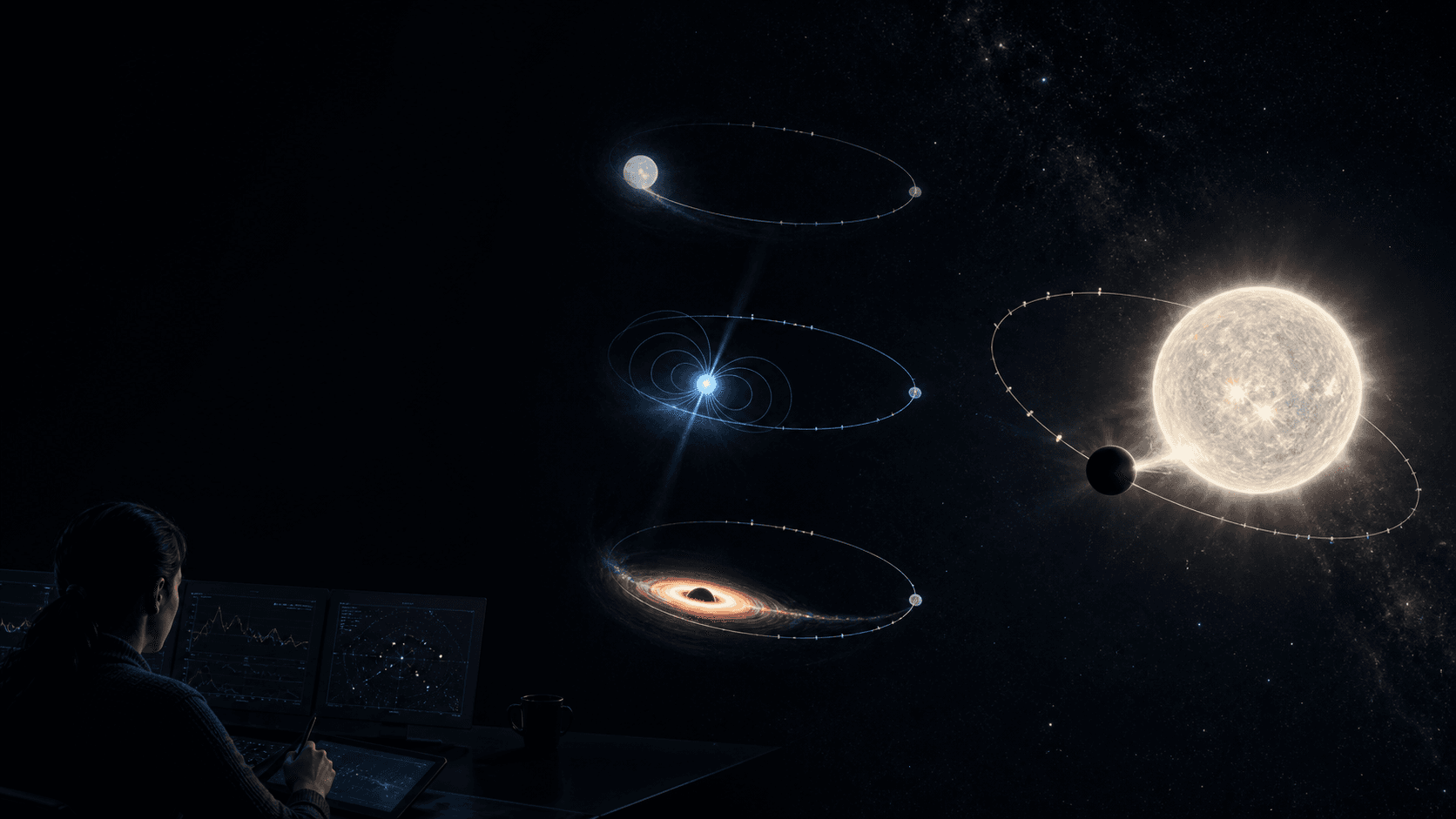
By the end of this lesson, you will be able to
You have classified by elimination, not by appearance.
- 01You compared three compact remnants, treated their mass borders honestly, and let the combined constraints select the surviving interpretation.
- 02Connect the idea to an observable signal, measurement, or instrument.
- 03Separate directly measured signals from the physical interpretation used to explain them.
Compact remnant means a stellar core compressed into a very small object
A white dwarf, neutron star, and stellar-mass black hole can all be the compact end states of stellar evolution. Compact means a large amount of mass occupies a small region; it does not mean all three objects have the same structure.
White dwarfs retain matter supported by electron pressure. Neutron stars compress more than a Sun's mass into a city-sized object. A black hole is bounded by an event horizon rather than a visible material surface.
First test: could the companion be a white dwarf?
A white dwarf can be roughly Earth-sized but near the Sun's mass. Theory places its familiar upper mass near 1.4 solar masses, called the Chandrasekhar limit.
If the orbit securely requires several solar masses in a compact dark companion, a single ordinary white dwarf cannot supply enough mass. Near the boundary, however, measurement uncertainty and unusual merger histories require care.
Second test: could it be a neutron star?
Neutron stars commonly contain around one to a few solar masses in a city-sized sphere. Some reveal a solid surface through pulses, bursts, or thermal emission, but orientation and activity can hide those signals.
The exact maximum stable neutron-star mass depends on dense-matter physics and remains a research question. A candidate near that boundary must not be classified from a rounded number alone.
A black-hole candidate survives when the alternatives fail together
In the teaching case, the orbit sets a 7.8-solar-mass minimum, deep observations find no normal luminous star, and follow-up radiation is consistent with accreting gas. White-dwarf and neutron-star interpretations no longer fit the combined constraints.
The responsible label is still black-hole candidate until the observation, analysis, and uncertainty have passed scrutiny. Science strengthens a classification by making it possible to challenge.
Test compact-remnant alternatives
Change the measured minimum mass and determine when white-dwarf, neutron-star, and black-hole interpretations remain viable or fail.
Each button changes the measured lower limit and which hypotheses remain compatible. The comparison does not rely on colour alone.
- Measured minimum mass (M☉ = solar masses)
- 0.9 M☉
- Hypotheses excluded by mass
- 0 / 3
0.9 M☉ case
This compact mass can still fit a white dwarf, so calling it a black hole would go far beyond the evidence.
The lower limit overlaps the common white-dwarf mass range; visible-light, ultraviolet, spectral, and radius constraints remain important.
White dwarf, neutron star, and black-hole-candidate lanes remain, become uncertain, or are crossed out as the mass constraint changes. Object sizes are schematic and not mutually to scale.
Swipe sideways on a small screen to inspect the full diagram and labels.
Which classification method preserves the scientific boundary?
Sources and evidence boundary
Vastward wrote this explanation independently and checked it against the official and research sources below. Each source supports a specific part of the evidence chain.
- Reviewed sourceBlack HolesNASA ScienceOpen official source
- Reviewed sourceTypes of Black HolesNASA ScienceOpen official source
- Reviewed sourceHow Do We Know There Are Black Holes?NASA ScienceOpen official source
- Reviewed sourceHubble Black HolesNASA ScienceOpen official source
- Reviewed sourceStar Orbiting Black Hole AnimationNASA ScienceOpen official source
- Reviewed sourceESO Telescope Sees Star Dance Around Supermassive Black Hole, Proves Einstein RightEuropean Southern ObservatoryOpen official source
- Reviewed sourceX-RaysNASA ScienceOpen official source
- Reviewed sourceUniverse GlossaryNASA ScienceOpen official source
- Reviewed sourceMass Chart for Dead Stars and Black HolesNASA ScienceOpen official source
- Reviewed sourceAnatomy of a Black HoleNASA ScienceOpen official source
- Reviewed sourceASCA: Black Hole SimulationNASA HEASARCOpen official source
- Reviewed sourceNASA’s IXPE Helps Researchers Determine Shape of Black Hole CoronaNASAOpen official source
- Reviewed sourceMagnetic Funnel Around a Supermassive Black HoleNASA ScienceOpen official source
- Reviewed sourceWebb’s Quest for Primeval Black HolesNASA ScienceOpen official source
- Reviewed sourceMonster Black Holes Grow After Galactic MergersNASA ScienceOpen official source
- Reviewed sourceGW190521LIGO Scientific CollaborationOpen official source
- Reviewed sourceBlack Holes — Gravity's Relentless PullNASA Imagine the Universe!Open official source
- Reviewed sourceNew NASA Black Hole Visualization Takes Viewers Beyond the BrinkNASA ScienceOpen official source
- Reviewed sourceBlack Hole MathNASAOpen official source
- Reviewed sourceHow to Measure the Spin of a Black HoleNASAOpen official source
- Reviewed sourceBlack Holes & Co.Einstein Online, Max Planck Institute for Gravitational PhysicsOpen official source
- Reviewed sourceCurvature and GeodesicsEinstein Online, Max Planck Institute for Gravitational PhysicsOpen official source
- Reviewed sourcePutting Einstein to the TestNational Institute of Standards and TechnologyOpen official source
- Reviewed sourceNICER Reveals the Geometry of a Black Hole Accretion FlowNASA HEASARCOpen official source
- Reviewed sourceAstronomers Capture First Image of a Black HoleEvent Horizon Telescope CollaborationOpen official source
- Reviewed sourceCan We Really Photograph a Black Hole?Event Horizon Telescope CollaborationOpen official source
- Reviewed sourceLIGO Frequently Asked QuestionsLIGO LaboratoryOpen official source
- Reviewed sourceMicrolensingNASA ScienceOpen official source
- Reviewed sourceLISAEuropean Space AgencyOpen official source
- Reviewed sourceWhich cosmic objects will LISA study?European Space AgencyOpen official source