Begin with one question
Why Can Falling Gas Produce X-rays?
Why does gas outside a black hole become an energetic messenger?
You followed angular-momentum-rich gas into an external disk, connected million-degree plasma to X-rays, and kept the compact object's identity open for testing.
By the end of this lesson, you will be able to
You can now place the X-rays in the right part of the system.
- 01You followed angular-momentum-rich gas into an external disk, connected million-degree plasma to X-rays, and kept the compact object's identity open for testing.
- 02Connect the idea to an observable signal, measurement, or instrument.
- 03Separate directly measured signals from the physical interpretation used to explain them.
The black hole stays dark; the gas outside it can become brilliant
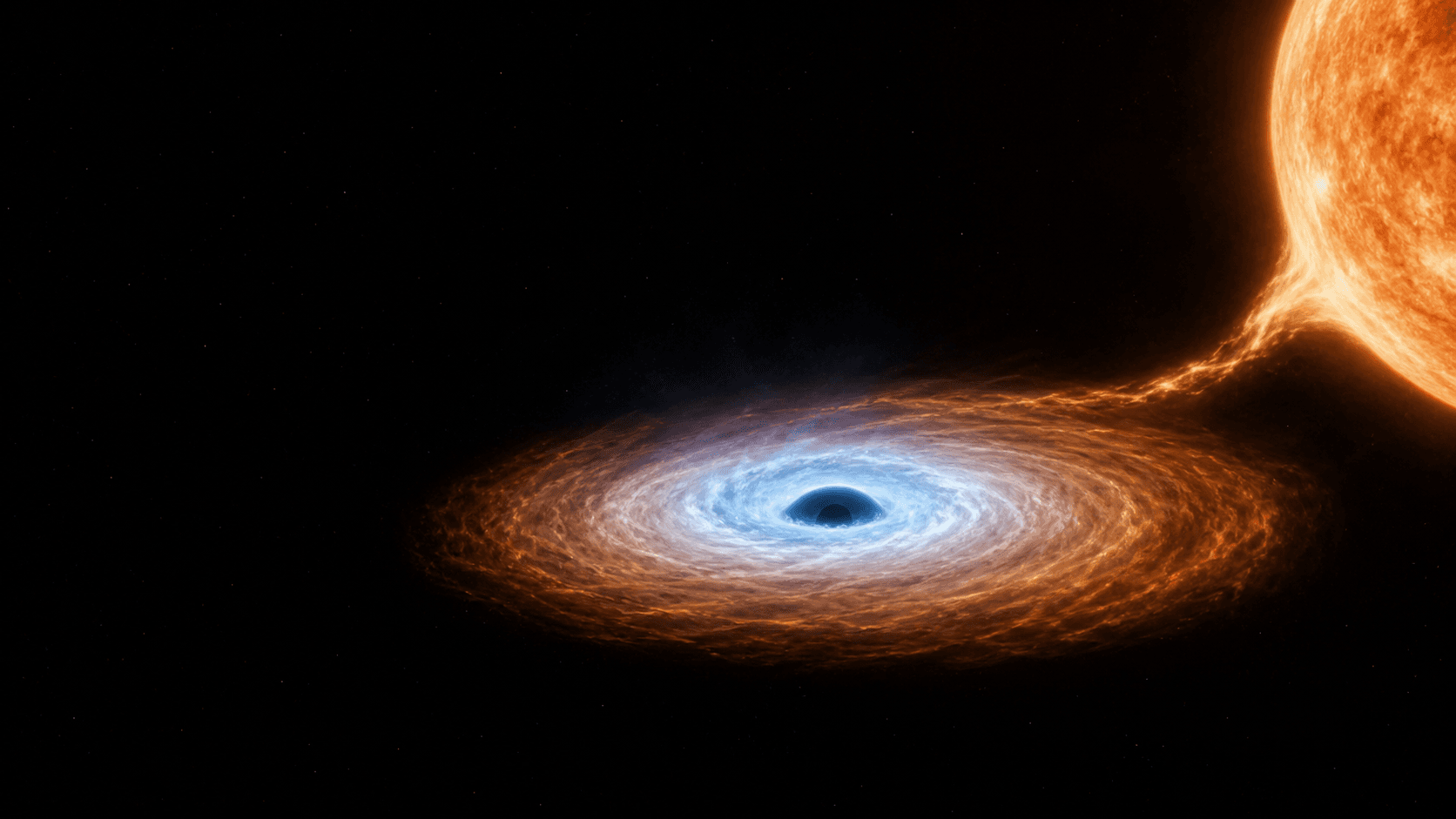
In some close binaries, gravity pulls gas from a companion star. The gas carries sideways motion, so it usually cannot fall straight inward. It spreads into a rotating accretion disk outside the event horizon.
Neighbouring rings of gas orbit at different speeds. Compression, collisions, turbulence, and magnetic stresses convert orbital energy into internal energy, which we describe as heat.
Hotter matter radiates at higher characteristic energies
Temperature tells us how energetic the random motion of particles is. K means kelvin, the scientific temperature unit. One MK means one million kelvin.
As the synthetic gas in the experiment reaches millions of kelvin, a larger part of its detectable radiation moves into X-ray energies. This is not ordinary orange fire; the colours in the diagram encode energy zones for learning.
X-ray telescopes must observe from above most of Earth's atmosphere
Earth's atmosphere protects life by absorbing most astronomical X-rays. That also means an ordinary ground telescope cannot simply photograph this signal.
Space observatories collect X-ray photons, record their energies and arrival times, and compare the source position with the binary measured in visible or infrared light.
X-rays reveal hot gas, not a unique object name
Neutron stars, pulsars, supernova remnants, stellar coronae, and black-hole accretion environments can all emit X-rays. Detecting X-rays therefore identifies an energetic process, not automatically a black hole.
A quiet black hole with little surrounding gas may emit very weak X-rays. Astronomers combine position, spectrum, timing, orbital mass, and the presence or absence of a surface-related signal.
Follow gas into an X-ray-bright accretion flow
Track how a captured gas stream forms a disk, heats inward, and becomes an X-ray signal outside the event horizon.
The four buttons change the stream, disk width, temperature encoding, spectrum band, and X-ray detector response together.
- Reference gas temperature (MK = million kelvin)
- 0.01 MK
- Synthetic X-ray contribution
- 0%
Captured stream
Gas has been pulled from the star, but most of the teaching signal is still cool compared with an X-ray disk.
The stream carries angular momentum and begins circularising outside the compact object; its 0.01 MK reference state contributes negligible X-ray emission.
Gas moves from the companion into an accretion disk and becomes more energetic inward. Colours and values are synthetic teaching encodings, not a direct image.
Swipe sideways on a small screen to inspect the full diagram and labels.
Which statement correctly connects the hot gas to a black-hole investigation?
Sources and evidence boundary
Vastward wrote this explanation independently and checked it against the official and research sources below. Each source supports a specific part of the evidence chain.
- Reviewed sourceBlack HolesNASA ScienceOpen official source
- Reviewed sourceTypes of Black HolesNASA ScienceOpen official source
- Reviewed sourceHow Do We Know There Are Black Holes?NASA ScienceOpen official source
- Reviewed sourceHubble Black HolesNASA ScienceOpen official source
- Reviewed sourceStar Orbiting Black Hole AnimationNASA ScienceOpen official source
- Reviewed sourceESO Telescope Sees Star Dance Around Supermassive Black Hole, Proves Einstein RightEuropean Southern ObservatoryOpen official source
- Reviewed sourceX-RaysNASA ScienceOpen official source
- Reviewed sourceUniverse GlossaryNASA ScienceOpen official source
- Reviewed sourceMass Chart for Dead Stars and Black HolesNASA ScienceOpen official source
- Reviewed sourceAnatomy of a Black HoleNASA ScienceOpen official source
- Reviewed sourceASCA: Black Hole SimulationNASA HEASARCOpen official source
- Reviewed sourceNASA’s IXPE Helps Researchers Determine Shape of Black Hole CoronaNASAOpen official source
- Reviewed sourceMagnetic Funnel Around a Supermassive Black HoleNASA ScienceOpen official source
- Reviewed sourceWebb’s Quest for Primeval Black HolesNASA ScienceOpen official source
- Reviewed sourceMonster Black Holes Grow After Galactic MergersNASA ScienceOpen official source
- Reviewed sourceGW190521LIGO Scientific CollaborationOpen official source
- Reviewed sourceBlack Holes — Gravity's Relentless PullNASA Imagine the Universe!Open official source
- Reviewed sourceNew NASA Black Hole Visualization Takes Viewers Beyond the BrinkNASA ScienceOpen official source
- Reviewed sourceBlack Hole MathNASAOpen official source
- Reviewed sourceHow to Measure the Spin of a Black HoleNASAOpen official source
- Reviewed sourceBlack Holes & Co.Einstein Online, Max Planck Institute for Gravitational PhysicsOpen official source
- Reviewed sourceCurvature and GeodesicsEinstein Online, Max Planck Institute for Gravitational PhysicsOpen official source
- Reviewed sourcePutting Einstein to the TestNational Institute of Standards and TechnologyOpen official source
- Reviewed sourceNICER Reveals the Geometry of a Black Hole Accretion FlowNASA HEASARCOpen official source
- Reviewed sourceAstronomers Capture First Image of a Black HoleEvent Horizon Telescope CollaborationOpen official source
- Reviewed sourceCan We Really Photograph a Black Hole?Event Horizon Telescope CollaborationOpen official source
- Reviewed sourceLIGO Frequently Asked QuestionsLIGO LaboratoryOpen official source
- Reviewed sourceMicrolensingNASA ScienceOpen official source
- Reviewed sourceLISAEuropean Space AgencyOpen official source
- Reviewed sourceWhich cosmic objects will LISA study?European Space AgencyOpen official source