Begin with one question
How Do We Weigh an Unseen Companion?
How can a visible star's orbit constrain the mass hiding beside it?
You used a repeating orbit and spectral speed to set a conservative mass floor, then kept geometry and stellar assumptions visible.
By the end of this lesson, you will be able to
You have weighed an object without seeing it.
- 01You used a repeating orbit and spectral speed to set a conservative mass floor, then kept geometry and stellar assumptions visible.
- 02Connect the idea to an observable signal, measurement, or instrument.
- 03Separate directly measured signals from the physical interpretation used to explain them.
We cannot put the companion on a scale, so we measure its pull
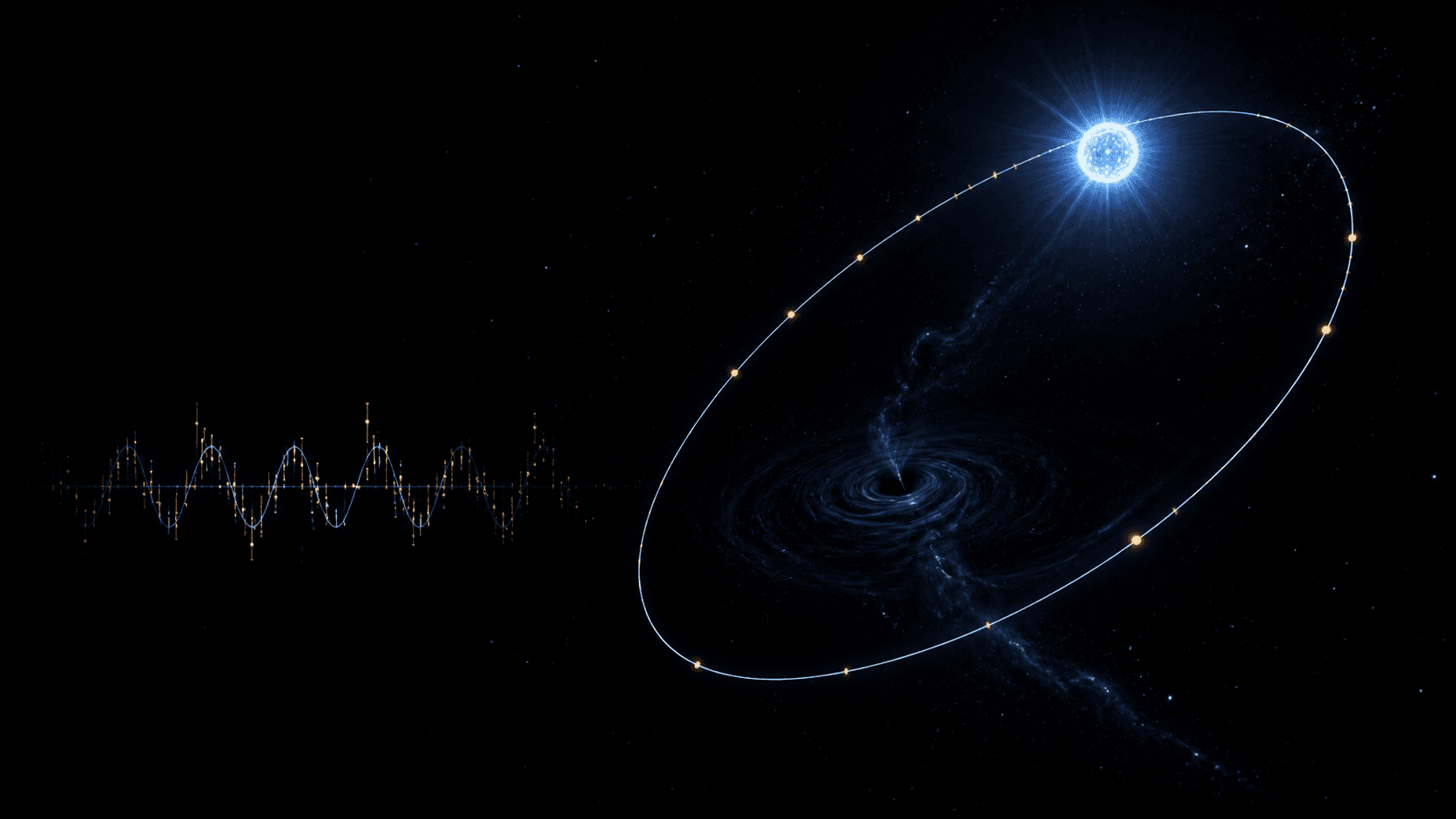
A visible star in a binary does not travel in a straight line. It repeatedly approaches and recedes as both objects orbit their shared centre of mass. The unseen companion leaves a rhythm in position and in the star's spectrum.
That rhythm gives astronomers an orbital period, while the size of the spectral shift gives a line-of-sight speed. A stronger, faster wobble requires more gravitational influence from the hidden side of the system.
Period and speed are the first two ingredients
Period P means the time required to repeat one orbit. Radial-velocity amplitude K means the largest measured speed toward or away from us. In the experiment, days measure P and kilometres per second measure K.
The compact-object mass function combines P and K. In plain language, it asks: what is the smallest companion mass that could produce this repeated speed, even under the most favourable viewing geometry?
Viewing angle can hide part of the true motion
An orbit seen edge-on exposes more of its toward-and-away speed than the same orbit seen face-on. Astronomers call that viewing angle the orbital inclination, written i.
Because i may not be known perfectly, the first result is often a minimum mass. Better constraints on inclination, distance, and the visible star's mass can move the estimate upward and narrow its uncertainty.
A mass constraint narrows the identity; it does not finish the case
A low minimum mass leaves ordinary faint stars or white dwarfs possible. A higher result may favour a neutron star. A compact unseen companion with a secure lower limit far above plausible neutron-star masses becomes a strong black-hole candidate.
Astronomers still examine the visible star, inclination, hidden light, and other signals. A calculation is strongest when its assumptions and uncertainty can be checked independently.
Weigh an unseen companion from its visible star
Compare four synthetic orbit measurements and watch period, radial-velocity amplitude, and the conservative mass floor change together.
Each button is a fictional but internally consistent teaching observation. Read the diagram from 1 to 4: motion, spectrum, measurement, then the mass floor.
- Minimum companion mass (M☉ = solar masses)
- 0.7 M☉
- Radial-velocity amplitude K (km/s)
- 42 km/s
Gentle wobble
The star changes speed slowly. A modest hidden mass can still explain the motion.
The synthetic period and radial-velocity amplitude produce a minimum companion mass of 0.7 solar masses; ordinary faint companions remain viable.
The visible star and hidden companion orbit a shared centre of mass. That motion shifts spectral lines, which supplies P and K; together with the visible star's estimated mass, the calculation returns a conservative minimum companion mass. Values are synthetic and the layout is not to scale.
Swipe sideways on a small screen to inspect the full diagram and labels.
What did this experiment actually measure about the hidden companion?
Sources and evidence boundary
Vastward wrote this explanation independently and checked it against the official and research sources below. Each source supports a specific part of the evidence chain.
- Reviewed sourceBlack HolesNASA ScienceOpen official source
- Reviewed sourceTypes of Black HolesNASA ScienceOpen official source
- Reviewed sourceHow Do We Know There Are Black Holes?NASA ScienceOpen official source
- Reviewed sourceHubble Black HolesNASA ScienceOpen official source
- Reviewed sourceStar Orbiting Black Hole AnimationNASA ScienceOpen official source
- Reviewed sourceESO Telescope Sees Star Dance Around Supermassive Black Hole, Proves Einstein RightEuropean Southern ObservatoryOpen official source
- Reviewed sourceX-RaysNASA ScienceOpen official source
- Reviewed sourceUniverse GlossaryNASA ScienceOpen official source
- Reviewed sourceMass Chart for Dead Stars and Black HolesNASA ScienceOpen official source
- Reviewed sourceAnatomy of a Black HoleNASA ScienceOpen official source
- Reviewed sourceASCA: Black Hole SimulationNASA HEASARCOpen official source
- Reviewed sourceNASA’s IXPE Helps Researchers Determine Shape of Black Hole CoronaNASAOpen official source
- Reviewed sourceMagnetic Funnel Around a Supermassive Black HoleNASA ScienceOpen official source
- Reviewed sourceWebb’s Quest for Primeval Black HolesNASA ScienceOpen official source
- Reviewed sourceMonster Black Holes Grow After Galactic MergersNASA ScienceOpen official source
- Reviewed sourceGW190521LIGO Scientific CollaborationOpen official source
- Reviewed sourceBlack Holes — Gravity's Relentless PullNASA Imagine the Universe!Open official source
- Reviewed sourceNew NASA Black Hole Visualization Takes Viewers Beyond the BrinkNASA ScienceOpen official source
- Reviewed sourceBlack Hole MathNASAOpen official source
- Reviewed sourceHow to Measure the Spin of a Black HoleNASAOpen official source
- Reviewed sourceBlack Holes & Co.Einstein Online, Max Planck Institute for Gravitational PhysicsOpen official source
- Reviewed sourceCurvature and GeodesicsEinstein Online, Max Planck Institute for Gravitational PhysicsOpen official source
- Reviewed sourcePutting Einstein to the TestNational Institute of Standards and TechnologyOpen official source
- Reviewed sourceNICER Reveals the Geometry of a Black Hole Accretion FlowNASA HEASARCOpen official source
- Reviewed sourceAstronomers Capture First Image of a Black HoleEvent Horizon Telescope CollaborationOpen official source
- Reviewed sourceCan We Really Photograph a Black Hole?Event Horizon Telescope CollaborationOpen official source
- Reviewed sourceLIGO Frequently Asked QuestionsLIGO LaboratoryOpen official source
- Reviewed sourceMicrolensingNASA ScienceOpen official source
- Reviewed sourceLISAEuropean Space AgencyOpen official source
- Reviewed sourceWhich cosmic objects will LISA study?European Space AgencyOpen official source