Begin with one question
If a Black Hole Is Invisible, How Do We Know It Is There?
What must move, glow, bend, or arrive before an unseen object becomes a black-hole candidate?
You separated non-detection from evidence, used motion to infer hidden mass, tested alternative compact objects, and treated X-rays as conditional follow-up rather than universal proof.
By the end of this lesson, you will be able to
You can now look for a black hole without looking for a black dot.
- 01You separated non-detection from evidence, used motion to infer hidden mass, tested alternative compact objects, and treated X-rays as conditional follow-up rather than universal proof.
- 02Connect the idea to an observable signal, measurement, or instrument.
- 03Separate directly measured signals from the physical interpretation used to explain them.
Invisible does not automatically mean black hole
A black hole does not shine like a normal star, so a telescope cannot identify it by finding a black dot. Empty-looking sky may simply contain an object that is faint, obscured, too small to resolve, or outside the detector's wavelength range.
Astronomers therefore look for repeatable effects: another object moving around an unseen focus, gas heated before it falls inward, background light being bent, or a gravitational-wave signal from a merger.
A visible star can reveal an unseen companion
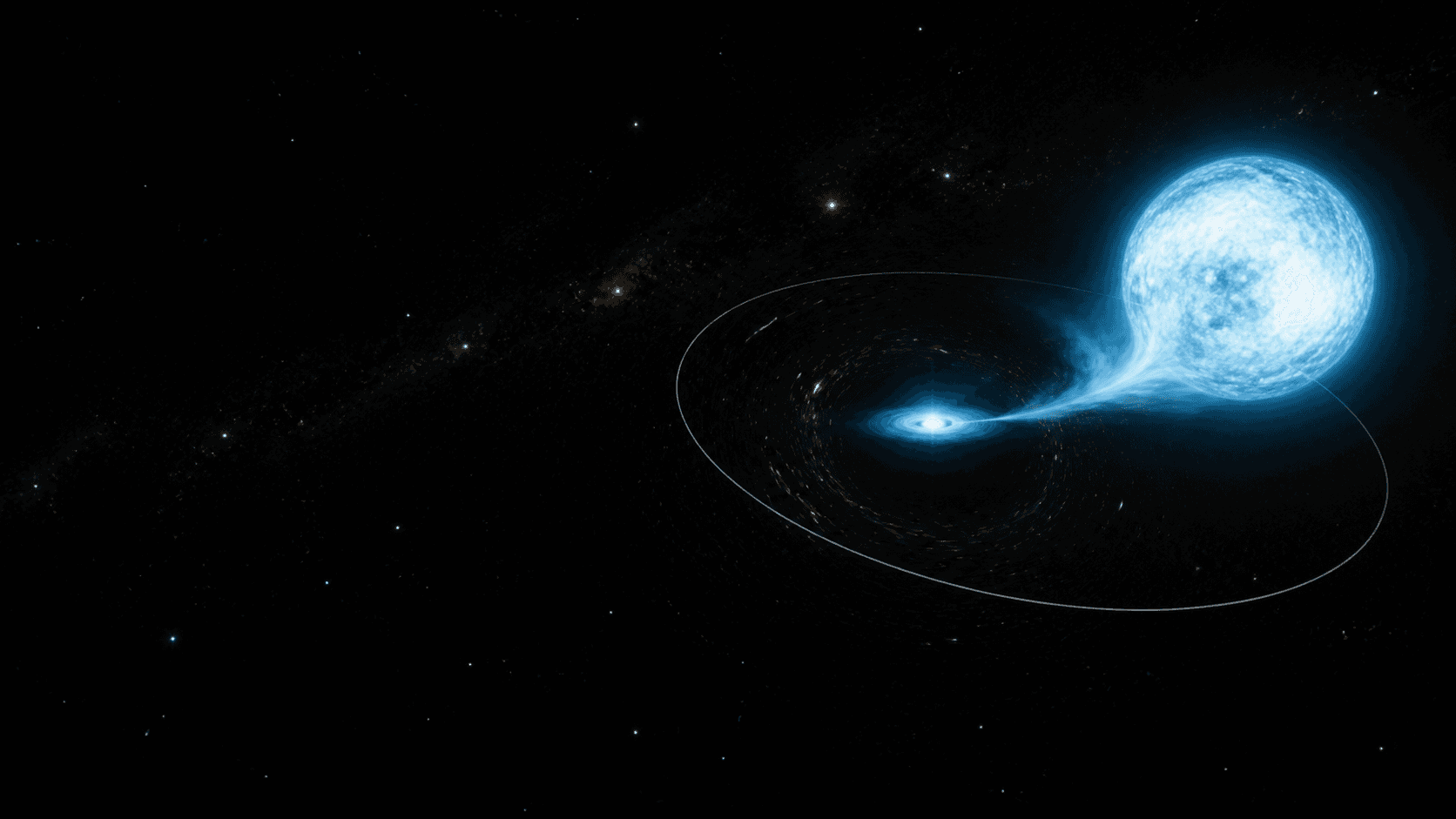
Imagine measuring one star at regular intervals. Its position and spectrum repeat in a steady rhythm, showing that it is orbiting a shared centre even though no companion star is visible there.
The orbit supplies a period and a speed. Together with geometry and distance, those measurements constrain how much mass must be pulling on the visible star. Mass is inferred from motion; it is not read from the darkness in the image.
Mass narrows the list of possible objects
An unseen companion could be a dim ordinary star, a white dwarf, a neutron star, or a black hole. Astronomers test those alternatives instead of jumping directly to the most dramatic name.
If repeated measurements require a compact companion substantially more massive than a plausible neutron star, while searches find no normal star bright enough to contain that mass, a stellar-mass black-hole interpretation becomes much stronger. Inclination, distance, and the visible star's own mass still contribute uncertainty.
Hot gas can add a second measurement channel
In some binary systems, gas pulled from the companion forms a rapidly moving accretion disk outside the black hole. Collisions, compression, and magnetic processes heat the gas so strongly that it can emit X-rays before crossing the horizon.
Those X-rays are light from the surrounding gas, not light from inside the black hole. A quiet black hole may have little or no bright disk, so the absence of X-rays cannot rule one out. Strong cases combine the measurements available for that particular system.
Build the first black-hole evidence chain
Move through four evidence layers and keep the alternative explanations, measurement limits, and conditional nature of X-rays visible.
Open each layer in order. The system is fictional, but every measurement route mirrors real black-hole investigations.
- Minimum companion mass (M☉ = solar masses)
- 1 M☉
- Independent evidence layers
- 1 / 4
Repeating motion
The visible star moves in a repeatable orbit, so something shares the system even though its identity is still unknown.
Repeated astrometry or Doppler shifts establish orbital motion and a period, but geometry and component masses remain underconstrained.
The diagram changes from orbital motion to a hidden companion, a mass constraint, and X-ray follow-up. Lines, sizes, and brightness are teaching cues and are not to scale.
Swipe sideways on a small screen to inspect the full diagram and labels.
Which statement describes a scientifically responsible black-hole candidate?
Sources and evidence boundary
Vastward wrote this explanation independently and checked it against the official and research sources below. Each source supports a specific part of the evidence chain.
- Reviewed sourceBlack HolesNASA ScienceOpen official source
- Reviewed sourceTypes of Black HolesNASA ScienceOpen official source
- Reviewed sourceHow Do We Know There Are Black Holes?NASA ScienceOpen official source
- Reviewed sourceHubble Black HolesNASA ScienceOpen official source
- Reviewed sourceStar Orbiting Black Hole AnimationNASA ScienceOpen official source
- Reviewed sourceESO Telescope Sees Star Dance Around Supermassive Black Hole, Proves Einstein RightEuropean Southern ObservatoryOpen official source
- Reviewed sourceX-RaysNASA ScienceOpen official source
- Reviewed sourceUniverse GlossaryNASA ScienceOpen official source
- Reviewed sourceMass Chart for Dead Stars and Black HolesNASA ScienceOpen official source
- Reviewed sourceAnatomy of a Black HoleNASA ScienceOpen official source
- Reviewed sourceASCA: Black Hole SimulationNASA HEASARCOpen official source
- Reviewed sourceNASA’s IXPE Helps Researchers Determine Shape of Black Hole CoronaNASAOpen official source
- Reviewed sourceMagnetic Funnel Around a Supermassive Black HoleNASA ScienceOpen official source
- Reviewed sourceWebb’s Quest for Primeval Black HolesNASA ScienceOpen official source
- Reviewed sourceMonster Black Holes Grow After Galactic MergersNASA ScienceOpen official source
- Reviewed sourceGW190521LIGO Scientific CollaborationOpen official source
- Reviewed sourceBlack Holes — Gravity's Relentless PullNASA Imagine the Universe!Open official source
- Reviewed sourceNew NASA Black Hole Visualization Takes Viewers Beyond the BrinkNASA ScienceOpen official source
- Reviewed sourceBlack Hole MathNASAOpen official source
- Reviewed sourceHow to Measure the Spin of a Black HoleNASAOpen official source
- Reviewed sourceBlack Holes & Co.Einstein Online, Max Planck Institute for Gravitational PhysicsOpen official source
- Reviewed sourceCurvature and GeodesicsEinstein Online, Max Planck Institute for Gravitational PhysicsOpen official source
- Reviewed sourcePutting Einstein to the TestNational Institute of Standards and TechnologyOpen official source
- Reviewed sourceNICER Reveals the Geometry of a Black Hole Accretion FlowNASA HEASARCOpen official source
- Reviewed sourceAstronomers Capture First Image of a Black HoleEvent Horizon Telescope CollaborationOpen official source
- Reviewed sourceCan We Really Photograph a Black Hole?Event Horizon Telescope CollaborationOpen official source
- Reviewed sourceLIGO Frequently Asked QuestionsLIGO LaboratoryOpen official source
- Reviewed sourceMicrolensingNASA ScienceOpen official source
- Reviewed sourceLISAEuropean Space AgencyOpen official source
- Reviewed sourceWhich cosmic objects will LISA study?European Space AgencyOpen official source