Begin with one question
Why Spread Starlight Apart?
Why do astronomers trade one point of light for a spectrum?
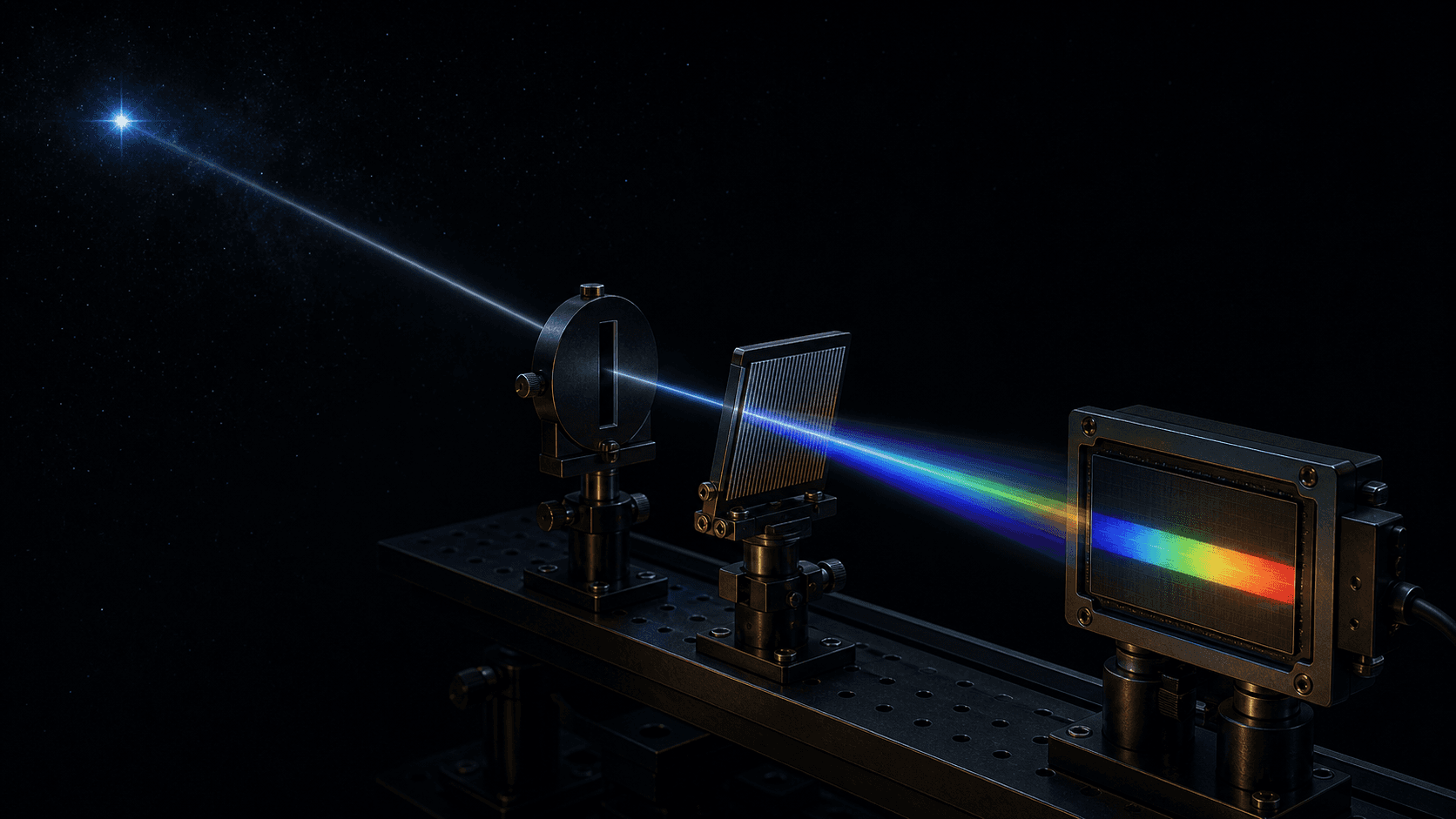
Follow starlight from a telescope image through a spectrograph until detector position becomes a wavelength measurement.
By the end of this lesson, you will be able to
Follow starlight from a telescope image through a spectrograph until detector position becomes a wavelength measurement.
- 01Explain the central measurement behind “Why Spread Starlight Apart?”.
- 02Use the lesson's symbols and units without dropping their physical meaning.
- 03Separate the direct measurement from calculation, model inference, and remaining uncertainty.
A spectrum is light sorted by wavelength
An ordinary image preserves where light arrived on the sky. A spectrograph deliberately trades some spatial information to spread the light by wavelength.
The result is not merely a rainbow picture: each detector position can become a measured wavelength with an intensity and uncertainty.
Four stations turn a beam into a measurement
The entrance slit selects a narrow slice of the target. A prism or diffraction grating sends different wavelengths in different directions. The detector records where the separated light lands.
Calibration lamps, known reference features, and instrument models then convert detector pixels into wavelength and correct how efficiently the instrument responds.
Raw detector position is not yet wavelength
A raw detector frame includes bias, dark current, cosmic-ray events, uneven sensitivity, optical distortion, and an uncalibrated position axis.
A reproducible spectrum keeps the raw data, calibration files, processing choices, wavelength solution, uncertainty, and provenance connected.
Follow starlight into a calibrated spectrum
Inspect what the slit, grating, detector, and calibration contribute, then explain why the result is a measurement rather than a decorative rainbow.
Walk a photon signal through the spectrograph
Select each station to see what it receives and what it hands to the next station. The sequence prevents a raw detector pattern from being mistaken for a finished spectrum.
Select a narrow beam
The opening limits which light enters so nearby positions do not overlap as badly.
What leaves this stage?A controlled strip of incoming target light.
Why is the detector image not yet the final scientific spectrum?
Sources and evidence boundary
Vastward wrote this explanation independently and checked it against the official and research sources below. Each source supports a specific part of the evidence chain.
- Reviewed sourceSpectroscopy 101: Light and MatterNASA ScienceOpen official source
- Reviewed sourceHow a Spectrograph WorksNASA ScienceOpen official source
- Reviewed sourceTypes of Spectra: Continuous, Emission, and AbsorptionNASA ScienceOpen official source
- Reviewed sourceSpectroscopy 101: IntroductionNASA ScienceOpen official source