Begin with one question
Mass, Weight, and Gravity
Why does the same person weigh differently on Earth and the Moon without losing mass?
Separate the amount of matter from the gravitational force acting on it.
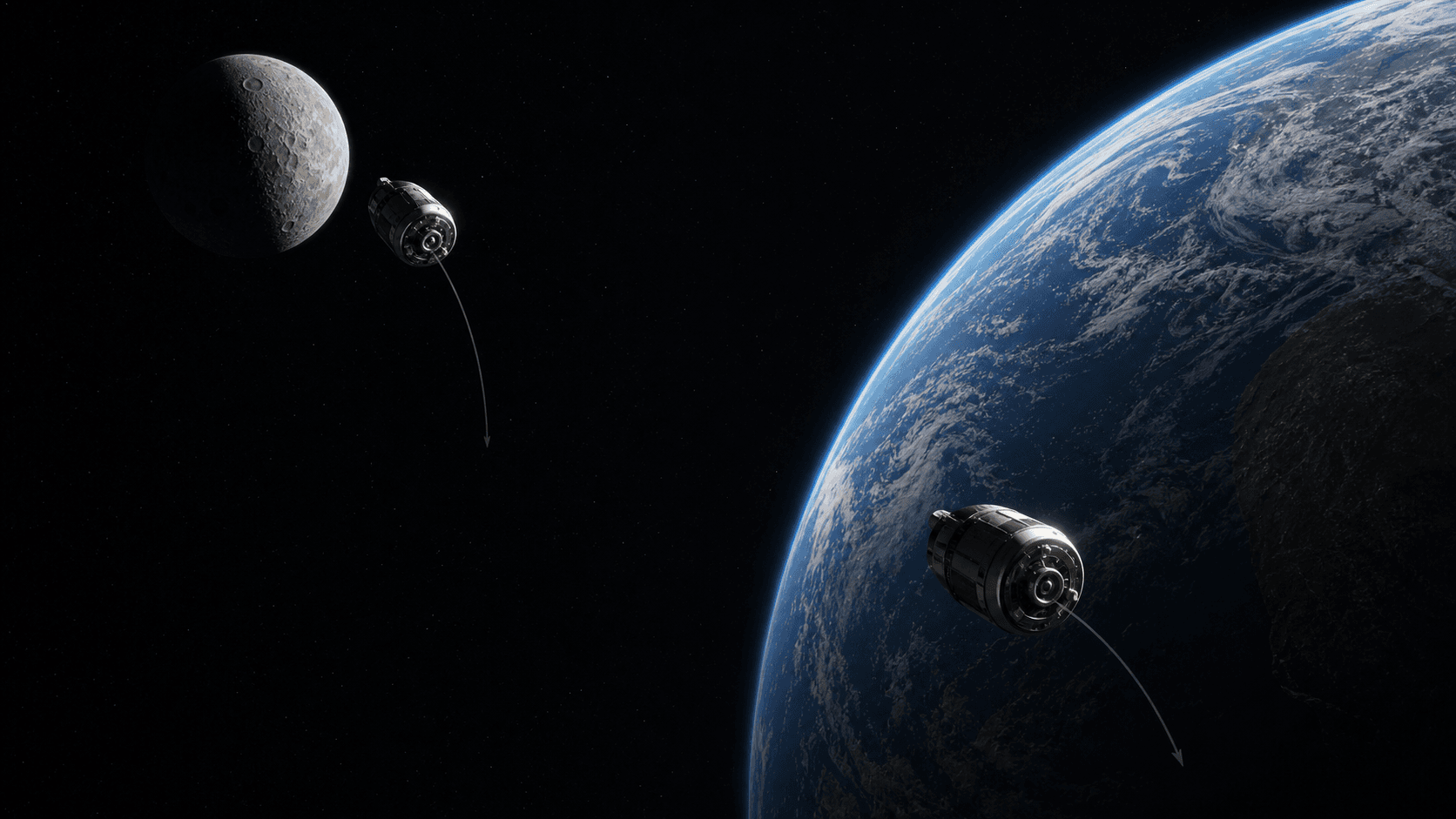
By the end of this lesson, you will be able to
Confusing mass and weight leads to incorrect spacecraft, planetary, and telemetry interpretations.
- 01Distinguish mass from weight.
- 02Describe weight as a gravitational force.
- 03Predict how weight changes between worlds.
Mass is the inventory; weight is the pull
Mass describes how much matter an object contains and how strongly it resists a change in motion. We measure it in kilograms.
Weight is a force produced when gravity acts on that mass. We measure force in newtons, so a weight reading is not another name for kilograms.
One equation separates the two ideas
Near a world's surface, weight is W = m × g. A 72 kg person on Earth experiences about 72 × 9.81 = 706 N of weight.
On the Moon, the same 72 kg mass experiences about 72 × 1.62 = 117 N. Nothing was removed from the person; the Moon's surface gravity is weaker.
Feeling weightless does not mean gravity vanished
Astronauts in orbit still feel Earth's gravity. Their spacecraft and bodies are falling together, so the floor no longer pushes up on them in the familiar way.
A scale measures this support force. In continuous free fall it can read close to zero even though gravity is still steering the orbit.
Mission Control tracks both for different reasons
A launch team needs vehicle mass to predict how a given force will change motion. It needs weight to know how much upward thrust must first be overcome near a planet.
As propellant leaves the vehicle, mass decreases. At the same location, weight decreases with it, changing the thrust margin and acceleration seen in telemetry.
Carry the Same Mass Across Four Worlds
Set an object's mass, land it on four worlds, and watch its mass stay fixed while local gravity changes its weight.
Earth
The baseline used for the familiar feeling of weight.
- Mass
- 72 kg
- Local gravity
- 9.807 m/s²
- Weight
- 706 N
- Earth-weight ratio
- 1×
W = 72 kg × 9.807 m/s² = 706 N
A 72 kg astronaut stands on the Moon. Which Mission Control report keeps mass and weight separate?
Sources and evidence boundary
Vastward wrote this explanation independently and checked it against the official and research sources below. Each source supports a specific part of the evidence chain.
- Reviewed sourceMass and WeightNASA ScienceOpen official source
- Reviewed sourceEarth's Moon: By the NumbersNASA ScienceOpen official source