VASTWARDACADEMY
Back to Academy

Journey route map · J01

From Earth to Orbit

Understand why spacecraft stay in orbit and use that understanding inside Mission Control.

1 courses4 modules12 focused lessonsAll Lessons free
Start the first open lesson

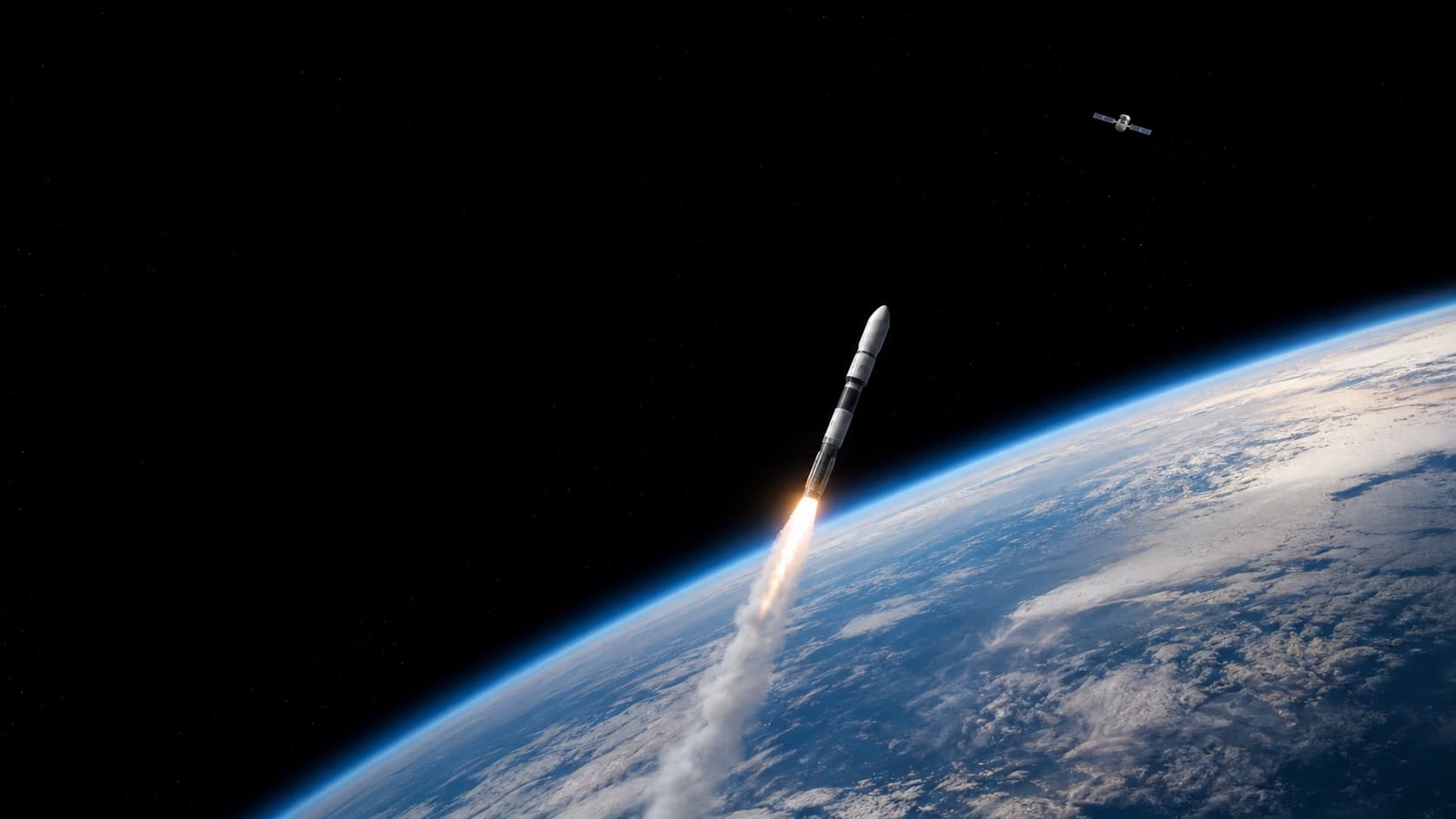
Original Vastward teaching visualization. It is not observational imagery or measurement data.

Build a mental model of scale, gravity, motion, orbits, launch, and telemetry before operating a complete launch-to-orbit mission.

Curious beginners who want to experience spaceflight without assuming prior physics or aerospace knowledge.

Explain the physical path from a stationary vehicle on Earth to a spacecraft in orbit, interpret essential telemetry, and complete the Vastward Launch-to-Orbit mission.
Course 01

The Physics of Reaching Orbit

A beginner course that connects measurement, Newtonian mechanics, planetary properties, launch, and real mission operations.

M01

Measure Motion and Gravity

Learn the language and physical laws needed to describe motion from Earth to space.

Free
  1. 01
    Scale, Time, and Scientific Notation

    How can we think clearly about distances and speeds that are far outside everyday experience?

    Free · 15 min
  2. 02
    Mass, Weight, and Gravity

    Why does the same person weigh differently on Earth and the Moon without losing mass?

    Free · 15 min
  3. 03
    Newton's Laws of Motion

    What must happen to change the speed or direction of a spacecraft?

    Free · 20 min
  4. 04
    Universal Gravitation

    Can the same force explain a falling object and the Moon's orbit?

    Free · 20 min
M02

Worlds in Motion

Connect the properties of planets to the motion of spacecraft around them.

Free
  1. 05
    Why Planets Become Round

    Why can an asteroid be irregular while a large planet becomes nearly spherical?

    Free · 15 min
  2. 06
    Planetary Volume, Mass, and Mean Density

    How can worlds of similar size hide radically different amounts of matter?

    Free · 28 min
  3. 07
    Why an Orbit Keeps Falling Without Hitting Earth

    If gravity is pulling a spacecraft toward Earth, why does it not hit the surface?

    Free · 30 min
  4. 08
    Orbital Speed and Period

    Why does a low spacecraft circle Earth faster than a distant satellite?

    Free · 35 min
  5. 09
    Escape Velocity

    What changes when a spacecraft has enough energy for its path to stop closing?

    Free · 35 min
M03

Launch and Observe

Follow how a launch vehicle creates the required motion and how engineers observe it through telemetry.

Free
  1. 10
    How a Rocket Reaches Orbit

    Why is reaching orbit more about building sideways speed than only climbing upward?

    Free · 35 min
  2. 11
    How to Read Mission Telemetry

    When a vehicle is far away, how do engineers decide whether the vehicle or the data needs attention?

    Free · 40 min
M04

Apply It in Mission Control

Use the complete mental model to operate, investigate, and debrief a simulated launch.

Free
  1. 12
    Complete the Launch-to-Orbit Mission

    Can you operate a full mission replay, resolve uncertain telemetry, and prove that the vehicle reached orbit?

    Free · 50 min

Where this route begins

These official sources establish the starting evidence boundary. Vastward will write, translate, visualize, and connect the lessons independently.

  1. NASA ScienceBasics of Space Flight
    Open official source
  2. NASA ScienceBasics of Space Flight: Units of Measure
    Open official source
  3. NASA ScienceChapter 3: Gravity and Mechanics — Newton's Principles
    Open official source
  4. NASA ScienceChapter 3: Gravity and Mechanics, Acceleration in Orbit
    Open official source
  5. NASA ScienceChapter 3: Gravity and Mechanics, How Orbits Work
    Open official source
  6. OpenStaxAstronomy 2e: Newton's Universal Law of Gravitation
    Open official source
  7. NASA ScienceMass and Weight
    Open official source
  8. NASA ScienceEarth's Moon: By the Numbers
    Open official source
  9. NASA Glenn Research CenterNewton's Laws of Motion
    Open official source
  10. NASA Glenn Research CenterFour Forces on a Rocket
    Open official source
  11. NASA Goddard Space Flight CenterNewton's Law of Universal Gravitation
    Open official source
  12. NASA ScienceBasics of Space Flight: Chapter 3, Gravity and Orbits
    Open official source
  13. NASA Space PlaceWhy Are Planets Round?
    Open official source
  14. NASA Jet Propulsion LaboratoryPlanetary Physical Parameters
    Open official source
  15. NASA ScienceCeres Facts
    Open official source
  16. NASA ScienceExoplanets
    Open official source
  17. NASA ScienceWhat's a Transit?
    Open official source
  18. NASA ScienceHow We Find and Characterize
    Open official source
  19. NASA ScienceNASA's Webb Detects Carbon Dioxide in Exoplanet Atmosphere
    Open official source
  20. NASA Glenn Research CenterFlight to Orbit
    Open official source
  21. NASA ScienceOrbits and Kepler's Laws
    Open official source
  22. NASA Earth ObservatoryHuman Spaceflight Facts
    Open official source
  23. NASA Goddard Space Flight CenterSpace Math Problem 601: Gravity and Escape Speed
    Open official source
  24. NASA ScienceUniverse Glossary: Gravitationally Bound
    Open official source
  25. NASA Goddard Space Flight CenterKepler's Second Law Lesson: Escape Velocity
    Open official source
  26. NASA Glenn Research CenterDynamic Pressure
    Open official source
  27. NASA ScienceBasics of Space Flight: Chapter 14, Launch
    Open official source
  28. NASA ScienceBasics of Space Flight: Chapter 10, Telecom
    Open official source
  29. NASA ScienceBasics of Space Flight: Chapter 15, Cruise
    Open official source
  30. NASA Small Spacecraft Systems Virtual InstituteGround Data Systems and Mission Operations
    Open official source