Begin with one question
Universal Gravitation
Can the same force explain a falling object and the Moon's orbit?
Connect mass and distance to gravitational attraction across planets, moons, and spacecraft.
By the end of this lesson, you will be able to
Orbit design begins by understanding how gravity changes with mass and distance.
- 01Explain how mass changes gravitational attraction.
- 02Explain the inverse-square effect of distance.
- 03Connect surface gravity to planetary mass and radius.
One law connects the falling object and the orbiting Moon
Every mass attracts every other mass. Near Earth, that attraction makes an unsupported object accelerate downward.
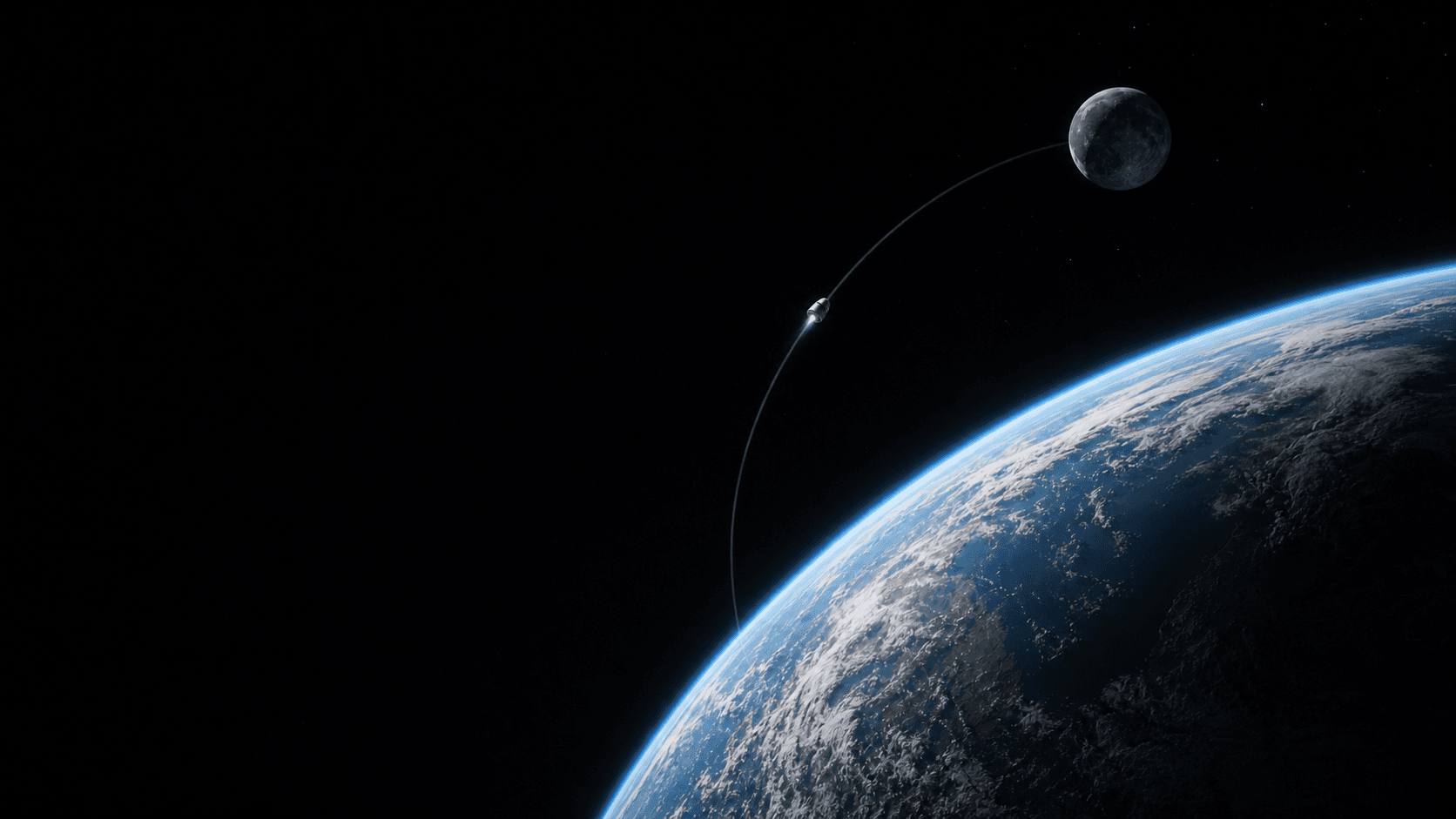
The Moon is also falling toward Earth, but its sideways motion keeps carrying it past the surface. Its path continually curves into an orbit.
More mass strengthens gravity; more distance weakens it quickly
Newton's relationship is F = Gm₁m₂/r². Doubling either mass doubles the force when everything else stays fixed.
Distance is more dramatic: doubling the separation between centres reduces the force to one quarter. The relevant r is measured from centre to centre, not from one surface to another.
Surface gravity is a contest between mass and radius
At a world's surface, g = GM/R². A more massive world tends to pull harder, but a larger radius places its surface farther from the centre.
That is why size alone cannot tell you surface gravity. A world with Earth's mass but twice Earth's radius would have only one quarter of Earth's surface gravity.
Navigation turns the law into a predicted path
Mission planners use a body's mass and a spacecraft's distance from its centre to predict acceleration along the route.
An orbiter, a lander, and a surface instrument experience different conditions even around the same world. Mission Control therefore tracks position together with velocity, not gravity as a single constant.
Build a World's Surface Gravity
Change planetary mass and radius independently, then compare your constructed world with Earth, the Moon, and Mars.
1 g⊕
This surface pulls more strongly than Earth's reference surface.
- Planet mass
- 1 M⊕
- Planet radius
- 1 R⊕
- Surface gravity
- 9.81 m/s²
- Earth-gravity ratio
- 1×
g / g⊕ = 1 / 1²
A fictional world keeps Earth's mass but has twice Earth's radius. What is its surface gravity relative to Earth?
Sources and evidence boundary
Vastward wrote this explanation independently and checked it against the official and research sources below. Each source supports a specific part of the evidence chain.
- Reviewed sourceNewton's Law of Universal GravitationNASA Goddard Space Flight CenterOpen official source
- Reviewed sourceBasics of Space Flight: Chapter 3, Gravity and OrbitsNASA ScienceOpen official source