Begin with one question
Why Planets Become Round
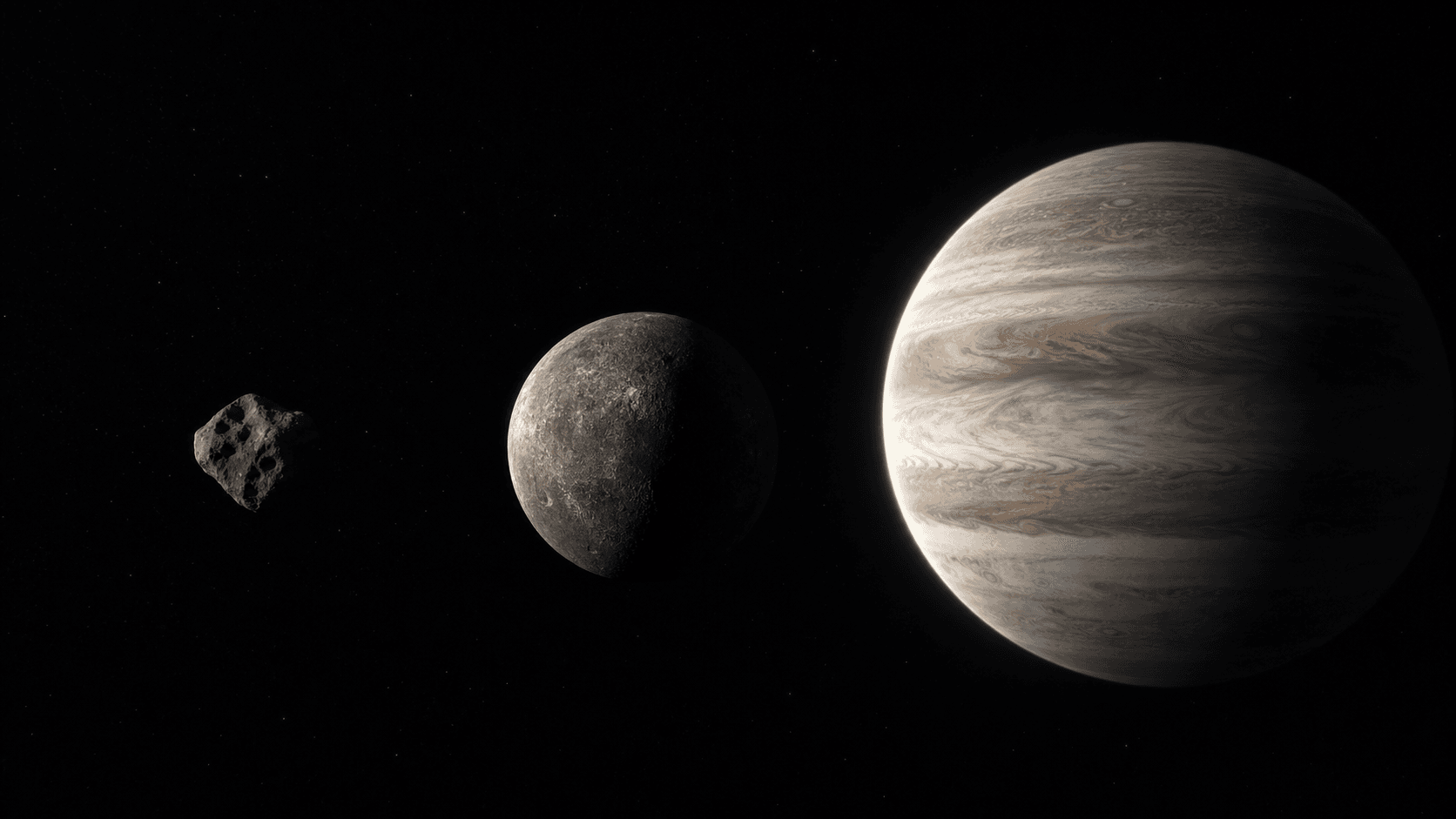
Why can an asteroid be irregular while a large planet becomes nearly spherical?
Explore how gravity pulls large worlds toward equilibrium and how rotation changes their shape.
By the end of this lesson, you will be able to
A world's shape reveals the competition between gravity, material strength, and rotation.
- 01Explain gravitational rounding qualitatively.
- 02Contrast small-body strength with planetary gravity.
- 03Recognize that rotation can flatten a planet.
Small bodies can keep scars; large worlds reshape themselves
Rock and ice have material strength. On a small body, weak self-gravity may be unable to move high regions downward or fill deep depressions.
As a body grows, self-gravity becomes strong enough to make material deform over geological time. Matter moves toward a lower-energy arrangement around the centre.
There is no single kilometre where every body becomes round
The transition depends on composition, temperature, impact history, and time. Ice deforms differently from strong rock, so two bodies of similar size can preserve different shapes.
Ceres is large enough for gravity to have pulled it into a nearly round form. A small asteroid can remain lumpy because its material strength still wins locally.
Rotation prevents a planet from being a perfect sphere
A rotating world carries material around its axis. Near the equator that motion produces a larger outward effect, so the equatorial region can bulge.
Earth is slightly wider at the equator than from pole to pole. Fast-rotating Saturn is more visibly oblate. Both remain round overall, but neither is a perfect mathematical sphere.
A world's shape changes how a mission approaches it
An irregular body does not produce a perfectly symmetric gravitational field. Orbit planning and landing prediction must account for shape, rotation, and uneven mass distribution.
Around a nearly spherical planet, a simple central-gravity model is a useful first approximation. Mission teams then add higher-detail corrections as accuracy demands.
Read a World's Shape
Compare a small rocky body, Ceres, Earth, and Saturn to identify the signatures of self-gravity and rotation.
Representative small rocky body
A qualitative comparison profile, not a named asteroid or a claimed universal threshold.
- Mean radius
- 5 km
- Rotation period
- Qualitative only
- Shape class
- Irregular
- Equatorial bulge
- Qualitative only
Gravity: Weak self-gravity may not overcome rock strength or erase impact-built relief.
Rotation: Rotation can alter the outline, but collision history and material strength may dominate.
Which explanation best accounts for an irregular asteroid, round Ceres, and oblate Saturn?
Sources and evidence boundary
Vastward wrote this explanation independently and checked it against the official and research sources below. Each source supports a specific part of the evidence chain.
- Reviewed sourceWhy Are Planets Round?NASA Space PlaceOpen official source
- Reviewed sourcePlanetary Physical ParametersNASA Jet Propulsion LaboratoryOpen official source
- Reviewed sourceCeres FactsNASA ScienceOpen official source