Begin with one question
Planetary Volume, Mass, and Mean Density
How can worlds of similar size hide radically different amounts of matter?
Build worlds from mass and radius, then use mean density as a careful clue about their possible interiors.
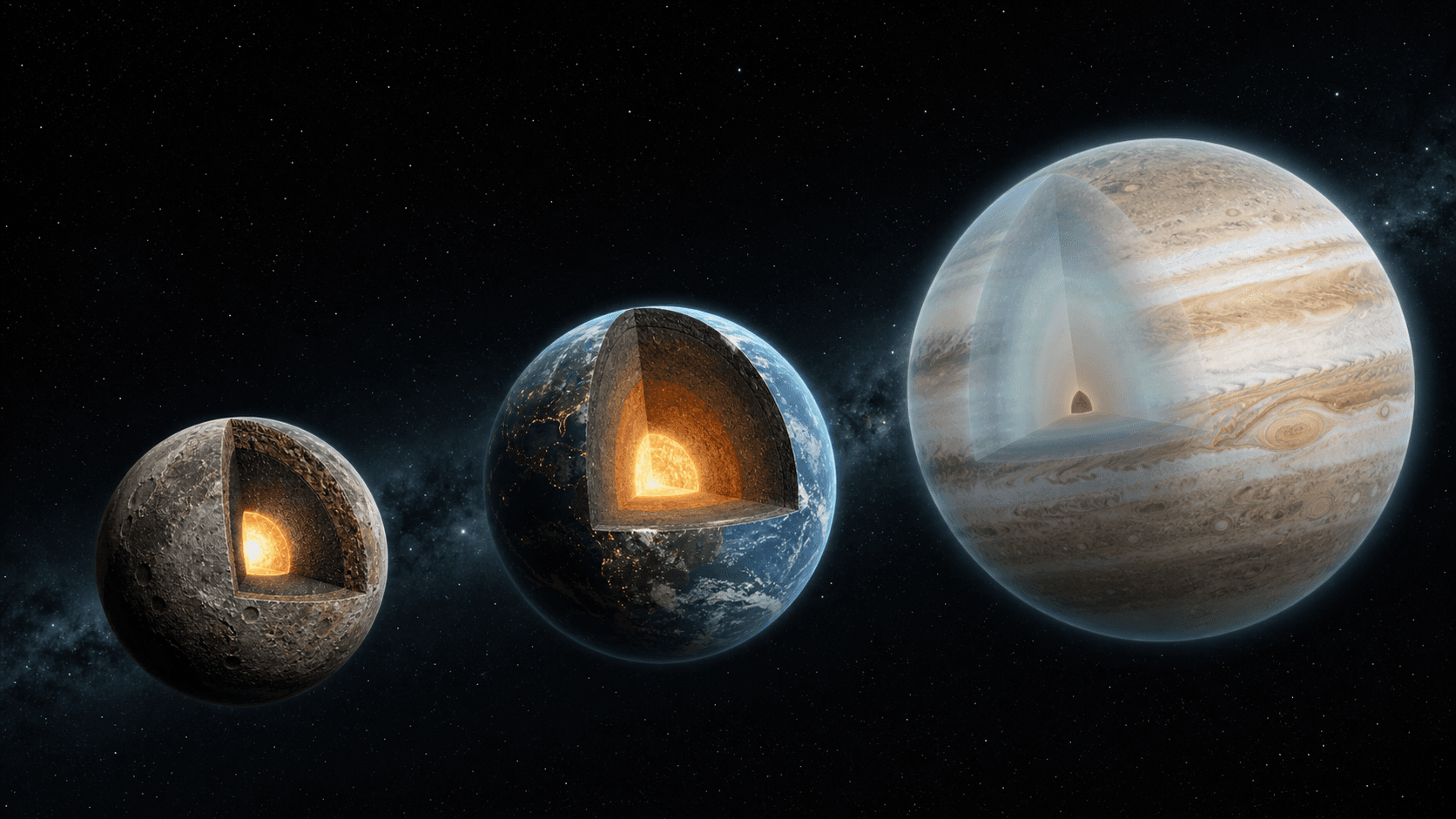
By the end of this lesson, you will be able to
Astronomers cannot place a distant planet on a scale or cut it open. Mass, radius, and mean density turn remote motion and light into a first interior constraint.
- 01Distinguish mass, weight, volume, and mean density.
- 02Use radius to calculate the volume of an approximately spherical world.
- 03Explain how missions and telescopes constrain planetary mass and radius.
- 04Calculate mean density from mass and volume.
- 05Use density to compare plausible planet families.
- 06Separate density and spectrum clues from claims about exact composition.
Mass, volume, and density answer different questions
Mass describes a world's inertia and its role in gravitational interaction. It is not weight: weight changes with the local gravitational field, while the world's mass does not. For a first mental model, mass tells us how much matter the world contains.
Volume describes how much space the world occupies. Mean density then compares the whole world's mass with its whole volume. A large world is not automatically massive, and a massive world is not automatically dense.
Radius grows once. Volume grows three times.
For a nearly spherical world, volume is V = 4/3 πR³. The cube matters: doubling the radius does not make twice the room. It makes eight times the volume.
This is why a small uncertainty in radius can create a much larger uncertainty in volume. Before comparing worlds, confirm whether a table uses mean radius, equatorial radius, or diameter.
Density asks how tightly mass is packed
Mean density is total mass divided by total volume: ρ = M/V. If two worlds have the same mass but one has twice the radius, that larger world spreads the same mass through eight times the volume, so its mean density falls to one eighth.
Use Earth as a reference and the comparison becomes compact: ρ/ρ⊕ = (M/M⊕) / (R/R⊕)³. The lab calculates this ratio while keeping the units visible.
A spacecraft can weigh a world without landing
For a solar-system body, teams constrain size from images, occultations, radar or laser altimetry, and a three-dimensional shape model. An irregular body needs a shape model rather than one perfect spherical radius.
Mass comes from gravity. Teams track how a moon, spacecraft, or nearby body accelerates and changes orbit, solve for the body's gravitational parameter GM, and then derive mass. The measurement is motion, not a reading from a physical scale.
A distant planet first appears as a change in starlight
When an exoplanet crosses its star, the transit depth records how much light is blocked. Combine that fraction with the star's known radius and astronomers can estimate the planet's radius. Repeated transits also reveal its orbital period.
The planet's gravity can make the star move toward and away from us. Spectrographs measure that radial-velocity wobble and constrain the planet's mass. Some systems instead use transit-timing variations or other methods. Density becomes available only when both mass and radius are constrained.
A density value is a clue, not an interior scan
Low mean density can point toward a large envelope of gas or ice. High density can favor a larger fraction of rock or metal. But planets are mixtures, pressure compresses deep material, and atmospheres change radius measurements.
The material markers in this lab are reference values, not verdicts. A planet near the density of rock is not a uniform ball of that rock, and two planets with similar mean density can still have different layered interiors.
Light can identify an atmosphere, not expose every layer
During a transit, a small fraction of starlight filters through the planet's atmosphere. Different atoms and molecules absorb different wavelengths, leaving patterns in the spectrum. This is how telescopes can identify atmospheric features associated with water vapor, carbon dioxide, methane, sodium, and other species.
A spectrum describes the light that reached the instrument and must be interpreted with atmosphere models. It does not directly sample the core, and one molecule never proves a complete interior, a habitable environment, or life. The dedicated course How to Read a Distant World will follow this evidence chain in depth.
Reconstruct a World from Observation
Trace how teams obtain mass and radius, then build worlds and decide what density and spectra can and cannot reveal.
Separate the three physical quantities
- MMass
- A measure of inertia and a key property in gravitational interaction. Unlike weight, it does not change when local gravity changes.
- VVolume
- The space a world occupies. For an approximately spherical world, radius determines volume through V = 4/3 πR³.
- ρMean density
- Total mass divided by total volume. It is a whole-world average, not a direct scan of any one internal layer.
A spacecraft can approach the target. Which measurements become available?
- Constrain size
Images, occultations, radar or laser altimetry build a radius or three-dimensional shape model.
- Constrain mass
Tracking a moon or spacecraft reveals gravitational acceleration, orbital changes, and GM, which constrain mass.
- Compare world types
Mass and modeled volume produce mean density. Density, gravity, shape, temperature, and geology narrow the plausible world type.
- Investigate material
Spectrometers, particle instruments, radar, magnetometers, landers, or samples can add surface, atmosphere, and interior clues.
- Water referenceA familiar 1 g/cm³ reference, not a claim that a planet is made only of water.
- 1 g/cm³
- Silicate-rock referenceA rough material comparison before planetary pressure and mixed layers are considered.
- 3.3 g/cm³
- Iron referenceA room-pressure material marker, not a direct model of a compressed planetary core.
- 7.87 g/cm³
These are familiar material values at ordinary conditions. Planetary interiors are mixtures under pressure, so proximity is a comparison, not a composition verdict.
5.51 g/cm³
This model packs substantial mass into its volume, producing a high mean density.
- Planet mass
- 1 M⊕
- Planet radius
- 1 R⊕
- Earth-volume ratio
- 1 V⊕
- Planet volume
- 1.083E12 km³
- Mean density
- 5.513 g/cm³
V / V⊕ = (1)³
ρ / ρ⊕ = 1 / 1³
Two worlds have the same mass. World B has twice World A's radius. What is World B's mean density relative to World A?
Sources and evidence boundary
Vastward wrote this explanation independently and checked it against the official and research sources below. Each source supports a specific part of the evidence chain.
- Reviewed sourcePlanetary Physical ParametersNASA Jet Propulsion LaboratoryOpen official source
- Reviewed sourceExoplanetsNASA ScienceOpen official source
- Reviewed sourceWhat's a Transit?NASA ScienceOpen official source
- Reviewed sourceHow We Find and CharacterizeNASA ScienceOpen official source
- Reviewed sourceNASA's Webb Detects Carbon Dioxide in Exoplanet AtmosphereNASA ScienceOpen official source