Begin with one question
Why an Orbit Keeps Falling Without Hitting Earth
If gravity is pulling a spacecraft toward Earth, why does it not hit the surface?
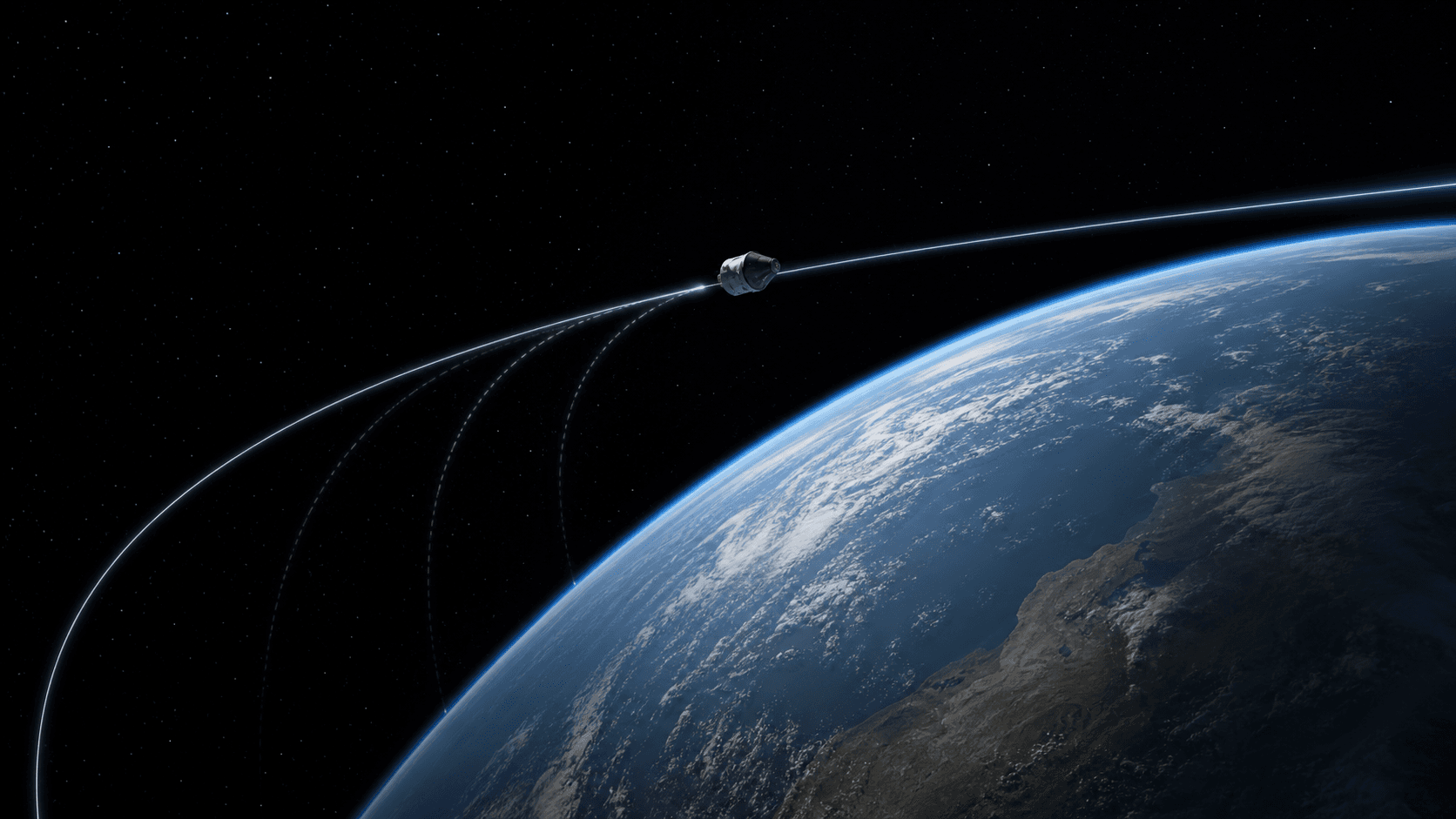
Treat orbit as continuous freefall and discover how sideways speed decides whether a path collides, circles, or escapes.
By the end of this lesson, you will be able to
This mental model turns orbital flight from a mysterious floating motion into a prediction you can test.
- 01Explain why gravity remains strong in low orbit.
- 02Use sideways speed to distinguish impact, orbit, and escape paths.
- 03Describe an orbit as continuous freefall around a curved world.
- 04State what the simplified two-body model leaves out.
Orbit begins with gravity, not the absence of it
A spacecraft a few hundred kilometres above Earth is not beyond gravity. Earth's pull continuously accelerates it inward, changing the direction of its velocity every moment.
Without that inward acceleration, the spacecraft would continue along a straight line. Gravity is therefore not an obstacle to orbit; it is the force that bends the path.
Throw farther until the ground curves away
Imagine launching an object horizontally from high above the atmosphere. With little sideways speed, it falls nearby. Increase that speed and it travels farther before reaching the surface.
At one special speed, the object falls toward Earth at the same rate that Earth's curved surface falls away beneath it. It keeps missing the ground and closes a path around the planet.
One starting point can produce several path families
Below circular speed, the trajectory bends more sharply toward Earth. If its lowest point lies inside the planet, the path intersects the surface. At circular speed, distance from Earth's centre stays constant in the ideal model.
Above circular speed but below escape speed, the path is a closed ellipse. At the escape threshold, the path no longer closes. The lab changes only one variable so you can see these regimes emerge.
Launch vehicles spend most of their effort building sideways speed
A rocket climbs first to clear dense atmosphere and terrain, but an orbit is established only after the vehicle develops enough horizontal velocity. Mission teams therefore monitor velocity direction and magnitude, not altitude alone.
If an engine stops too early, the predicted lowest point may remain inside Earth or its atmosphere. Orbit insertion aims to raise that lowest point and shape a survivable trajectory.
The clean path is a model, not a promise
This lesson treats Earth as spherical, keeps its gravity field simple, starts above the atmosphere, and ignores the Moon, Sun, thrust, drag, and uneven mass inside Earth.
Real orbit determination adds those effects and measurement uncertainty. The simplified model remains valuable because it isolates the governing idea before operational detail is introduced.
Make the Surface Fall Away
Change only the spacecraft's sideways speed and discover when its path intersects Earth, closes into an orbit, or opens toward escape.
Circular orbit
The sideways speed matches the ideal circular-orbit speed at this altitude.
Arrows show instantaneous velocity and gravity, not a flight trail or engine exhaust. Their lengths are schematic.
- Circular speed
- 7.61 km/s
- Escape speed
- 10.77 km/s
- Lowest altitude
- 500 km
- Highest altitude
- 500 km
Mission Control sees a spacecraft in stable low orbit. Which explanation matches the evidence?
Sources and evidence boundary
Vastward wrote this explanation independently and checked it against the official and research sources below. Each source supports a specific part of the evidence chain.
- Reviewed sourceChapter 3: Gravity and Mechanics, Acceleration in OrbitNASA ScienceOpen official source
- Reviewed sourceChapter 3: Gravity and Mechanics, How Orbits WorkNASA ScienceOpen official source