Begin with one question
Orbital Speed and Period
Why does a low spacecraft circle Earth faster than a distant satellite?
Build circular orbits around Earth, the Moon, and Mars, then connect altitude and central-body gravity to speed and period.
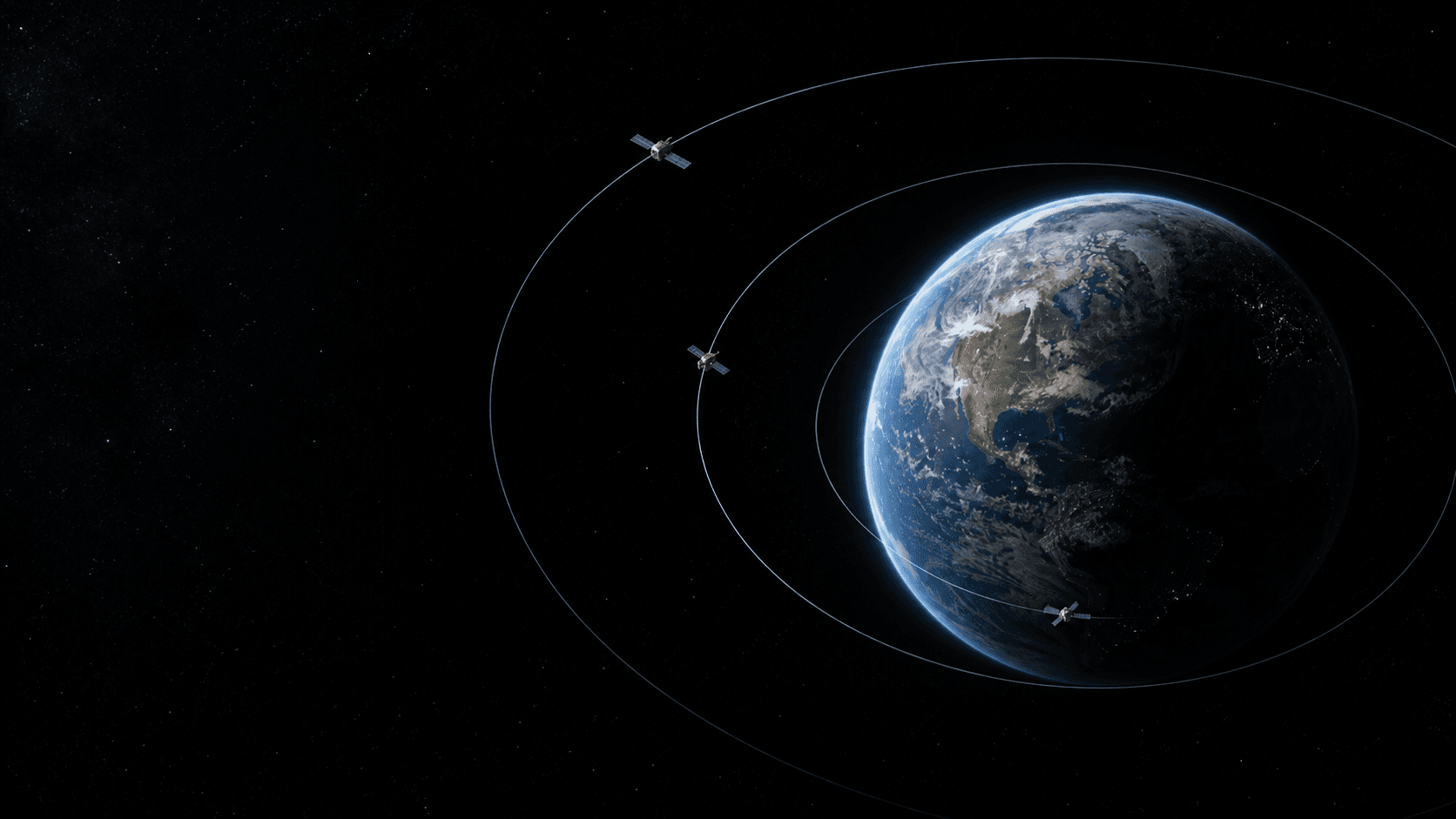
By the end of this lesson, you will be able to
Orbit period shapes mission timelines, ground-station contacts, revisit time, and the rhythm of spacecraft operations.
- 01Calculate circular-orbit speed from radius and gravitational parameter.
- 02Predict how higher altitude changes speed and period.
- 03Compare equivalent-altitude orbits around different worlds.
- 04Separate a useful two-body model from real operational corrections.
A circular orbit is a continuous turn
Velocity includes direction. Even if a spacecraft's speed stays constant, following a circle means its velocity direction changes continuously, so it is accelerating toward the centre.
In the ideal circular-orbit model, gravity supplies exactly this inward acceleration. The spacecraft does not balance gravity with an outward engine force.
Two equations turn an orbit into a schedule
For a circular orbit, speed is v = √(μ/r), where μ is the central body's gravitational parameter and r is distance from its centre, not altitude above the surface.
One orbit takes T = 2π√(r³/μ). At roughly 400 km above Earth, this ideal model gives about 7.67 km/s and 92.6 minutes, close to the operating scale associated with the International Space Station.
Higher circular orbits are slower and longer
Farther from the central body, gravity is weaker. A circular path therefore requires a lower speed. But the spacecraft also has a much larger circumference to travel.
Both effects lengthen the period. This is why a high satellite can take many hours to complete one orbit even though it is still moving thousands of metres each second.
The same altitude means different motion at another world
Earth, the Moon, and Mars have different radii and gravitational parameters. A spacecraft 400 km above each surface is therefore not at the same centre-to-centre distance and does not feel the same inward acceleration.
Mission designers carry the correct body's μ into every calculation. Copying an Earth-orbit speed into a lunar or Martian plan would produce the wrong trajectory.
Period becomes the heartbeat of operations
A low-Earth spacecraft can circle the planet roughly every hour and a half. Each pass changes lighting, ground visibility, thermal conditions, and opportunities to communicate with specific stations.
Controllers use orbit predictions to schedule contacts and activities. The simple period is the first layer; real planning also accounts for Earth's rotation, orbit shape, drag, and perturbations.
Real trajectories are not frozen circles
The lab assumes a spherical central body, a perfectly circular orbit, no atmosphere, no thrust, and only two gravitating bodies. It uses established mean constants rather than a live navigation solution.
Operational flight dynamics propagates a spacecraft state through time and incorporates drag, non-spherical gravity, other bodies, manoeuvres, and tracking uncertainty.
Build a Circular Orbit
Choose Earth, the Moon, or Mars, change altitude, and calculate the speed and time required to complete one circular orbit.
Earth
This low orbit moves quickly and repeats in a short operational rhythm.
The orbit radius is compressed logarithmically for comparison. Arrows show direction; bodies and distances are not drawn to physical scale.
- Centre-to-centre radius
- 6,778 km
- Orbital speed
- 7.669 km/s
- Orbital period
- 92.6 min
- Gravity at orbit
- 8.676 m/s²
- Path circumference
- 42,588 km
v = √(μ / r)
T = 2π√(r³ / μ)
Around the same world, Mission Control moves a spacecraft from a low circular orbit to a higher circular orbit. What changes?
Sources and evidence boundary
Vastward wrote this explanation independently and checked it against the official and research sources below. Each source supports a specific part of the evidence chain.
- Reviewed sourceChapter 3: Gravity and Mechanics, Acceleration in OrbitNASA ScienceOpen official source
- Reviewed sourceFlight to OrbitNASA Glenn Research CenterOpen official source
- Reviewed sourceOrbits and Kepler's LawsNASA ScienceOpen official source
- Reviewed sourceHuman Spaceflight FactsNASA Earth ObservatoryOpen official source