Begin with one question
Escape Velocity
What changes when a spacecraft has enough energy for its path to stop closing?
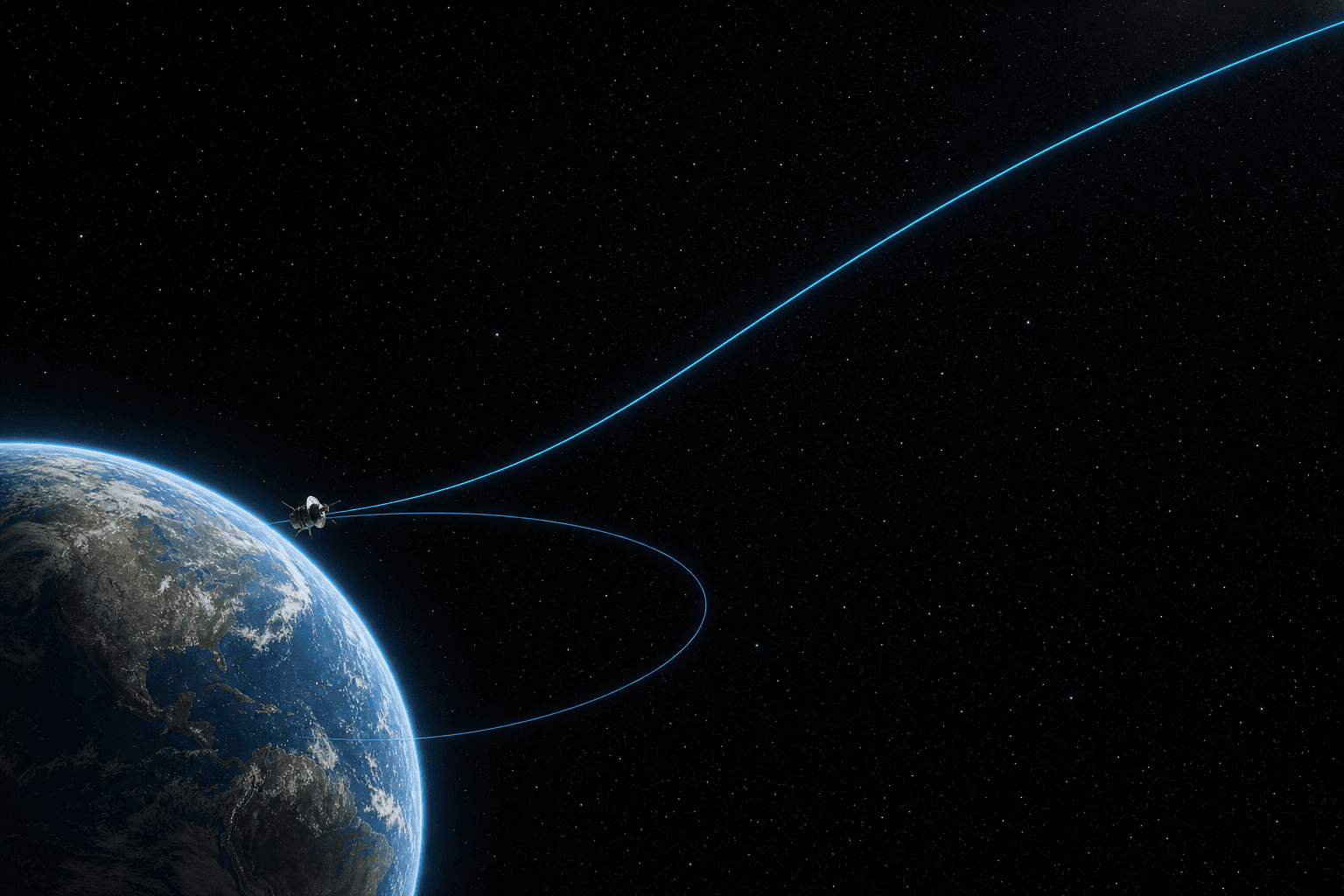
Turn a circular orbit into an ellipse and then an open escape path while comparing Earth, the Moon, and Mars.
By the end of this lesson, you will be able to
Escape speed separates a spacecraft that remains bound to a world from one that can depart toward another destination.
- 01Describe escape velocity as an energy threshold, not a place where gravity ends.
- 02Calculate escape speed from a world's gravitational parameter and centre distance.
- 03Compare circular, bound elliptical, and open escape trajectories.
- 04Explain why escaping Earth does not automatically escape the Sun.
Escape means unbound, not untouched by gravity
A spacecraft in orbit is gravitationally bound. Its path keeps returning because its total orbital energy is below the level required to separate from the central world indefinitely.
At the escape threshold, the ideal trajectory becomes open. Gravity still acts at every point and continues to slow the outward-moving spacecraft, but it can no longer turn the path into a closed orbit.
The threshold comes from an energy balance
For an ideal two-body coast, escape speed is vₑ = √(2μ/r). Here μ is the central world's gravitational parameter and r is the centre-to-centre distance at the moment the speed is measured.
At exactly this threshold, the spacecraft has just enough kinetic energy to keep moving outward while its speed approaches zero at an indefinitely large distance. More speed leaves positive excess energy; less speed remains bound.
At one radius, escape speed is √2 times circular speed
Lesson 8 used v꜀ = √(μ/r) for a circular orbit. Comparing it with vₑ = √(2μ/r) shows that escape speed is about 1.414 times the circular speed at the same centre distance.
A tangential burn above circular speed first stretches the circle into an ellipse. As the speed approaches escape, the far side moves farther away until the ellipse no longer closes.
A larger mass or smaller distance raises the threshold
Earth, the Moon, and Mars have different masses and radii, so their surface escape speeds differ. The Moon's weaker gravity produces a much lower threshold than Earth's.
Moving higher above the same world also lowers escape speed because the spacecraft begins with more gravitational potential energy. Altitude alone is not enough; the calculation always uses distance from the world's centre.
A real rocket builds departure energy over time
The surface value near 11.2 km/s is an ideal instantaneous threshold with no atmosphere, rotation, or propulsion after release. A real launch vehicle does not need to jump from rest to that speed at one instant.
Missions build velocity through powered flight, staging, parking orbits, later burns, and sometimes gravity assists. Engineers plan the total change in velocity and departure energy along a trajectory, not one dramatic speedometer moment.
Every escape claim needs a reference body
Leaving Earth's gravitationally bound trajectory usually places a spacecraft on an orbit around the Sun. It has escaped Earth, but it has not automatically escaped the solar system.
The Sun, planets, moons, and other bodies continue to shape the motion. Operational trajectory design therefore asks a precise question: escape from which body, with how much speed remaining, and toward what encounter?
Open a Bound Orbit
Choose a world, change altitude and sideways speed, then watch a closed orbit become an open escape path.
Circular orbit
The selected speed is the circular value at this radius. The path remains bound and closed.
The solid line is a model prediction, not exhaust or an observed trail. Distances are compressed, and the open path is schematic beyond the visible frame.
- Tangential departure speed
- 7.669 km/s
- Circular speed
- 7.669 km/s
- Escape speed
- 10.845 km/s
- Specific orbital energy
- -29.403 km²/s²
- Far-away excess speed
- 0 km/s
vₑ = √(2μ / r)
ε = v² / 2 - μ / r
A probe crosses Earth's ideal escape threshold with its engines off. Which statement should Mission Control use?
Sources and evidence boundary
Vastward wrote this explanation independently and checked it against the official and research sources below. Each source supports a specific part of the evidence chain.
- Reviewed sourceEarth's Moon: By the NumbersNASA ScienceOpen official source
- Reviewed sourcePlanetary Physical ParametersNASA Jet Propulsion LaboratoryOpen official source
- Reviewed sourceSpace Math Problem 601: Gravity and Escape SpeedNASA Goddard Space Flight CenterOpen official source
- Reviewed sourceUniverse Glossary: Gravitationally BoundNASA ScienceOpen official source
- Reviewed sourceKepler's Second Law Lesson: Escape VelocityNASA Goddard Space Flight CenterOpen official source