Begin with one question
How Do Astronomers Confirm That a Star Is Forming?
Which observations separate a hidden protostar from a merely dark cloud?
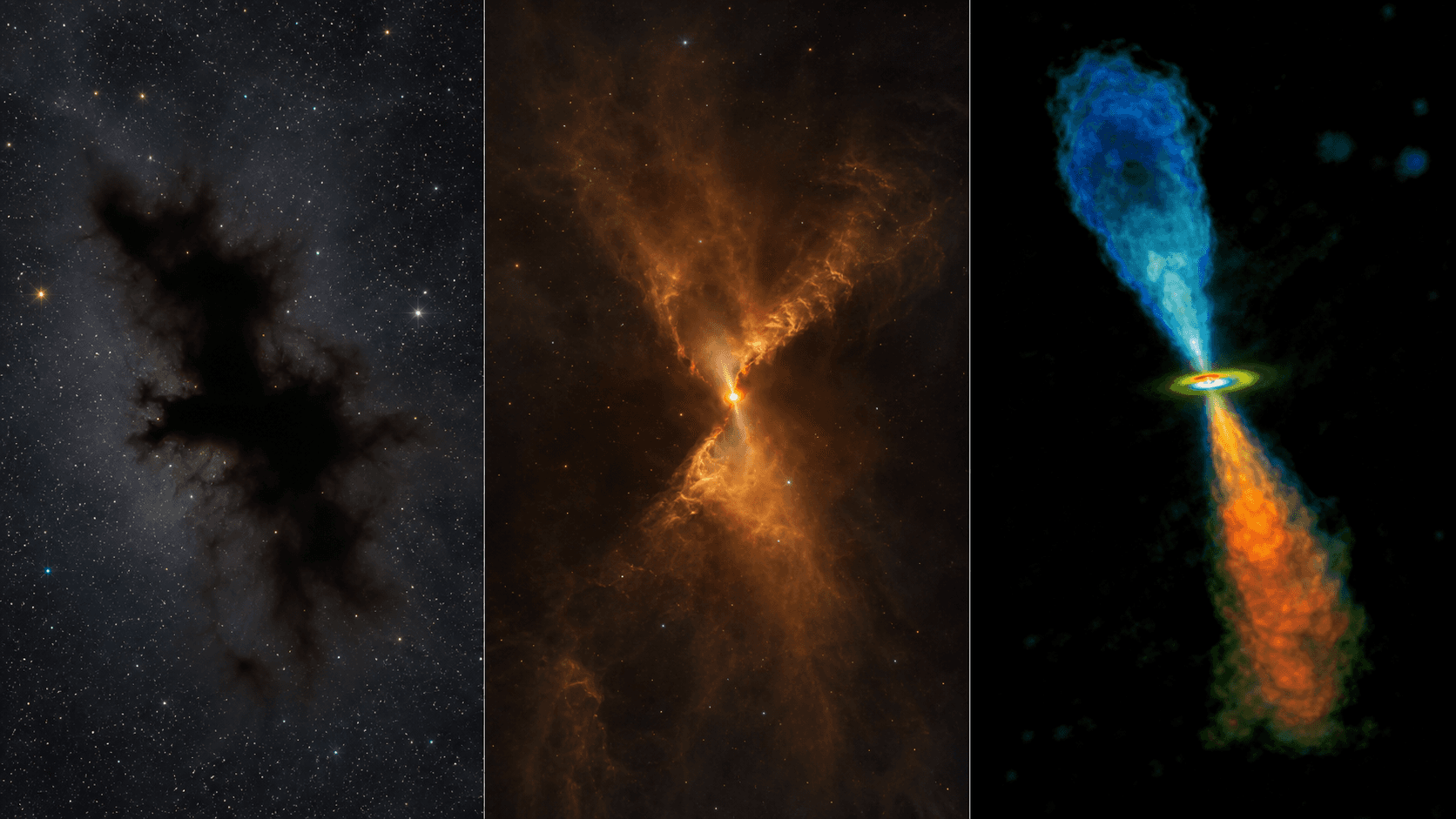
Combine infrared emission, dense gas, disks, jets, and motion into a bounded diagnosis.
By the end of this lesson, you will be able to
Combine infrared emission, dense gas, disks, jets, and motion into a bounded diagnosis.
- 01Combine five independent clues into an evidence-led diagnosis of ongoing star formation.
- 02Connect the idea to an observable signal, measurement, or instrument.
- 03No single bright source, dark patch, disk-shaped feature, or jet is sufficient without context and follow-up measurements.
Start with a candidate, not a verdict
A cold dense dark cloud tells astronomers where star formation could occur. It does not show whether gas is already falling inward or whether a new central object is heating its surroundings.
The careful starting statement is therefore: this is a promising dense core. Every later observation should test a different part of the formation story instead of repeating the same clue.
Look for heat that the visible image cannot show
Infrared observations can reveal a warm embedded source because warmed dust reradiates energy at longer wavelengths. Far-infrared and submillimetre measurements map colder dust and help estimate how much material surrounds the source.
A warm point is useful but still not conclusive. A background object, foreground dust, or several unresolved sources can confuse the picture, so position and wavelength coverage matter.
A rotating disk and bipolar outflow reveal organised structure
A flattened rotating disk around the warm source links the object to accretion. A pair of oppositely directed outflows centred on the same location shows that material is being launched along a shared axis.
Geometry matters: the disk and outflow should align as one system. Inclination can hide a disk or make one outflow lobe brighter, so an apparently missing feature may be an orientation effect rather than proof of absence.
Spectral lines test whether gas is moving in the required directions
Molecular spectral lines carry Doppler shifts. Spatially resolved red- and blueshift patterns can reveal rotation, outflow, or inward motion when they match a physical geometry around the same source.
The strongest diagnosis combines cold dense material, an embedded heat source, a rotating disk, bipolar outflow, and gas kinematics. Astronomers still report uncertainty and alternative explanations because each measurement has limited resolution and sensitivity.
Build a five-clue star-formation case
Add cold dust, embedded heat, a rotating disk, bipolar outflow, and inward gas motion one at a time, then decide when the evidence becomes coherent.
Add one evidence channel at a time. The model rewards agreement among different measurements, not repeated versions of one image.
- Independent clues included
- 3 / 5
- Strength of current case
- Rotating-disk clue
Rotating-disk clue
A flattened structure around the source shows ordered rotation and a route for accretion.
Resolved continuum and velocity gradients can connect the structure to a rotating disk rather than an unrelated filament.
The central object is a teaching composite. Each lower card activates a distinct clue: cold dust, embedded heat, a rotating disk, bipolar outflow, and inward gas motion.
Swipe sideways on a small screen to inspect the full diagram and labels.
Which workflow best supports a careful claim that a star is actively forming?
Sources and evidence boundary
Vastward wrote this explanation independently and checked it against the official and research sources below. Each source supports a specific part of the evidence chain.
- Reviewed sourceWebb's Star Formation DiscoveriesNASA ScienceOpen official source
- Reviewed sourceHow Herschel unlocked the secrets of star formationEuropean Space AgencyOpen official source
- Reviewed sourceHubble's Album of Planet-Forming DisksNASA ScienceOpen official source
- Reviewed sourceHow Newborn Stars Prepare for the Birth of PlanetsALMA ObservatoryOpen official source