Begin with one question
Why Does a Protostar Have a Disk and Jets?
How does infalling rotating gas become a flattened disk and a pair of outflows?
A protostar is the growing hot centre formed by collapse before sustained hydrogen fusion begins. Follow its disk, accretion, magnetic fields, and outflows.
By the end of this lesson, you will be able to
A protostar is the growing hot centre formed by collapse before sustained hydrogen fusion begins. Follow its disk, accretion, magnetic fields, and outflows.
- 01Trace how rotation redirects infalling material into a disk and why bipolar jets emerge along the rotation axis.
- 02Connect the idea to an observable signal, measurement, or instrument.
- 03The diagram is a teaching sequence; real disks, magnetic fields, and outflows are three-dimensional and evolve together.
A tiny initial spin becomes important during collapse
When a collapsing cloud builds a compact central object that is still gathering material but has not begun sustained hydrogen fusion, astronomers call it a protostar. It can already grow hotter and shine because gravity and infalling material release energy; it is an early stage of a star, not yet a main-sequence star.
A molecular-cloud core is rarely perfectly motionless. As gravity draws material into a smaller region, the same angular momentum is concentrated. The rotation therefore becomes harder to ignore, much like a skater spinning faster after pulling their arms inward.
Angular momentum is the scientific name for rotational motion combined with how mass is distributed around an axis. It does not mean every gas parcel circles at one identical speed.
Rotating material cannot all fall straight into the centre
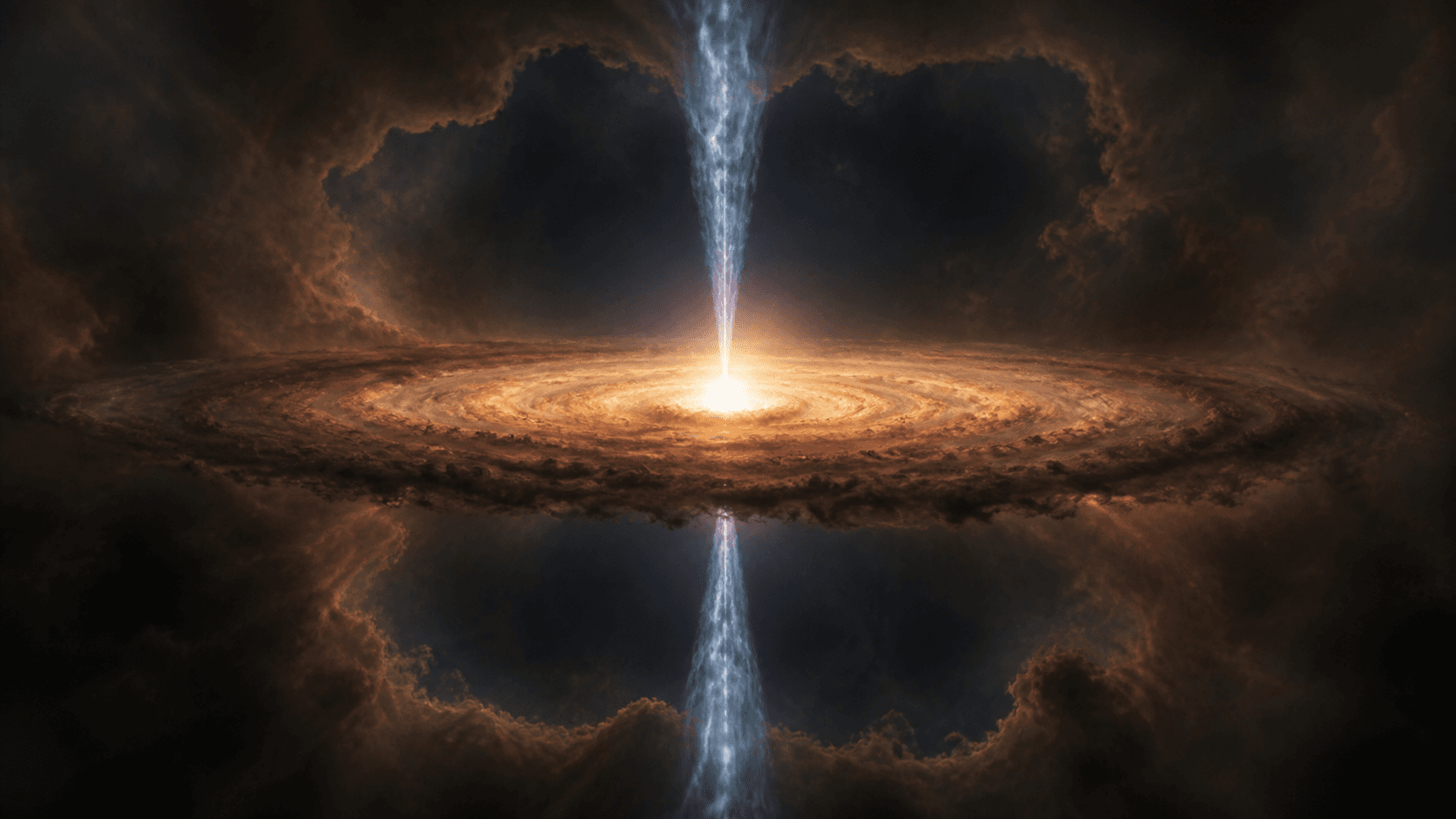
Gas moving along the rotation axis can fall inward more directly. Gas approaching from other directions carries sideways motion, collides, and settles toward a flattened plane. The result is a rotating accretion disk around the protostar.
Accretion means that material is being added to the growing object. The disk is not a solid plate; it is gas and dust orbiting at different speeds while slowly transporting material inward.
Material moves inward while angular momentum moves outward
Neighbouring parts of a disk interact through turbulence, magnetic stresses, and other transport processes. Some gas loses angular momentum and spirals inward, while other material gains angular momentum or is redirected outward.
This is why a disk can feed the protostar rather than becoming a permanent traffic jam. The exact mix of transport processes is an active research topic, so the diagram shows the direction of exchange without pretending to solve every detail.
Jets escape along the rotation axis, not through the disk
Magnetic fields connected to the rotating inner disk can help launch and guide a fraction of material away from the system. The easiest escape route is roughly perpendicular to the disk, producing two oppositely directed outflows called bipolar jets.
A jet is not all the gas that failed to fall in, and it is not a rocket exhaust pipe. It is an organised outflow that can remove some mass and angular momentum and drive shocks into the surrounding cloud.
Assemble a protostar, disk, and jet system
Move through the formation sequence and follow infall, disk rotation, inward accretion, the rotation axis, and bipolar jets without confusing inflow with outflow.
Move through a teaching sequence from a rotating envelope to a disk-and-jet system. The percentage is sequence progress, not the age of a real protostar.
- Teaching-sequence progress
- 60%
- Current structure
- Accreting disk
Accreting disk
The disk transports some material inward while redistributing angular momentum through the system.
Turbulent and magnetic stresses help couple neighbouring disk regions, enabling mass accretion and angular-momentum transport.
Blue curved arrows show infalling material, the flattened ellipse is the rotating disk, the dashed line is the rotation axis, and the bright vertical beams are bipolar jets.
Swipe sideways on a small screen to inspect the full diagram and labels.
Which explanation correctly connects the protostar, disk, rotation axis, and bipolar jets?
Sources and evidence boundary
Vastward wrote this explanation independently and checked it against the official and research sources below. Each source supports a specific part of the evidence chain.
- Reviewed sourceStarsNASA ScienceOpen official source
- Reviewed sourceHubble's Album of Planet-Forming DisksNASA ScienceOpen official source
- Reviewed sourceHow Newborn Stars Prepare for the Birth of PlanetsALMA ObservatoryOpen official source