Begin with one question
A Telescope Receives Light One Count at a Time
What does a detector actually record when a source is too faint for our eyes to see?
Connect photons, detector events, exposure time, and the need to separate source counts from background counts.
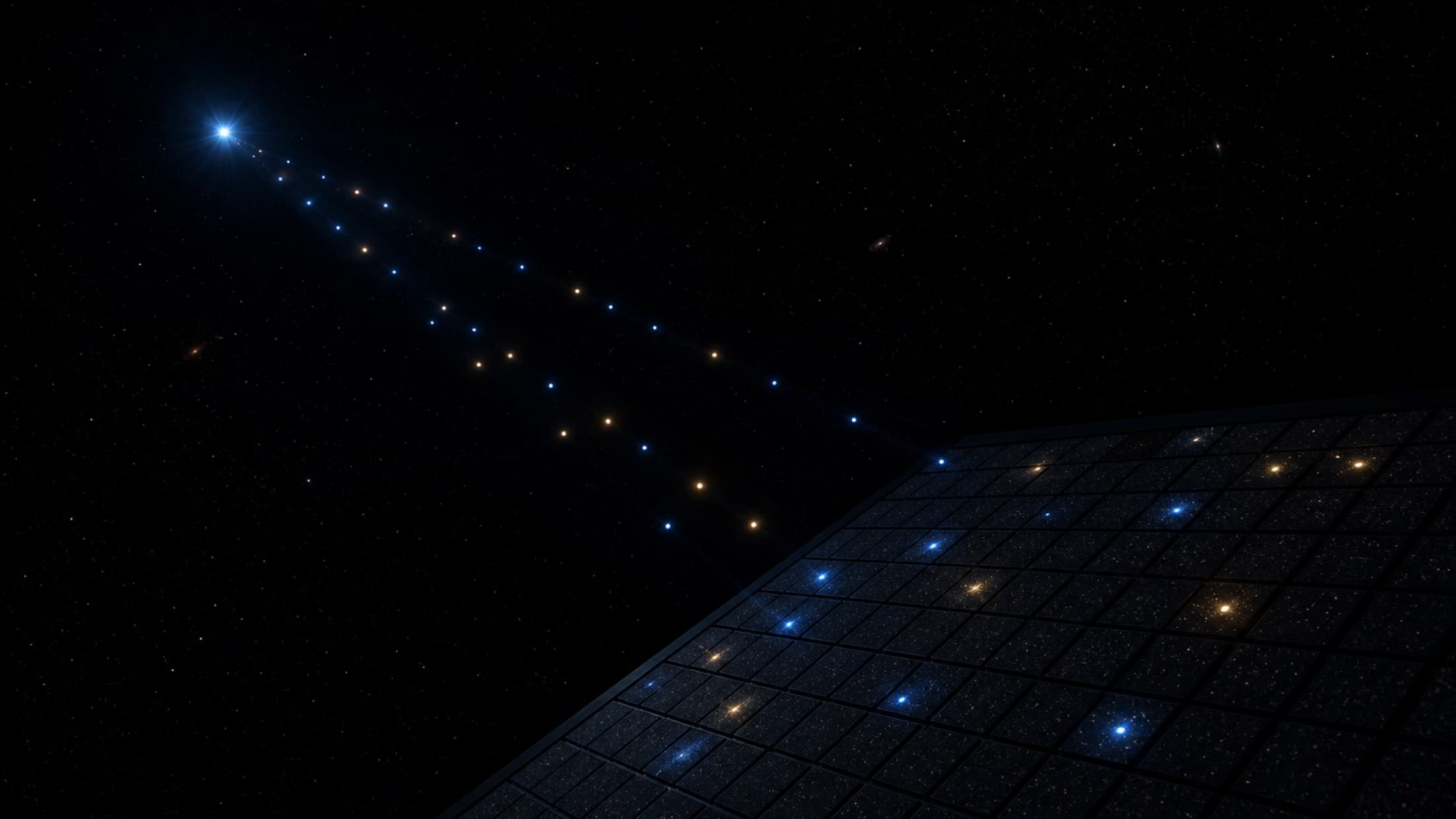
By the end of this lesson, you will be able to
Connect photons, detector events, exposure time, and the need to separate source counts from background counts.
- 01Explain how repeated detector events accumulate into a measurable signal.
- 02Connect the idea to an observable signal, measurement, or instrument.
- 03Recognize that a detector count is not automatically one uncontaminated photon from the target.
A faint object becomes a stream of detector events
A digital astronomical detector converts arriving light into electrical events or accumulated charge. Software then records where, when, or with what energy those events appeared.
For a very faint source, the image begins as only a small statistical excess above everything else the detector records.
Not every count belongs to the target
Sky glow, nearby sources, cosmic rays, thermal electrons, detector dark current, and electronic read noise can all add events.
Astronomers estimate the background from nearby blank regions or calibration data, then compare the remaining source estimate with the total statistical uncertainty.
Longer exposure helps more slowly than intuition expects
If target and background rates stay steady, doubling exposure doubles both. Random counting uncertainty grows roughly with the square root of the total.
That is why a simple photon-counting signal-to-noise ratio often improves with the square root of exposure time: four times longer may be needed for roughly twice the signal-to-noise.
Separate a faint target from background
Change exposure time and compare target counts, background, and signal-to-noise.
Expose longer, then separate source from background
Move the exposure time. The classroom detector accumulates a fixed target rate, a background rate, and read noise so the signal-to-noise tradeoff stays visible.
- Target signal
- 48 counts
- Sky + detector background
- 27 counts
- Total recorded counts
- 75 counts
- Estimated target counts
- 48 counts
- Signal-to-noise ratio
- 4.7 : 1
60-second exposure: more time accumulates target photons and background together. Signal-to-noise usually improves only with the square root of exposure time.
Why can a longer exposure help without making every recorded count trustworthy?
Sources and evidence boundary
Vastward wrote this explanation independently and checked it against the official and research sources below. Each source supports a specific part of the evidence chain.
- Reviewed sourceThe Electromagnetic SpectrumNASA ScienceOpen official source
- Reviewed sourceSensitivity, Count Rate, and Signal-to-NoiseSpace Telescope Science InstituteOpen official source
- Reviewed sourceTelescopes 101NASA ScienceOpen official source