Begin with one question
What Can Matter Do to Light?
How do emission, absorption, transmission, reflection, and scattering leave different evidence?
Follow light through five interactions before asking what an image or spectrum can establish.
By the end of this lesson, you will be able to
Follow light through five interactions before asking what an image or spectrum can establish.
- 01Identify the five common light-matter interactions in an observation.
- 02Connect the idea to an observable signal, measurement, or instrument.
- 03Separate a measured change in light from the model used to identify the material that caused it.
Light can leave, disappear, pass, bounce, or change direction
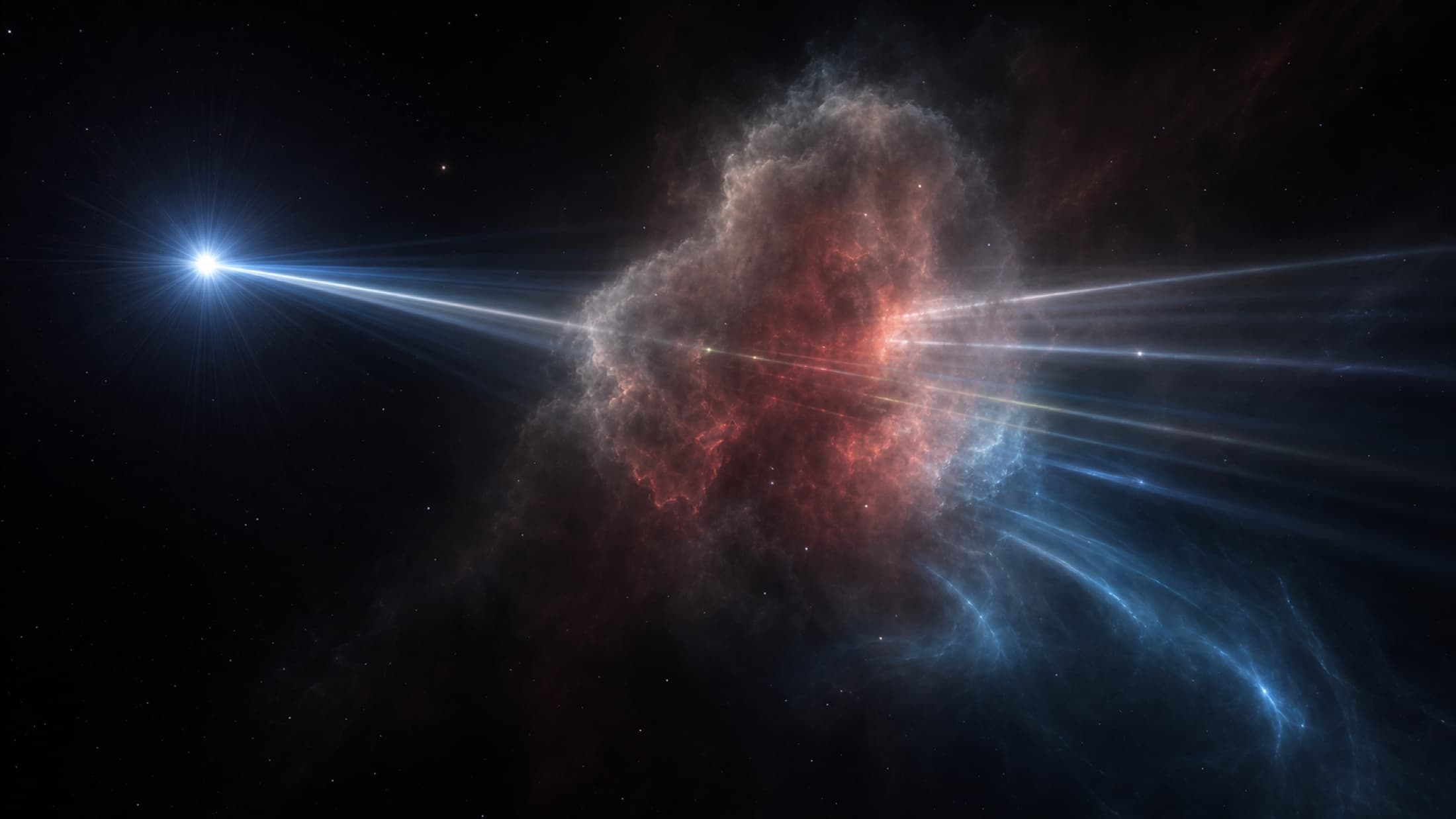
Matter can emit new light, absorb selected energy, transmit light through itself, reflect light from a surface, or scatter light into new directions.
These everyday descriptions come first. Their scientific names are emission, absorption, transmission, reflection, and scattering.
Atoms do not accept every photon energy equally
Electrons in atoms and molecules occupy allowed energy arrangements. A photon with a matching energy can be absorbed; a later transition can release a photon with a characteristic energy.
That selectivity is why spectra contain structured lines instead of losing or gaining all colors equally.
Astronomy begins with changed light, not a remote sample
A telescope records how much light arrives at each position, time, or wavelength. It does not directly hold the distant cloud, atmosphere, or star in the detector.
Scientists compare the measured change with laboratory spectra and physical models, while checking whether dust, geometry, temperature, pressure, or another material could mimic the pattern.
Follow light through matter
Switch among emission, absorption, transmission, reflection, and scattering.
Follow one beam through five possible encounters
Switch interactions and watch the source, matter, outgoing light, and detector remain labeled. The diagram shows causal geometry, not a microscopic simulation.
Absorption
Matter removes part of the incoming light and takes up its energy.
What the detector can establishThe detector records less light at selected wavelengths than the expected background.
A dark wavelength appears after starlight passes through cooler gas. What is directly measured?
Sources and evidence boundary
Vastward wrote this explanation independently and checked it against the official and research sources below. Each source supports a specific part of the evidence chain.
- Reviewed sourceThe Electromagnetic SpectrumNASA ScienceOpen official source
- Reviewed sourceSpectroscopy 101: Light and MatterNASA ScienceOpen official source
- Reviewed sourceSpectroscopy 101: IntroductionNASA ScienceOpen official source