Begin with one question
Wavelength, Frequency, and Energy
Why does making a light wave shorter also make its frequency and photon energy higher?
Use one relationship to connect the distance between wave crests, cycles per second, and photon energy.
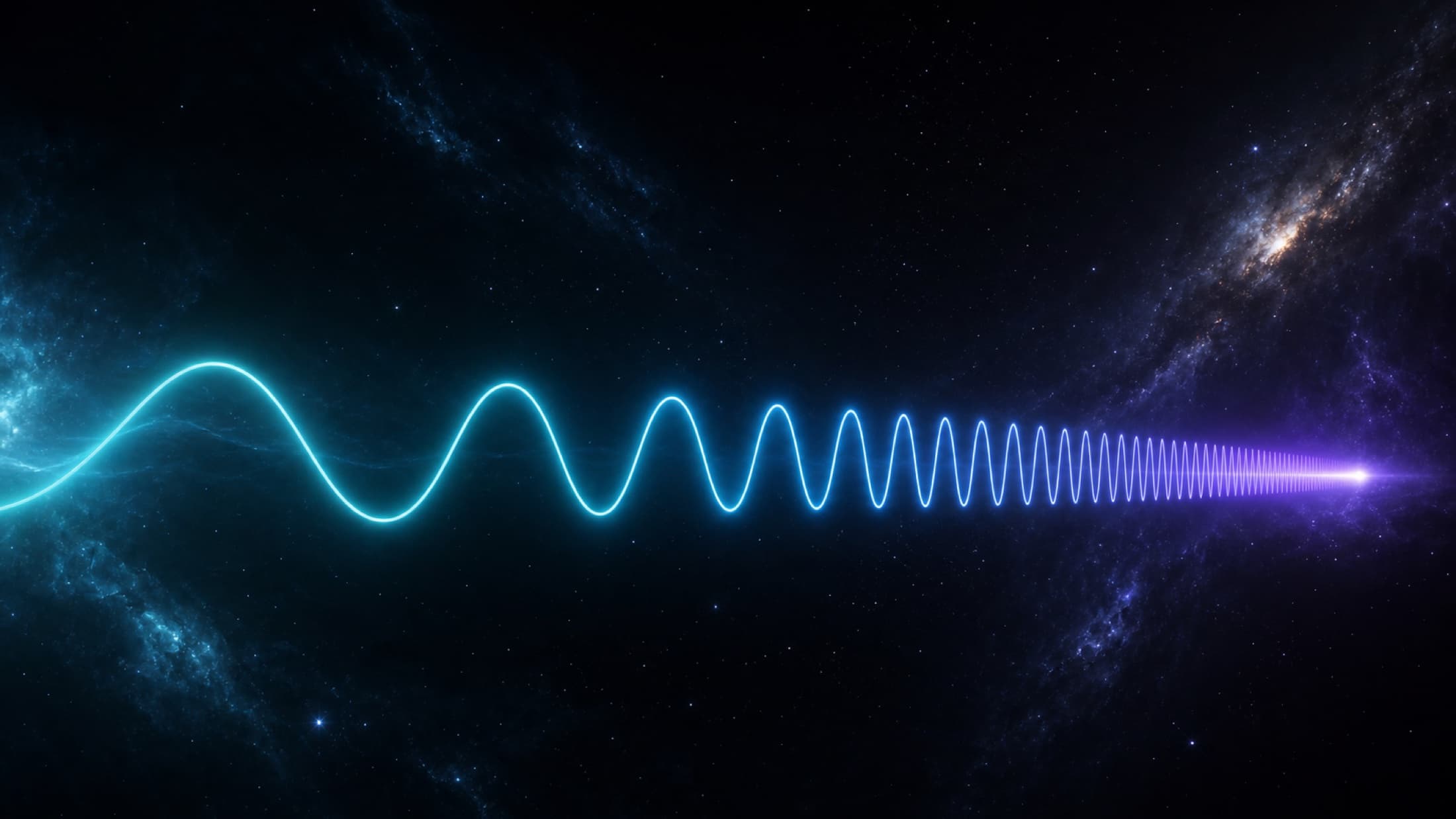
By the end of this lesson, you will be able to
Use one relationship to connect the distance between wave crests, cycles per second, and photon energy.
- 01Translate between wavelength, frequency, and photon energy.
- 02Connect the idea to an observable signal, measurement, or instrument.
- 03Explain what the equations describe without treating the teaching wave sketch as a literal photon path.
Start with spacing and rhythm
Imagine evenly spaced ripples crossing water. The distance from one crest to the next is the wavelength. Count how many crests pass you each second and you have the frequency.
For light in vacuum, the travel speed stays fixed. Wider spacing means fewer cycles per second; tighter spacing means more cycles per second.
The equations connect three views of one signal
Astronomers write c = λf: light speed c equals wavelength λ multiplied by frequency f. They also write E = hf: photon energy E rises with frequency, with h as Planck's constant.
At 500 nanometres, visible light oscillates roughly 600 trillion times each second and each photon carries about 2.5 electronvolts.
The drawn wave is a model, not a winding flight path
The curve in a textbook represents an oscillating electric or magnetic field as light travels forward. It does not mean one photon physically snakes up and down through space.
The model is useful because spacing and rhythm can be measured. The lesson diagram labels both the propagation direction and wavelength so the two ideas cannot be confused.
Link spacing, rhythm, and photon energy
Change representative wavelengths and keep light speed, frequency, and photon energy connected.
Compress the wave without changing light speed
Choose a representative wavelength and watch spacing, frequency, and photon energy change together. The drawing changes cycle density for clarity; it is not a proportional map of the full spectrum.
Green visible light: A familiar middle visible wavelength
If wavelength becomes shorter while light still travels at the same vacuum speed, what must happen?
Sources and evidence boundary
Vastward wrote this explanation independently and checked it against the official and research sources below. Each source supports a specific part of the evidence chain.
- Reviewed sourceThe Electromagnetic SpectrumNASA ScienceOpen official source
- Reviewed sourceAnatomy of an Electromagnetic WaveNASA ScienceOpen official source