
Object profile · GANYMEDE
Ganymede
Largest moon and magnetic ocean-world candidate
The Solar System's largest moon, with its own internally generated magnetic field and evidence for deep water layers.
- Atlas data reviewed
- Editorial stage
- Published
- Visibility
- Public
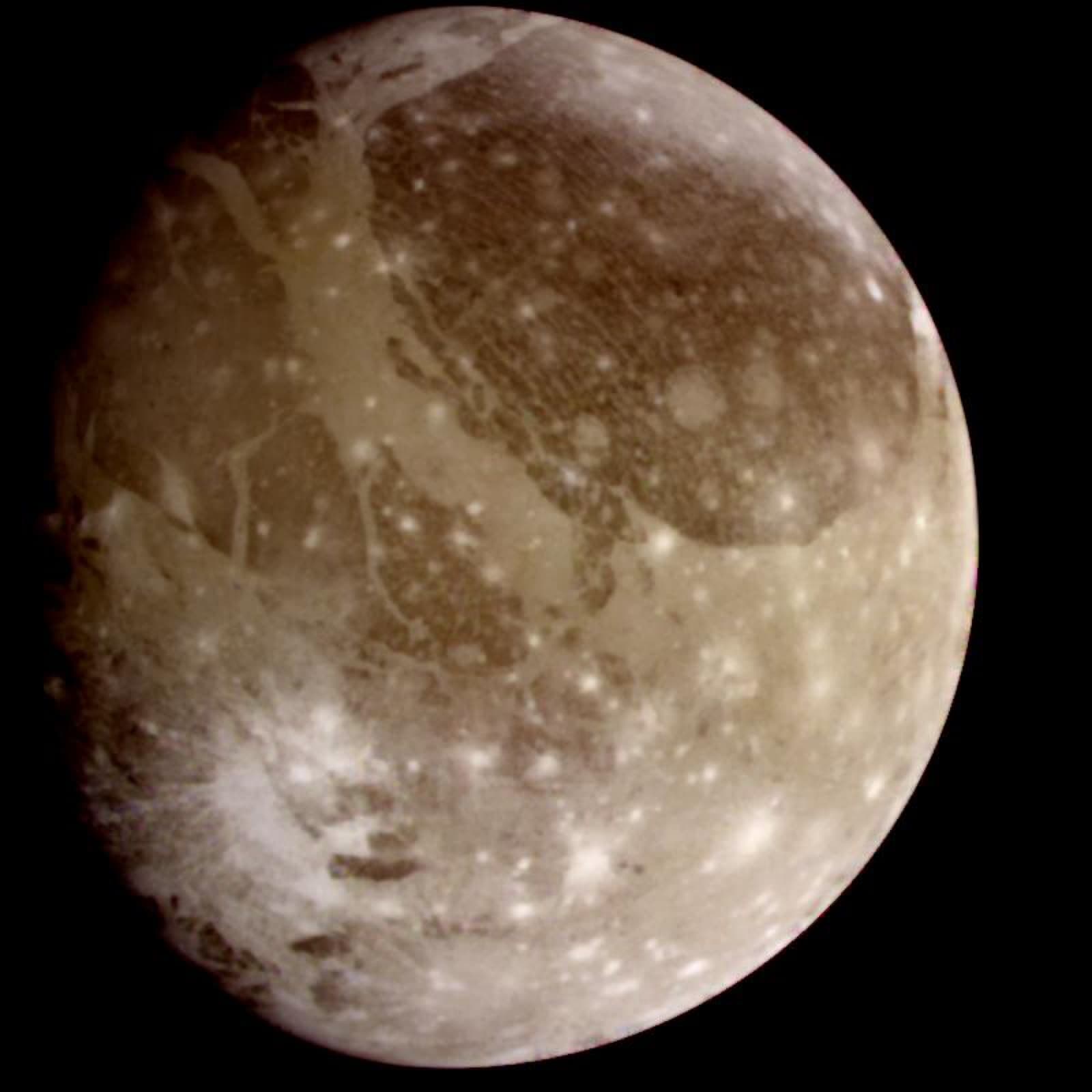 Direct observation
Official natural-color spacecraft observation. The globe is isolated for comparison and is not shown to scale with Jupiter.
NASA/JPL ↗What this world is
Ganymede is bigger than Mercury but much less massive because it contains abundant ice. It is the only known moon with an intrinsic magnetic field.
Why it looks this way now
Auroral and magnetic measurements support a deep salty ocean, possibly arranged with several high-pressure ice layers. The exact stack is a scientific model.
Where it sits
The third Galilean moon and outer member of the Io-Europa-Ganymede resonance.
Swipe sideways to inspect the full map
Ganymede is 3 of 4 profiled Jupiter moons by distance, at a mean center distance of about 1,070,400 km.
The left panel locates Jupiter, dashed lines mark the scale change, and muted orbits and dots represent other profiled moons on the right. Europa is the adjacent profiled moon inside; Callisto is adjacent outside.
Read the numbers
Reference values retain their units, context, evidence state and published uncertainty.
Physical measurements
- Mean radiusglobal mean
- 2,631.2kmCalculated measurementThe mean radius is about 1.51 times the radius of Earth's Moon.
Irregular moons have no single true radius; the mean radius is an equal-volume comparison.
Published uncertainty: ± 1.7 km
JPL tabulated uncertainty for the adopted mean radius.
- Massglobal mean
- 1.481479E23kgCalculated measurementMass is not read from a scale. Motion under gravity constrains GM, from which mass is derived.
Calculated from JPL GM with a conventional gravitational constant, then rounded for display.
Approximate value
Derived from JPL's gravitational parameter GM and a conventional gravitational constant, then rounded.
- Mean densityglobal mean
- 1.9416g/cm³Calculated measurementA rock-ice mixture: much less dense than Io, but denser than nearly pure ice.
This is a whole-body average and cannot by itself prove the composition of every interior layer.
Published uncertainty: ± 0.0038 g/cm³
JPL tabulated uncertainty for the adopted mean density.
- Reference gravitysurface
- 1.4282m/s²Calculated measurementRepresentative surface gravity is about 14.6% of Earth's.
Shape, terrain and local mass distribution make real gravity vary by location.
Approximate value
Calculated from the adopted GM and mean radius. Irregular shape and local terrain can change the actual value.
- Temperaturesurface
- -163°CScientific modelThe exposed surface stays deeply frozen even though internal liquid layers are inferred.
This is a representative surface value and says little about temperature deep below the ice.
Approximate value
Representative surface value; local illumination and latitude produce a broad range.
Orbit and rotation
- Average distancesystem reference
- 1,070,400kmCalculated measurementThis is a representative center-to-center distance between Ganymede and Jupiter.
The real distance changes around an elliptical orbit.
Approximate value
Rounded orbital distance from the moon center to the planet center. The real orbit is not a perfect circle.
- Rotation periodrelative to distant stars
- 7.155Earth daysCalculated measurementTidal locking makes one rotation take nearly the same time as one orbit around the planet.
This is a sidereal rotation, not a local sunrise-to-sunrise solar day.
Approximate value
Rounded synchronous rotation period. The same hemisphere normally faces the primary planet.
- Orbital periodrelative to distant stars
- 7.155Earth daysCalculated measurementThis reports the time for one orbit, not a claim that the path is perfectly circular.
A rounded sidereal period is used for the beginner-facing display.
Approximate value
Rounded sidereal orbital period.
Atmosphere and inside
Atmosphere
Ganymede has a very thin oxygen atmosphere and an extensive magnetosphere, not a breathable air layer.
- Molecular oxygenRelative abundance described; exact fraction not listed
Surface and interior
A metal core and rocky mantle sit below a complex water-rich shell that may alternate liquid and high-pressure ice.
- 1Liquid iron-rich core
An electrically conducting convecting core explains Ganymede's intrinsic magnetic field.
Scientific model - 2Rocky mantle
A dense silicate layer separates the core from the outer water-rich shell.
Scientific model - 3Modeled ocean and high-pressure ice layers
Magnetic and auroral evidence supports salty liquid water, while pressure models allow several ice phases below it.
Scientific model - 4Grooved ice crust
Direct images show old dark terrain beside younger grooved icy terrain.
Direct observation
How we know
Images constrain size, orbital and radio tracking constrain GM, and spectra and thermal emission constrain materials. Every number retains its method and limitation.
- 01Direct observation
Spacecraft imaging and shape reconstruction
Repeated views reveal the limb, terrain, crater record and the shape used to estimate size.
Where this method stops
Lighting, viewing angle and incomplete coverage can hide topography. A mosaic is not a single untouched photograph.
- 02Calculated measurement
Radio tracking and orbital dynamics
Engineers measure spacecraft motion and moon orbits, solve for GM, and then derive mass and gravity.
Where this method stops
The result depends on trajectory coverage and a dynamical model. Very small moons leave weaker gravitational signatures.
- 03Direct observation
Spectroscopy and thermal sensing
The spectrum and thermal glow constrain surface materials, gases and representative temperature.
Where this method stops
A spectrum samples the visible surface or atmosphere. It does not directly photograph deep interior layers.
Evidence key
- Direct observation
- An instrument or sample recorded the phenomenon, with processing still disclosed.
- Calculated measurement
- Observed motion or signal is converted into a physical quantity using equations and reference constants.
- Scientific model
- A tested interpretation that fits observations but is not directly imaged or sampled.
- Vastward explanation
- Original beginner-facing synthesis, traceable to the source records but not itself a measurement.
- Artist visualization
- An interpretive image, not observational evidence.
Missions and instruments
Galileo
Galileo measured Ganymede's magnetic field, gravity and surface, establishing the modern differentiated-ocean model.
Official mission ↗- Solid-State Imaging cameraImages the limb, terrain, color differences and time-dependent surface changes.
- Spacecraft radio scienceMeasures Doppler and range changes that constrain trajectory, gravity and mass.
- Near-Infrared Mapping SpectrometerSeparates light by wavelength to constrain composition, gases and temperature.
Official source trail
Links below are the exact records used for this profile. Access dates are retained with the content.
- 01
NASA Science · official-page
Ganymede Facts
- Source updated
- No source update date published
- Access checked
- 2026-07-31
- 02
NASA Jet Propulsion Laboratory, Solar System Dynamics · dataset
Planetary Satellite Physical Parameters
- Source updated
- No source update date published
- Access checked
- 2026-07-31
- 03
NASA Science Photojournal · image
Ganymede Color Global
- Source updated
- No source update date published
- Access checked
- 2026-07-31
- 04
NASA Science · official-page
Galileo mission
- Source updated
- No source update date published
- Access checked
- 2026-07-31
Continue exploring
Atlas is a starting point. Use these relationships to move into explanation, experiment and mission thinking.