
Object profile · MAKEMAKE
Makemake
Dwarf planet · Kuiper Belt
A methane-coated distant world whose faint moon may one day let us weigh it properly.
- Atlas data reviewed
- Editorial stage
- Published
- Visibility
- Public
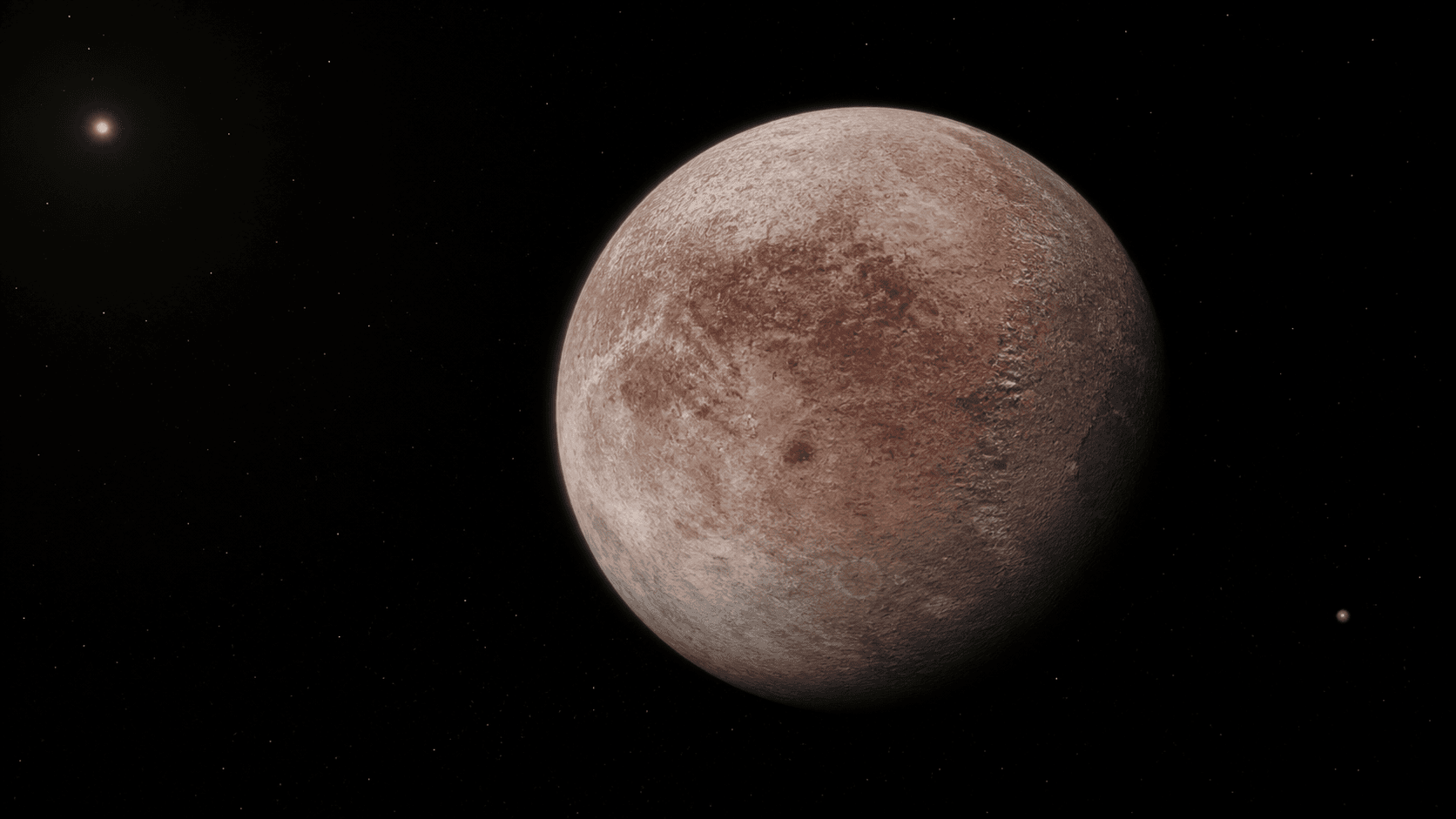 Artist visualization
Artist visualization, not a spacecraft photograph. Scale, surface texture and moon position are illustrative.
Vastward original reconstruction; scientific basis: NASA Science and cited occultation observations ↗What this world is
Makemake is bright enough to reveal surface ice in spectra, yet too far away for detailed terrain images. Its tiny moon is important because a measured moon orbit can turn motion into mass.
Why it looks this way now
No spacecraft has visited. Size comes from thermal data and occultation, rotation from brightness changes, and composition from spectra.
Where it sits
Makemake occupies the classical Kuiper Belt beyond Neptune, receiving less than one five-hundredth of Earth's sunlight.
Swipe sideways to inspect the full map
Makemake orbits the Sun directly at a mean distance of about 45.6 AU; the marker is not a live position.
Neptune provides the outer-planet reference. The shaded zone shows the broad relationship to the Kuiper Belt, while muted dots are other profiled outer-system dwarf planets; horizontal distance is heavily compressed.
Read the numbers
Reference values retain their units, context, evidence state and published uncertainty.
Physical measurements
- Mean radiusglobal mean
- 715.0kmScientific modelSmaller than Earth's Moon.
A global reference radius reconstructed from imaging, thermal data or occultation.
Approximate value
Approximate radius from thermal and occultation constraints.
- Massglobal mean
- 2.6E21kgScientific modelFar below Earth's mass, yet enough gravity to become rounded.
A clearly labeled model estimate pending a secure moon orbit.
Approximate value
Educational model estimate from radius and an assumed 1.7 g/cm³ bulk density; not a secure measured system mass.
- Mean densityglobal mean
- 1.700g/cm³Scientific modelA clue to the relative mixture of rock, water ice and voids.
Density is calculated from mass and volume; it does not reveal a unique interior by itself.
Reported range: 1.4 to 2 g/cm³
- Reference gravitysurface
- 0.34m/s²Scientific modelOnly a few percent of Earth's surface gravity.
A reference value derived from mass and radius.
Approximate value
Derived from the model mass and reference radius; not independently measured.
- Temperaturesurface
- -240°CScientific modelCold enough for volatile compounds to remain as surface ice.
A model-supported representative temperature, not a thermometer reading on the ground.
Approximate value
Representative equilibrium or surface temperature; local and seasonal conditions vary.
Orbit and rotation
- Average distancerelative to the Sun
- 45.600AUCalculated measurementDozens of times farther from the Sun than Earth.
The semi-major-axis reference summarizes an orbit whose actual distance changes.
No uncertainty published in this source table
The selected summary source does not publish a compact uncertainty for this reference value.
- Rotation periodrelative to distant stars
- 22.8266hCalculated measurementMeasured from repeating brightness or surface patterns.
A sidereal rotation period relative to distant stars.
Approximate value
JPL flags the adopted light-curve rotation period as uncertain and potentially subject to revision.
- Orbital periodrelative to the Sun
- 306.60Earth yearsCalculated measurementOne full season cycle lasts many human lifetimes.
Calculated from long-baseline astrometry and a fitted heliocentric orbit.
No uncertainty published in this source table
The selected summary source does not publish a compact uncertainty for this reference value.
Atmosphere and inside
Atmosphere
A stellar occultation ruled out a Pluto-like global atmosphere at the time observed. Local or seasonal gas remains possible.
Surface and interior
A mixed rock-and-ice interior is plausible, but a secure mass and density are not yet available.
- 1Rock-and-ice interior model
Without a secure system mass, proportions of rock and ice remain estimated rather than measured.
Scientific model - 2Methane-rich frozen surface
Spectroscopy shows methane and likely ethane and nitrogen ices across the very cold surface.
Scientific model - 3One known moon: MK2
The moon may eventually provide a better system mass once its orbit is securely measured.
Scientific model
How we know
Size comes from imaging, thermal data or occultation; orbit and rotation from repeated positions and brightness; mass only when gravity leaves a measurable trace.
- 01Calculated measurement
Stellar-occultation shape reconstruction
Multiple observatories time the object's shadow crossing a background star to reconstruct chords across its silhouette.
Where this method stops
A single event samples one orientation and requires a shape model.
- 02Calculated measurement
Mass model pending a moon orbit
Radius and an assumed density provide a provisional educational mass estimate.
Where this method stops
This is not a secure measured mass and must not be presented as one.
- 03Calculated measurement
Thermal radiometry and spectroscopy
Brightness at visible, infrared and thermal wavelengths constrains temperature, reflectivity and surface ices.
Where this method stops
Temperature and size can trade off against albedo, roughness and thermal assumptions.
- 04Calculated measurement
Long-baseline astrometry
Repeated sky positions over years are fitted to a heliocentric orbit.
Where this method stops
Long-period distant objects need many years of observations and future values remain predictions.
- 05Calculated measurement
Rotational light curve
Repeating brightness changes reveal a candidate rotation period.
Where this method stops
Shape, surface markings and viewing angle can create aliases or double-peaked solutions.
Evidence key
- Direct observation
- An instrument or sample recorded the phenomenon, with processing still disclosed.
- Calculated measurement
- Observed motion or signal is converted into a physical quantity using equations and reference constants.
- Scientific model
- A tested interpretation that fits observations but is not directly imaged or sampled.
- Vastward explanation
- Original beginner-facing synthesis, traceable to the source records but not itself a measurement.
- Artist visualization
- An interpretive image, not observational evidence.
Missions and instruments
Hubble Space Telescope
Hubble discovered Makemake's small moon MK2 and helps separate the system's light.
Official mission ↗- Hubble WFC3Resolved images of Makemake and the faint moon MK2.
Official source trail
Links below are the exact records used for this profile. Access dates are retained with the content.
- 01
NASA Science · official-page
Makemake Facts
- Source updated
- No source update date published
- Access checked
- 2026-07-31
- 02
NASA Jet Propulsion Laboratory, Solar System Dynamics · dataset
JPL Small-Body Database Lookup: 136472 Makemake
- Source updated
- No source update date published
- Access checked
- 2026-07-31
- 03
NASA Hubble Space Telescope · image
Makemake and Its Moon
- Source updated
- No source update date published
- Access checked
- 2026-07-31
- 04
Nature · research-paper
Albedo and atmospheric constraints of dwarf planet Makemake
- Source updated
- 2012-11-21
- Access checked
- 2026-07-31
Continue exploring
Atlas is a starting point. Use these relationships to move into explanation, experiment and mission thinking.
Why is it a dwarf planet?
Use Makemake to separate roundness, orbit and orbital clearing—the three ideas behind the classification.
academyCompare the small worlds
Place radius, density and sunlight side by side without pretending every value is equally certain.
lab