
Object profile · NEPTUNE
Neptune
Ice giant
The outermost major planet, a cold blue world with fast winds, changing storms and a warm hidden interior.
- Atlas data reviewed
- Editorial stage
- Published
- Visibility
- Public
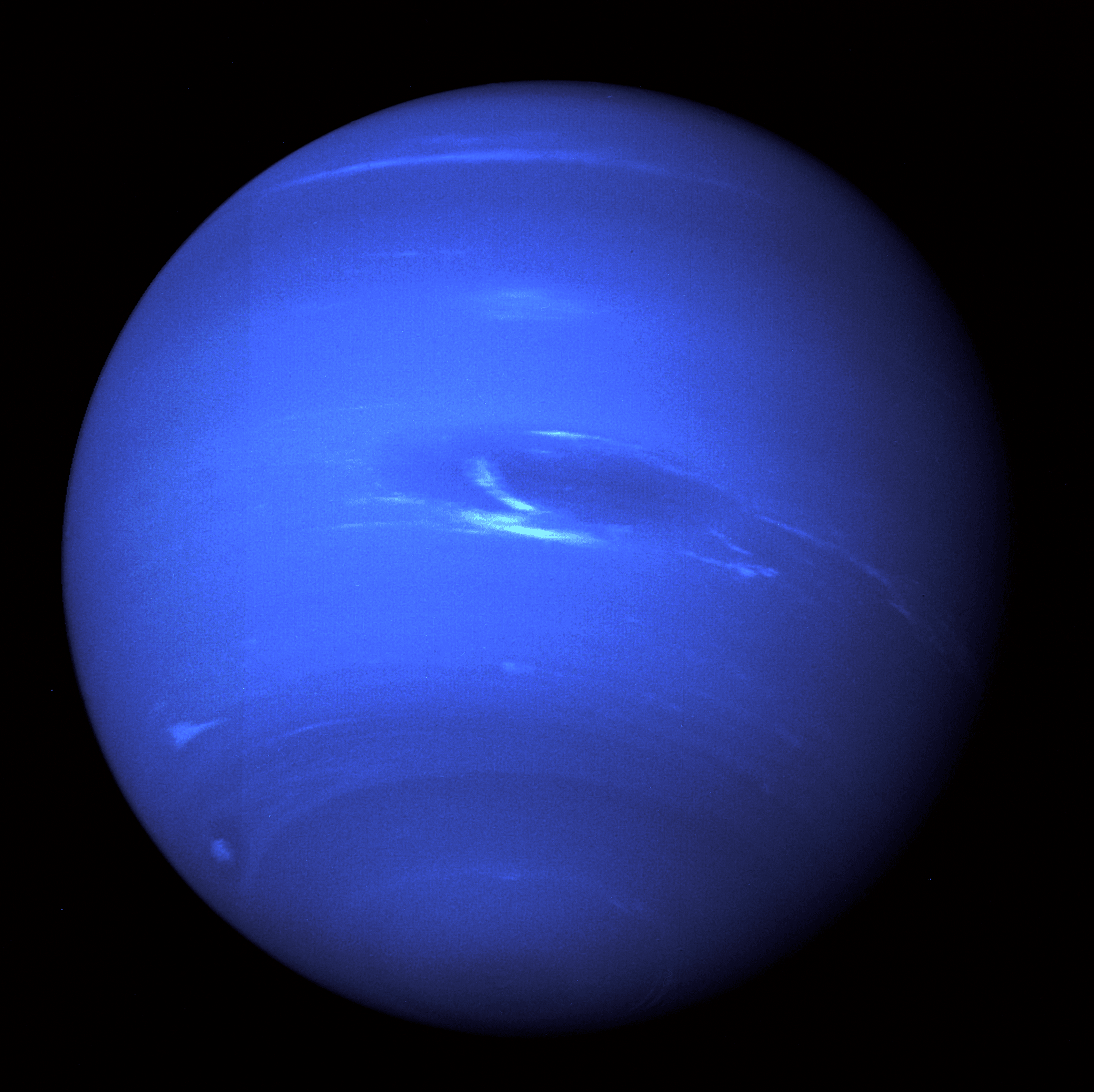 Direct observation
Processed spacecraft colour image. Filter combinations and contrast shape the familiar blue appearance; it is not one unaltered exposure or a size and distance scale.
NASA/Caltech ↗What this world is
Neptune receives very little sunlight, yet its atmosphere is remarkably active. Bright methane-ice clouds race above dark storm systems, and the planet gives off more energy than it absorbs from the Sun. Like Uranus, it has no solid surface.
Why it looks this way now
Residual formation heat and ongoing contraction likely help drive convection and weather, but the detailed energy path is modeled. Methane absorbs red wavelengths, while haze and deeper absorbers also influence colour. Modern reprocessing shows the familiar vivid blue can overstate its visual difference from Uranus.
Where it sits
Neptune is the eighth planet from the Sun, averaging about 4.5 billion kilometres or 30 astronomical units away. One orbit lasts almost 165 Earth years.
Swipe sideways to inspect the full map
The blue orbit, marker and name locate Neptune without implying its live position today.
Uranus is immediately inside; it is the outermost planet. The lower sequence preserves all eight positions.
Read the numbers
Reference values retain their units, context, evidence state and published uncertainty.
Physical measurements
- Mean radiusglobal mean
- 24,622kmCalculated measurementAbout 3.9 Earth radii.
An atmospheric reference radius, not solid ground.
Published uncertainty: ± 19 km
JPL tabulated uncertainty at an adopted atmospheric reference level.
- Massglobal mean
- 1.024092E26kgCalculated measurementAbout 17 Earth masses.
Moon orbits and Voyager tracking constrain total mass.
Published uncertainty: ± 4.8E21 kg
Converted from the uncertainty in the JPL 10^24 kilogram table.
- Mean densityglobal mean
- 1.638g/cm³Calculated measurementThe densest of the four giant planets.
Bulk density still does not uniquely specify the internal mixture.
Published uncertainty: ± 0.004 g/cm³
Calculated from adopted mass and volume.
- Reference gravityequatorial reference
- 11.15m/s²Calculated measurementAbout 1.14 times Earth's at the reference level.
There is no solid surface to stand on.
No uncertainty published in this source table
Reference gravity at an adopted atmospheric level; Neptune has no solid surface.
- Temperaturevisible cloud level
- -214°CCalculated measurementA representative value near the one-bar level.
Higher clouds and deeper layers have different temperatures.
Approximate value
Representative temperature near the one-bar atmospheric level; altitude, latitude and season matter.
- Temperaturedeep interior model
- 5,127°CScientific modelA modeled deep value, not a probe reading.
Composition and thermal histories remain uncertain.
Approximate value
Representative modeled deep-interior temperature near 5,400 kelvin; no direct probe has reached this layer.
Orbit and rotation
- Average distancerelative to the Sun
- 4,500,000,000kmCalculated measurementAbout 30 times Earth's solar distance.
Sunlight is roughly one 900th as intense.
Approximate value
Rounded average distance, about 30 astronomical units.
- Rotation periodrelative to distant stars
- 0.67125Earth daysCalculated measurementAbout 16 hours 7 minutes.
Visible winds rotate differently from the adopted bulk period.
No uncertainty published in this source table
Adopted bulk rotation period; visible clouds rotate differentially.
- Orbital periodrelative to the Sun
- 164.79132Earth yearsCalculated measurementNeptune completed its first full orbit since discovery in 2011.
A year lasts almost 165 Earth years.
No uncertainty published in this source table
Sidereal orbital period from astrometry and dynamical ephemerides.
Atmosphere and inside
Atmosphere
Hydrogen and helium dominate, with methane and trace gases. Strong winds, high clouds and transient dark vortices occur across a deep atmosphere that grades into dense fluid.
- HydrogenRelative abundance described; exact fraction not listed
- HeliumRelative abundance described; exact fraction not listed
- Methane and trace gasesRelative abundance described; exact fraction not listed
Surface and interior
Models place a volatile-rich conducting fluid layer above a denser core region. Gravity, magnetic and heat data constrain possibilities but do not directly image the interior.
No solid surface: layers transition gradually as pressure and temperature rise.
- 1Dense core region
Models allow a compact rock-and-metal-rich centre, but its boundary is not directly measured.
Scientific model - 2Hot volatile-rich fluid mantle
Water, methane and ammonia components are modeled in a hot dense conducting mixture. Ice giant refers to elemental inventory, not frozen blocks.
Scientific model - 3Hydrogen-helium envelope
A lighter outer envelope compresses gradually into dense fluid, with no solid landing surface.
Scientific model - 4Methane clouds and active weather
Spacecraft and telescopes directly see bright high clouds, bands and changing dark vortices in the upper atmosphere.
Direct observation
How we know
Voyager 2 supplied the sole close encounter. Filtered imaging, infrared spectra, radio tracking and occultations combine with long-term telescope monitoring and astrometry.
- 01Direct observation
Multifilter imaging
Voyager 2 and telescopes record reflected light to track clouds, vortices, rings and limb geometry.
Where this method stops
Filter mapping and contrast processing alter appearance; a single 1989 flyby sampled a brief season.
- 02Calculated measurement
Astrometry and flyby radio tracking
Long-term sky positions establish the orbit; Voyager Doppler and moon motions constrain mass and gravity.
Where this method stops
One close flyby leaves the gravity field and rotation less precise than for planets with orbiters.
- 03Calculated measurement
Infrared spectroscopy and radiometry
Thermal and reflected spectra constrain gases, clouds, temperatures and the planet's strong internal heat output.
Where this method stops
Retrievals sense broad pressure layers and depend on cloud opacity and radiative-transfer models.
- 04Scientific model
Interior and thermal-evolution modeling
Mass, shape, gravity, magnetic field and emitted heat are tested against candidate compositions and histories.
Where this method stops
Sparse gravity harmonics permit multiple core sizes, mixing profiles and thermal histories.
Evidence key
- Direct observation
- An instrument or sample recorded the phenomenon, with processing still disclosed.
- Calculated measurement
- Observed motion or signal is converted into a physical quantity using equations and reference constants.
- Scientific model
- A tested interpretation that fits observations but is not directly imaged or sampled.
- Vastward explanation
- Original beginner-facing synthesis, traceable to the source records but not itself a measurement.
- Artist visualization
- An interpretive image, not observational evidence.
Missions and instruments
Voyager 2
The only spacecraft to visit Neptune, measuring its weather, rings, moons, gravity, magnetic field and plasma environment during the 1989 flyby.
Official mission ↗- Voyager Imaging Science SubsystemFiltered visible-light images of Neptune, its weather, rings and moons.
- Voyager radio scienceDoppler motion and occultations used for gravity, atmospheric profiles and ring structure.
- Infrared Interferometer Spectrometer and RadiometerThermal spectra, temperatures and atmospheric energy balance.
Official source trail
Links below are the exact records used for this profile. Access dates are retained with the content.
- 01
NASA Jet Propulsion Laboratory, Solar System Dynamics · dataset
Planetary Physical Parameters
- Source updated
- No source update date published
- Access checked
- 2026-07-30
- 02
NASA Science · official-page
Neptune Facts
- Source updated
- 2025-06-26
- Access checked
- 2026-07-30
- 03
NASA Science · image
Neptune (Voyager 2)
- Source updated
- 2025-08-28
- Access checked
- 2026-07-30
- 04
NASA Science · official-page
Voyager 2
- Source updated
- 2026-01-07
- Access checked
- 2026-07-30
Continue exploring
Atlas is a starting point. Use these relationships to move into explanation, experiment and mission thinking.
Drive weather far from the Sun
Balance weak sunlight against internal heat and atmospheric motion.
labRebuild Neptune's colour
Compare filter mappings and separate spectral evidence from presentation.
labCompare the ice giants
Ask why similar sizes can hide different heat flows and histories.
lab