
Object profile · PHOEBE
Phoebe
Distant retrograde irregular moon of Saturn
A dark, cratered moon travelling backward around Saturn—strong evidence that it was captured from elsewhere.
- Atlas data reviewed
- Editorial stage
- Published
- Visibility
- Public
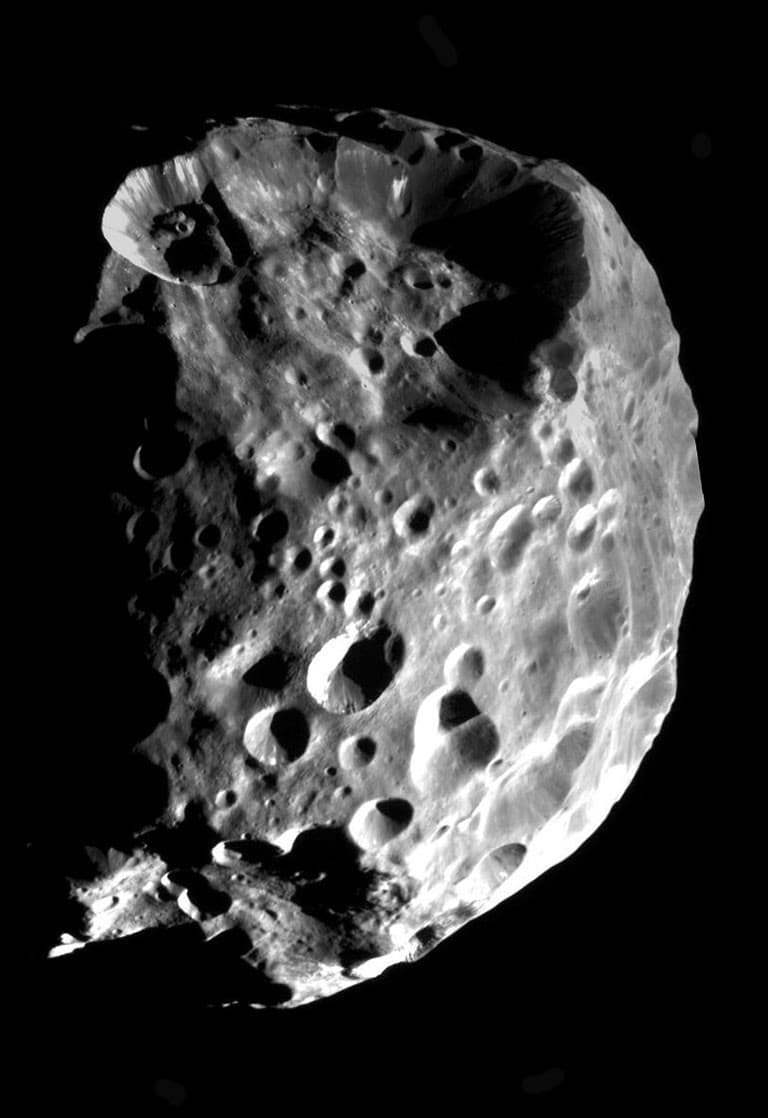 Direct observation
Official grayscale two-frame mosaic with no enhancement reported for this release. Bright patches can include over-exposure and exposed ice-rich material.
NASA/JPL/Space Science Institute ↗What this world is
Most large Saturnian moons circle near the planet's equator in the same direction. Phoebe approaches the system like an outsider: far away, strongly tilted and moving backward. Gravity likely captured it after it formed elsewhere.
Why it looks this way now
Cassini's 2004 flyby directly mapped dark terrain, bright excavated ice, water ice and carbon dioxide signatures. The retrograde orbit and composition support capture from the outer solar system, but do not prove one exact birthplace.
Where it sits
A remote irregular moon nearly 13 million kilometres from Saturn, orbiting far outside Iapetus on a steeply inclined retrograde path.
Swipe sideways to inspect the full map
Phoebe is 9 of 9 profiled Saturn moons by distance, at a mean center distance of about 12,952,000 km.
The left panel locates Saturn, dashed lines mark the scale change, and muted orbits and dots represent other profiled moons on the right. Iapetus is the adjacent profiled moon inside; it is the outermost profiled moon in the system.
Read the numbers
Reference values retain their units, context, evidence state and published uncertainty.
Physical measurements
- Mean radiusglobal mean
- 106.5kmCalculated measurementThe mean radius is about 0.061 times the radius of Earth's Moon.
Irregular moons have no single true radius; the mean radius is an equal-volume comparison.
Published uncertainty: ± 0.7 km
JPL tabulated uncertainty for the adopted mean radius.
- Massglobal mean
- 8.312332E18kgCalculated measurementMass is not read from a scale. Motion under gravity constrains GM, from which mass is derived.
Calculated from JPL GM with a conventional gravitational constant, then rounded for display.
Approximate value
Derived from JPL's gravitational parameter GM and a conventional gravitational constant, then rounded.
- Mean densityglobal mean
- 1.6428g/cm³Calculated measurementDenser than Saturn's ice-rich regular moons, consistent with a mixed body that did not form in the same local environment.
This is a whole-body average and cannot by itself prove the composition of every interior layer.
Published uncertainty: ± 0.0326 g/cm³
JPL tabulated uncertainty for the adopted mean density.
- Reference gravitysurface
- 0.048914m/s²Calculated measurementRepresentative surface gravity is about 0.50% of Earth's.
Shape, terrain and local mass distribution make real gravity vary by location.
Approximate value
Calculated from the adopted GM and mean radius. Irregular shape and local terrain can change the actual value.
- Temperatureverified station extreme
- -161°CDirect observationThe surface can fall by more than 30 K between afternoon and pre-dawn because loose material stores little heat.
The displayed value is a measured equatorial afternoon peak; night, shadow and higher latitudes are much colder.
Approximate value
Cassini CIRS measured an equatorial afternoon peak near 112 K (-161 °C) and pre-dawn values near 78 K (-195 °C). The displayed value is the measured warm extreme, not a global mean.
Orbit and rotation
- Average distancesystem reference
- 12,952,000kmCalculated measurementThis is a representative center-to-center distance between Phoebe and Saturn.
The real distance changes around an elliptical orbit.
Approximate value
Rounded orbital distance from the moon center to the planet center. The real orbit is not a perfect circle.
- Rotation periodrelative to distant stars
- 0.3864Earth daysCalculated measurementPhoebe spins in about nine hours while taking roughly 18 months to orbit Saturn, so it does not keep one face toward the planet.
This is a sidereal rotation, not a local sunrise-to-sunrise solar day.
Approximate value
Rounded roughly nine-hour rotation measured from changing brightness and spacecraft observations; Phoebe is not synchronously locked to Saturn.
- Orbital periodrelative to distant stars
- 550.31Earth daysCalculated measurementThis reports duration; Phoebe's direction is opposite Saturn's rotation.
A rounded sidereal period is used for the beginner-facing display.
Approximate value
Rounded sidereal period. Phoebe travels opposite Saturn's rotation; the positive number reports duration, not direction.
Atmosphere and inside
Atmosphere
Phoebe has no persistent atmosphere. Its small gravity cannot retain a substantial gas layer.
Surface and interior
Phoebe is best treated as a mixed ice-rock body with a thin dark outer coating. Its captured origin is inferred from orbit and composition, not visible as an interior layer.
- 1Mixed ice-and-rock interior
Bulk density and spectral composition support more rock than in many regular Saturnian moons, but no mission has mapped a sharp internal core boundary.
Scientific model - 2Dark coating over brighter ice-rich material
Cassini directly observed a dark cratered surface where impacts and landslides expose brighter material likely rich in ice.
Direct observation
How we know
Images constrain size, orbital and radio tracking constrain GM, and spectra and thermal emission constrain materials. Every number retains its method and limitation.
- 01Direct observation
Spacecraft imaging and shape reconstruction
Repeated views reveal the limb, terrain, crater record and the shape used to estimate size.
Where this method stops
Lighting, viewing angle and incomplete coverage can hide topography. A mosaic is not a single untouched photograph.
- 02Calculated measurement
Radio tracking and orbital dynamics
Engineers measure spacecraft motion and moon orbits, solve for GM, and then derive mass and gravity.
Where this method stops
The result depends on trajectory coverage and a dynamical model. Very small moons leave weaker gravitational signatures.
- 03Direct observation
Spectroscopy and thermal sensing
The spectrum and thermal glow constrain surface materials, gases and representative temperature.
Where this method stops
A spectrum samples the visible surface or atmosphere. It does not directly photograph deep interior layers.
Evidence key
- Direct observation
- An instrument or sample recorded the phenomenon, with processing still disclosed.
- Calculated measurement
- Observed motion or signal is converted into a physical quantity using equations and reference constants.
- Scientific model
- A tested interpretation that fits observations but is not directly imaged or sampled.
- Vastward explanation
- Original beginner-facing synthesis, traceable to the source records but not itself a measurement.
- Artist visualization
- An interpretive image, not observational evidence.
Missions and instruments
Cassini-Huygens
Cassini performed the only close Phoebe flyby, measuring mass, thermal behavior and composition while returning high-resolution mosaics.
Official mission ↗- Imaging Science SubsystemImages the limb, terrain, color differences and time-dependent surface changes.
- Spacecraft radio scienceMeasures Doppler and range changes that constrain trajectory, gravity and mass.
- Visual and Infrared Mapping SpectrometerSeparates light by wavelength to constrain composition, gases and temperature.
Official source trail
Links below are the exact records used for this profile. Access dates are retained with the content.
- 01
NASA Science · official-page
Phoebe
- Source updated
- No source update date published
- Access checked
- 2026-07-31
- 02
NASA Jet Propulsion Laboratory, Solar System Dynamics · dataset
Planetary Satellite Physical Parameters
- Source updated
- No source update date published
- Access checked
- 2026-07-31
- 03
NASA Science Photojournal · image
The Face of Phoebe, PIA06064
- Source updated
- No source update date published
- Access checked
- 2026-07-31
- 04
NASA Science · official-page
Cassini mission
- Source updated
- No source update date published
- Access checked
- 2026-07-31
- 05
NASA Science Photojournal · official-page
Phoebe Temperature Maps
- Source updated
- No source update date published
- Access checked
- 2026-07-31
Continue exploring
Atlas is a starting point. Use these relationships to move into explanation, experiment and mission thinking.
Understand moon systems
Place Phoebe back inside Saturn's moon system and connect orbit, tides and resonance.
academyCompare the major moons
Compare size, density, gravity and orbit without treating similar colors as identical composition.
lab