
Object profile · TITAN
Titan
Large moon with a nitrogen atmosphere and hydrocarbon seas
A hazy world with weather, dunes, rivers and seas made of hydrocarbons, plus an inferred water ocean below.
- Atlas data reviewed
- Editorial stage
- Published
- Visibility
- Public
 Direct observation
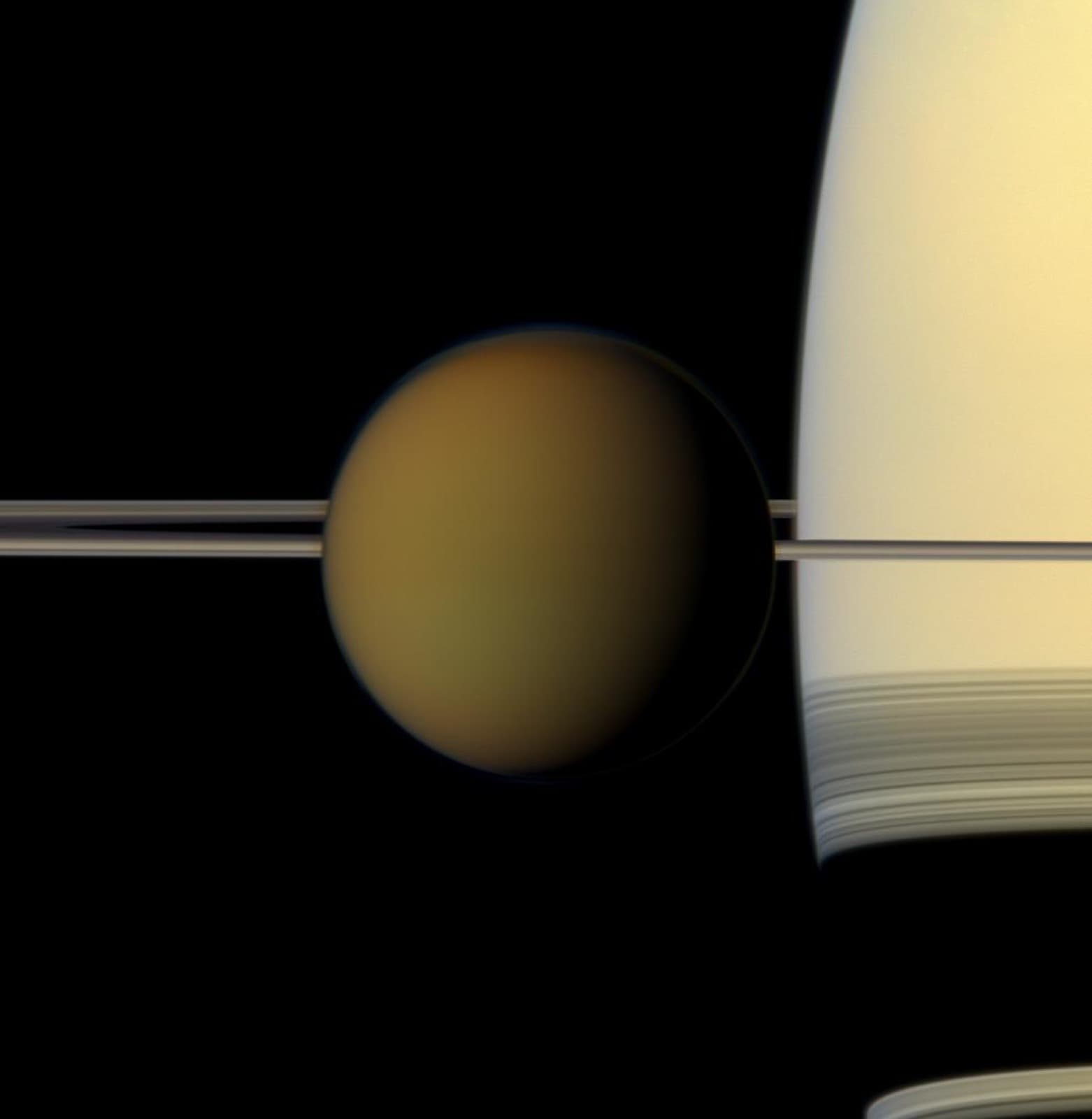
Official natural-color spacecraft image. Saturn and Titan share the frame, but the crop is not intended as a precise scale diagram.
NASA/JPL-Caltech/Space Science Institute ↗What this world is
Titan is the only moon with a thick atmosphere and the only place beyond Earth known to have stable surface liquids. Those liquids are methane and ethane, not water.
Why it looks this way now
Cassini radar mapped lakes, seas, dunes and channels through the haze, while Huygens landed and sampled the atmosphere. A buried water ocean is inferred, and no life has been detected.
Where it sits
Saturn's largest moon, orbiting beyond the main rings and dominating much of the moon system's mass.
Swipe sideways to inspect the full map
Titan is 6 of 9 profiled Saturn moons by distance, at a mean center distance of about 1,221,870 km.
The left panel locates Saturn, dashed lines mark the scale change, and muted orbits and dots represent other profiled moons on the right. Rhea is the adjacent profiled moon inside; Hyperion is adjacent outside.
Read the numbers
Reference values retain their units, context, evidence state and published uncertainty.
Physical measurements
- Mean radiusglobal mean
- 2,574.76kmCalculated measurementThe mean radius is about 1.48 times the radius of Earth's Moon.
Irregular moons have no single true radius; the mean radius is an equal-volume comparison.
Published uncertainty: ± 0.02 km
JPL tabulated uncertainty for the adopted mean radius.
- Massglobal mean
- 1.34518E23kgCalculated measurementMass is not read from a scale. Motion under gravity constrains GM, from which mass is derived.
Calculated from JPL GM with a conventional gravitational constant, then rounded for display.
Approximate value
Derived from JPL's gravitational parameter GM and a conventional gravitational constant, then rounded.
- Mean densityglobal mean
- 1.8814g/cm³Calculated measurementA rock-ice mixture, less dense than Ganymede despite their similar size.
This is a whole-body average and cannot by itself prove the composition of every interior layer.
Published uncertainty: ± 0.0001 g/cm³
JPL tabulated uncertainty for the adopted mean density.
- Reference gravitysurface
- 1.3543m/s²Calculated measurementRepresentative surface gravity is about 13.8% of Earth's.
Shape, terrain and local mass distribution make real gravity vary by location.
Approximate value
Calculated from the adopted GM and mean radius. Irregular shape and local terrain can change the actual value.
- Temperaturesurface
- -179°CDirect observationCold enough for methane and ethane to flow as liquids on the surface.
The representative surface temperature enables a methane weather cycle, not liquid surface water.
Approximate value
Representative surface temperature measured by remote sensing and the Huygens landing environment.
Orbit and rotation
- Average distancesystem reference
- 1,221,870kmCalculated measurementThis is a representative center-to-center distance between Titan and Saturn.
The real distance changes around an elliptical orbit.
Approximate value
Rounded orbital distance from the moon center to the planet center. The real orbit is not a perfect circle.
- Rotation periodrelative to distant stars
- 15.945Earth daysCalculated measurementTidal locking makes one rotation take nearly the same time as one orbit around the planet.
This is a sidereal rotation, not a local sunrise-to-sunrise solar day.
Approximate value
Rounded synchronous rotation period. The same hemisphere normally faces the primary planet.
- Orbital periodrelative to distant stars
- 15.945Earth daysCalculated measurementThis reports the time for one orbit, not a claim that the path is perfectly circular.
A rounded sidereal period is used for the beginner-facing display.
Approximate value
Rounded sidereal orbital period.
Atmosphere and inside
Atmosphere
Titan's dense atmosphere is mostly nitrogen with methane and trace gases. The approximate percentages vary by altitude and source convention.
- Nitrogen95%
- Methane5%
Surface and interior
Titan likely combines a mixed rock-ice interior, a buried water-rich ocean, a thick ice shell and an organic-rich surface.
- 1Rock and high-pressure ice interior
Gravity and rotation data support a dense mixed interior rather than a simple exposed rock core.
Scientific model - 2Inferred water-rich ocean
Gravity, shape and rotational response are consistent with a subsurface liquid-water layer.
Scientific model - 3Water-ice shell
A thick ice shell separates the buried water layer from the hydrocarbon landscape.
Scientific model - 4Organic-rich surface
Radar and landing images directly reveal dunes, channels, pebbles and polar seas under the haze.
Direct observation
How we know
Images constrain size, orbital and radio tracking constrain GM, and spectra and thermal emission constrain materials. Every number retains its method and limitation.
- 01Direct observation
Spacecraft imaging and shape reconstruction
Repeated views reveal the limb, terrain, crater record and the shape used to estimate size.
Where this method stops
Lighting, viewing angle and incomplete coverage can hide topography. A mosaic is not a single untouched photograph.
- 02Calculated measurement
Radio tracking and orbital dynamics
Engineers measure spacecraft motion and moon orbits, solve for GM, and then derive mass and gravity.
Where this method stops
The result depends on trajectory coverage and a dynamical model. Very small moons leave weaker gravitational signatures.
- 03Direct observation
Spectroscopy and thermal sensing
The spectrum and thermal glow constrain surface materials, gases and representative temperature.
Where this method stops
A spectrum samples the visible surface or atmosphere. It does not directly photograph deep interior layers.
Evidence key
- Direct observation
- An instrument or sample recorded the phenomenon, with processing still disclosed.
- Calculated measurement
- Observed motion or signal is converted into a physical quantity using equations and reference constants.
- Scientific model
- A tested interpretation that fits observations but is not directly imaged or sampled.
- Vastward explanation
- Original beginner-facing synthesis, traceable to the source records but not itself a measurement.
- Artist visualization
- An interpretive image, not observational evidence.
Missions and instruments
Cassini-Huygens
Cassini mapped Titan through haze with radar while Huygens descended, measured the atmosphere and returned surface images.
Official mission ↗- Imaging Science SubsystemImages the limb, terrain, color differences and time-dependent surface changes.
- Spacecraft radio scienceMeasures Doppler and range changes that constrain trajectory, gravity and mass.
- Visual and Infrared Mapping SpectrometerSeparates light by wavelength to constrain composition, gases and temperature.
Official source trail
Links below are the exact records used for this profile. Access dates are retained with the content.
- 01
NASA Science · official-page
Titan Facts
- Source updated
- No source update date published
- Access checked
- 2026-07-31
- 02
NASA Jet Propulsion Laboratory, Solar System Dynamics · dataset
Planetary Satellite Physical Parameters
- Source updated
- No source update date published
- Access checked
- 2026-07-31
- 03
NASA Science Photojournal · image
Titan and Saturn's Rings, PIA14909
- Source updated
- No source update date published
- Access checked
- 2026-07-31
- 04
NASA Science · official-page
Cassini mission
- Source updated
- No source update date published
- Access checked
- 2026-07-31
Continue exploring
Atlas is a starting point. Use these relationships to move into explanation, experiment and mission thinking.