
Object profile · MERCURY
Mercury
Rocky terrestrial planet
The smallest planet and the closest to the Sun, with an old cratered surface, a huge metal core and almost no insulating atmosphere.
- Atlas data reviewed
- Editorial stage
- Published
- Visibility
- Public
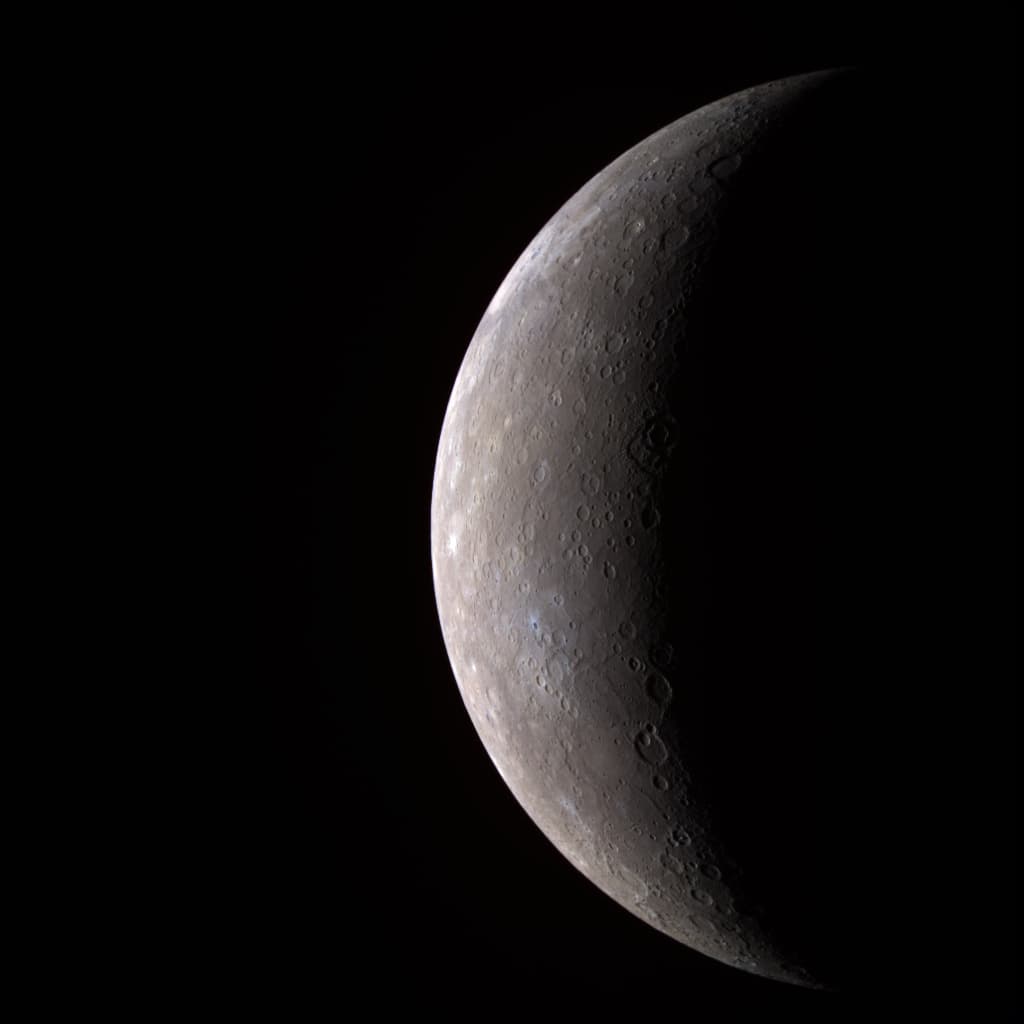 Direct observation
Processed spacecraft observation, not natural colour. Images through 1,000, 700 and 430 nanometre filters were assigned to red, green and blue, so the subtle colours emphasize surface differences beyond an ordinary human-eye view.
NASA/Johns Hopkins University Applied Physics Laboratory/Carnegie Institution of Washington ↗What this world is
Mercury can look Moon-like, but it is a planet moving deep inside the Sun's gravity. Its ground bakes in daylight and freezes at night because only a collision-fed exosphere sits above it. One slow turn relative to the stars takes almost 59 Earth days.
Why it looks this way now
Mercury lost heat and shrank, leaving long cliffs where the crust buckled. Ancient impacts preserved a crowded crater record. A very large iron-rich core helps explain its high density and still powers a weak global magnetic field.
Where it sits
Mercury is the first planet from the Sun, averaging about 58 million kilometres or 0.39 astronomical unit away. It completes an orbit in 88 Earth days.
Swipe sideways to inspect the full map
The blue orbit, marker and name locate Mercury without implying its live position today.
It is the innermost planet; Venus is immediately outside. The lower sequence preserves all eight positions.
Read the numbers
Reference values retain their units, context, evidence state and published uncertainty.
Physical measurements
- Mean radiusglobal mean
- 2,439.4kmCalculated measurementAbout 38 percent of Earth's radius.
A global average smooths over basins, mountains and Mercury's slight shape differences.
Published uncertainty: ± 0.1 km
JPL tabulated uncertainty for the adopted mean radius.
- Massglobal mean
- 3.30103E23kgCalculated measurementAbout 5.5 percent of Earth's mass.
Mass is inferred from how Mercury pulls on spacecraft and other bodies.
Published uncertainty: ± 2.1E19 kg
Converted from the uncertainty in the JPL 10^24 kilogram table.
- Mean densityglobal mean
- 5.4289g/cm³Calculated measurementNearly as dense as Earth despite being much smaller.
That high bulk density points to an unusually large metal fraction.
Published uncertainty: ± 0.0007 g/cm³
Calculated from the adopted mass and volume.
- Reference gravitysurface
- 3.70m/s²Calculated measurementAbout 38 percent of Earth's surface gravity.
A 60-kilogram Earth scale would respond as if about 23 kilograms, though mass itself is unchanged.
No uncertainty published in this source table
Representative surface gravity derived from Mercury's mass and reference radius; local terrain changes it slightly.
- Temperatureverified station extreme
- 430°CDirect observationHot enough to melt lead.
This refers to sunlit equatorial ground, not every place and time.
Approximate value
NASA gives about 430 degrees Celsius for sunlit equatorial terrain; temperature varies with latitude, slope and local time.
- Temperatureverified station extreme
- -180°CDirect observationColder than a household freezer by more than 150 degrees.
Without a substantial atmosphere, stored daytime heat escapes quickly.
Approximate value
NASA gives about minus 180 degrees Celsius on the nightside; permanently shadowed polar terrain can be colder.
Orbit and rotation
- Average distancerelative to the Sun
- 58,000,000kmCalculated measurementAbout 39 percent of Earth's average solar distance.
Its eccentric orbit ranges noticeably nearer to and farther from the Sun.
Approximate value
Rounded average distance, about 0.39 astronomical unit; Mercury's actual distance changes substantially along its eccentric orbit.
- Rotation periodrelative to distant stars
- 58.6462Earth daysCalculated measurementOne star-relative turn takes almost 59 Earth days.
Because Mercury also moves around the Sun, sunrise to sunrise lasts 176 Earth days.
No uncertainty published in this source table
Sidereal rotation period from JPL's adopted physical parameters.
- Orbital periodrelative to the Sun
- 0.2408467Earth yearsCalculated measurementOne Mercury year is only 88 Earth days.
Closer planets travel faster and around a shorter orbit.
No uncertainty published in this source table
Sidereal orbital period from long-baseline astrometry and dynamical ephemerides.
Atmosphere and inside
Atmosphere
Mercury has no weather-forming atmosphere. It has a surface-bounded exosphere of atoms such as oxygen, sodium, hydrogen, helium and potassium, supplied and removed by sunlight, solar wind and impacts.
- Oxygen, sodium, hydrogen, helium, potassium and other trace atomsRelative abundance described; exact fraction not listed
Surface and interior
Cameras directly map the rocky crust. The unusually large metallic core and thin silicate shell come from gravity, spin, magnetic, chemical and topographic constraints combined in interior models.
- 1Large metallic core
Gravity, rotation and magnetic-field data support an iron-rich core occupying much of Mercury's radius. Its exact solid and liquid fractions remain model-dependent.
Scientific model - 2Rocky mantle and crust
A comparatively thin silicate shell surrounds the core. MESSENGER chemistry and topography constrain it without drilling through the crust.
Scientific model - 3Cratered surface
Impact basins, smooth plains, cliffs and polar shadow deposits are mapped directly by spacecraft cameras, laser altimetry and other instruments.
Direct observation
How we know
Images and laser ranging measure shape and relief. Earth radar and spacecraft radio tracking recover rotation, orbit, mass and gravity. Thermal and spectral sensors read emitted and reflected light.
- 01Calculated measurement
Imaging and laser altimetry
Overlapping images map surface features and the visible limb, while laser pulse travel times measure topography.
Where this method stops
Illumination and viewing geometry affect images, and the laser sampled tracks rather than every point.
- 02Calculated measurement
Radar and spacecraft radio tracking
Earth radar and Doppler tracking follow Mercury's spin, orbit and gravity-driven effects on a spacecraft.
Where this method stops
The solution depends on a dynamical model that separates planetary gravity, solar gravity and spacecraft forces.
- 03Direct observation
Thermal and spectral sensing
Infrared brightness and spectra constrain surface temperature, minerals and the extremely thin exosphere.
Where this method stops
Brightness temperature depends on surface texture and emissivity, and a sparse exosphere changes with sunlight and space weather.
Evidence key
- Direct observation
- An instrument or sample recorded the phenomenon, with processing still disclosed.
- Calculated measurement
- Observed motion or signal is converted into a physical quantity using equations and reference constants.
- Scientific model
- A tested interpretation that fits observations but is not directly imaged or sampled.
- Vastward explanation
- Original beginner-facing synthesis, traceable to the source records but not itself a measurement.
- Artist visualization
- An interpretive image, not observational evidence.
Missions and instruments
MESSENGER
The first Mercury orbiter mapped the planet, measured its chemistry, topography, magnetic field, gravity and polar deposits.
Official mission ↗- Mercury Dual Imaging SystemMultispectral images used for global mapping, colour ratios, geology and limb geometry.
- Mercury Laser AltimeterLaser pulse travel time used to measure elevation and surface reflectance along orbital tracks.
- Radio Science ExperimentDoppler and range changes used to recover Mercury's gravity field and orbital motion.
- Atmospheric and Surface Composition SpectrometerUltraviolet, visible and infrared spectra of surface minerals and exospheric species.
Official source trail
Links below are the exact records used for this profile. Access dates are retained with the content.
- 01
NASA Jet Propulsion Laboratory, Solar System Dynamics · dataset
Planetary Physical Parameters
- Source updated
- No source update date published
- Access checked
- 2026-07-30
- 02
NASA Science · official-page
Mercury Facts
- Source updated
- 2025-04-21
- Access checked
- 2026-07-30
- 03
NASA/JPL Photojournal · image
Full Global Mercury Mosaic
- Source updated
- 2025-09-03
- Access checked
- 2026-07-30
- 04
NASA Science Photojournal · image
Mercury - in Color!
- Source updated
- 2025-09-03
- Access checked
- 2026-07-30
- 05
NASA Science · official-page
MESSENGER
- Source updated
- No source update date published
- Access checked
- 2026-07-30
Continue exploring
Atlas is a starting point. Use these relationships to move into explanation, experiment and mission thinking.
Why does an airless world swing so far?
Test how sunlight, rotation and atmosphere change a surface temperature curve.
labInfer a hidden metal core
Use radius, mass and density to compare Mercury with Earth and the Moon.
academyRead a cratered timeline
Compare crater density across Mercury's plains without assuming every surface is the same age.
lab