
Object profile · SATURN
Saturn
Hydrogen-rich gas giant
A low-density giant wrapped in weather and a broad system of icy rings, with no solid surface beneath its visible clouds.
- Atlas data reviewed
- Editorial stage
- Published
- Visibility
- Public
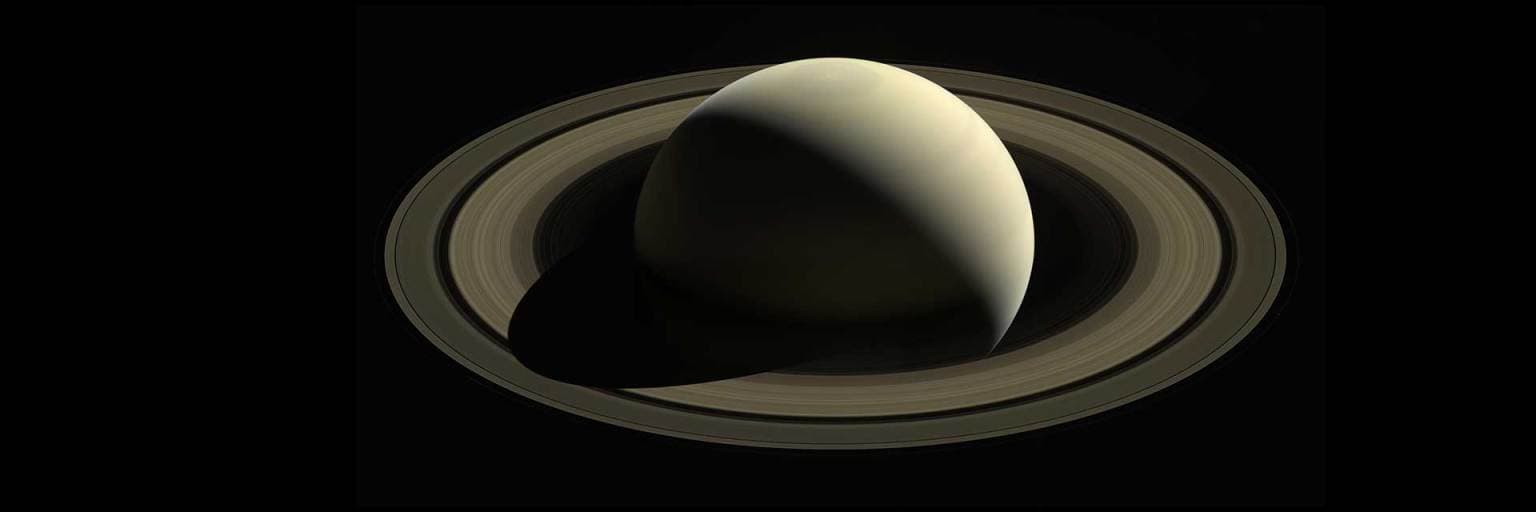 Direct observation
Processed spacecraft mosaic, not one exposure. Multiple filtered frames were assembled; ring and planet sizes share the same view, but this crop is not a Solar System distance scale.
NASA/JPL-Caltech/Space Science Institute ↗What this world is
Saturn is more than its rings. The pale globe is a deep hydrogen-helium world that becomes denser with depth instead of ending at solid ground. Countless orbiting ice and rock particles make the rings look continuous from afar.
Why it looks this way now
Saturn still leaks heat left from formation and from helium settling deeper inside. Fast rotation flattens the planet and organizes clouds into bands, while gravity and resonances sculpt gaps and waves in the rings.
Where it sits
Saturn is the sixth planet from the Sun, averaging about 1.4 billion kilometres or 9.5 astronomical units away. One orbit lasts about 29.4 Earth years.
Swipe sideways to inspect the full map
The blue orbit, marker and name locate Saturn without implying its live position today.
Jupiter is immediately inside; Uranus is immediately outside. The lower sequence preserves all eight positions.
Read the numbers
Reference values retain their units, context, evidence state and published uncertainty.
Physical measurements
- Mean radiusglobal mean
- 58,232kmCalculated measurementAbout 9.1 Earth radii.
An atmospheric reference radius, not a boundary of solid ground.
Published uncertainty: ± 6 km
JPL tabulated uncertainty at an adopted atmospheric reference level; Saturn has no solid surface.
- Massglobal mean
- 5.68317E26kgCalculated measurementAbout 95 Earth masses.
Moon and spacecraft motions reveal the total gravitational mass.
Published uncertainty: ± 2.6E22 kg
Converted from the uncertainty in the JPL 10^24 kilogram table.
- Mean densityglobal mean
- 0.6871g/cm³Calculated measurementLower than liquid water's density.
The popular floating comparison ignores that no ocean could hold Saturn and gravity compresses it.
Published uncertainty: ± 0.0002 g/cm³
Calculated from adopted mass and volume.
- Reference gravityequatorial reference
- 10.44m/s²Calculated measurementAbout 1.06 times Earth's at the reference level.
Large radius offsets much of the effect of Saturn's larger mass.
No uncertainty published in this source table
Reference equatorial gravity at an adopted atmospheric level, not gravity on solid ground.
- Temperaturevisible cloud level
- -140°CCalculated measurementA representative value near the visible cloud level.
Temperature rises deeper down and varies with season and latitude.
Approximate value
Representative one-bar cloud-level temperature; altitude, latitude and season matter.
- Temperaturedeep interior model
- 11,700°CScientific modelA model value roughly twice the Sun's visible-surface temperature.
No instrument has entered Saturn's centre.
Approximate value
NASA's approximate modeled central temperature, not a direct thermometer measurement.
Orbit and rotation
- Average distancerelative to the Sun
- 1,400,000,000kmCalculated measurementAbout 9.5 times Earth's average solar distance.
Sunlight there is about one ninetieth as intense per square metre.
Approximate value
Rounded average distance, about 9.5 astronomical units.
- Rotation periodrelative to distant stars
- 0.44401Earth daysCalculated measurementAbout 10 hours 39 minutes.
Clouds rotate differentially and magnetic estimates are not perfectly simple.
No uncertainty published in this source table
Adopted bulk rotation period; Saturn's visible atmosphere rotates at different speeds by latitude.
- Orbital periodrelative to the Sun
- 29.447498Earth yearsCalculated measurementA Saturn season lasts more than seven Earth years.
One full year spans about 29.4 Earth years.
No uncertainty published in this source table
Sidereal orbital period from astrometry and dynamical ephemerides.
Atmosphere and inside
Atmosphere
Hydrogen dominates, followed by helium and trace methane, ammonia, water and other species. Ammonia clouds help form the visible upper deck, with deeper condensate layers inferred below.
- HydrogenRelative abundance described; exact fraction not listed
- HeliumRelative abundance described; exact fraction not listed
- Methane, ammonia, water and trace speciesRelative abundance described; exact fraction not listed
Surface and interior
There is no solid surface. Clouds and rings are observed directly; metallic hydrogen and a diffuse heavy-element core are pressure-and-composition models tested against gravity, magnetic and ring-wave data.
No solid surface: layers transition gradually as pressure and temperature rise.
- 1Diffuse heavy-element core
Cassini gravity and ring-seismology studies favour a broad central region mixed with hydrogen and helium, not a sharply bounded rock ball.
Scientific model - 2Metallic hydrogen layer
Extreme pressure is modeled to turn hydrogen into an electrically conducting fluid that helps generate the magnetic field.
Scientific model - 3Molecular hydrogen envelope
Hydrogen and helium compress gradually from gas-like clouds into dense fluid, with no solid landing surface.
Scientific model - 4Cloud decks and ring system
Spacecraft directly image atmospheric bands, storms and icy rings. The rings orbit outside Saturn and are not an interior layer.
Direct observation
How we know
Images define clouds, shape and rings. Radio tracking maps gravity and occultations. Infrared spectra retrieve temperatures and gases. Ring waves add an unusual probe of internal oscillations.
- 01Direct observation
Multifilter spacecraft imaging
Cassini cameras mapped clouds, rings, shadows and the apparent limb across wavelengths and viewing angles.
Where this method stops
Colour composites combine filters and exposures; clouds mark pressure levels, not solid terrain.
- 02Calculated measurement
Radio tracking, occultations and ring waves
Doppler tracking measures gravity; radio occultations probe atmosphere and rings; waves in the rings can carry signatures of Saturn's oscillations.
Where this method stops
Recovering an interior requires models of rotation, winds, ring dynamics and spacecraft forces.
- 03Calculated measurement
Infrared spectroscopy
Thermal spectra reveal temperature, gases, clouds and seasonal change at different atmospheric depths.
Where this method stops
Spectra sense broad weighting layers and require radiative-transfer models to retrieve physical conditions.
- 04Scientific model
Interior model inversion
Gravity, shape, magnetic and ring-wave constraints are compared with candidate pressure, composition and flow models.
Where this method stops
Several interiors can fit the same global data; core boundaries and helium separation remain uncertain.
Evidence key
- Direct observation
- An instrument or sample recorded the phenomenon, with processing still disclosed.
- Calculated measurement
- Observed motion or signal is converted into a physical quantity using equations and reference constants.
- Scientific model
- A tested interpretation that fits observations but is not directly imaged or sampled.
- Vastward explanation
- Original beginner-facing synthesis, traceable to the source records but not itself a measurement.
- Artist visualization
- An interpretive image, not observational evidence.
Missions and instruments
Cassini-Huygens
Orbited Saturn for 13 years, mapping the planet, rings, magnetosphere and moons with remote sensing and radio science.
Official mission ↗- Imaging Science SubsystemVisible and near-infrared images of atmosphere, rings, moons and limb geometry.
- Radio Science SubsystemDoppler motion, atmospheric and ring occultations, gravity harmonics and ring particle structure.
- Composite Infrared SpectrometerThermal spectra used to retrieve atmospheric temperature and composition.
Official source trail
Links below are the exact records used for this profile. Access dates are retained with the content.
- 01
NASA Jet Propulsion Laboratory, Solar System Dynamics · dataset
Planetary Physical Parameters
- Source updated
- No source update date published
- Access checked
- 2026-07-30
- 02
NASA Science · official-page
Saturn Facts
- Source updated
- 2025-05-22
- Access checked
- 2026-07-30
- 03
NASA/JPL-Caltech/Space Science Institute · image
Saturn Farewell
- Source updated
- 2025-05-22
- Access checked
- 2026-07-30
- 04
NASA Science · official-page
Cassini-Huygens
- Source updated
- No source update date published
- Access checked
- 2026-07-30
Continue exploring
Atlas is a starting point. Use these relationships to move into explanation, experiment and mission thinking.
Interrogate the floating-Saturn claim
Use bulk density carefully and identify what the ocean analogy leaves out.
academyBuild gaps from resonances
Change moon periods and watch repeated tugs organize ring-particle orbits.
labListen through the rings
Explore how an internal oscillation can leave a measurable wave outside the planet.
lab