
Object profile · SUN
Sun
G-type main-sequence star · Solar System primary
The star whose gravity, light and plasma weather shape every Solar System journey.
- Atlas data reviewed
- Editorial stage
- Published
- Visibility
- Public
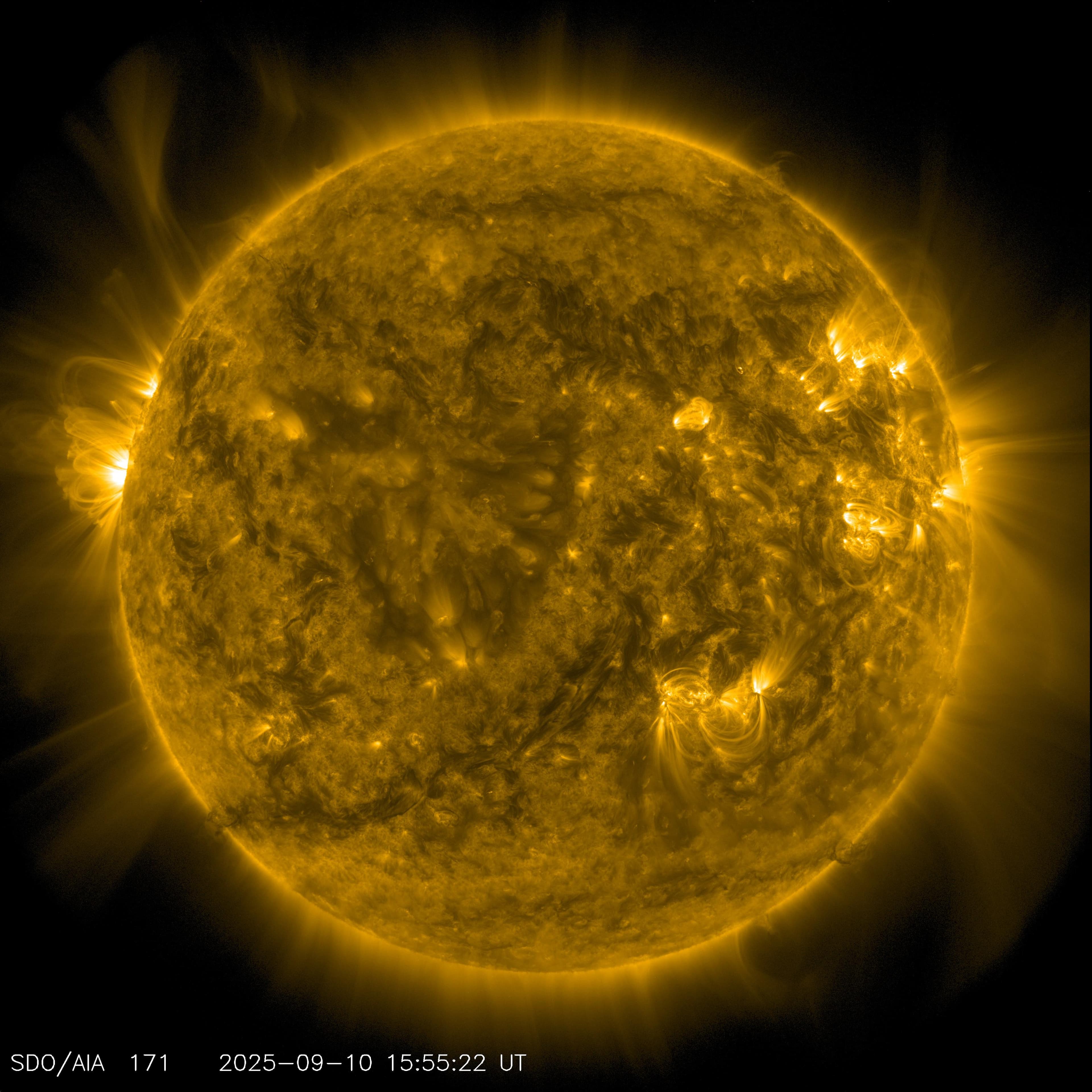 Direct observation
Official NASA observation. Orange-red is a false-color wavelength mapping, not natural human-eye color.
NASA/SDO/AIA/HMI/Goddard Space Flight Center ↗What this world is
The Sun is not a burning ball with a solid surface. It is a self-gravitating sphere of plasma: its core releases energy through nuclear fusion, and that energy works outward until it escapes as light and heat.
Why it looks this way now
The Sun is a middle-aged main-sequence star about 4.5 billion years old. Its magnetic cycle produces sunspots, flares and coronal mass ejections that can affect spacecraft and technology near Earth.
Where it sits
The Sun is the Solar System's central mass. Planets and smaller bodies orbit a shared barycentre that usually lies within or near the Sun.
Swipe sideways to inspect the full map
The blue ring identifies the Sun. It is not fixed at a perfect center and moves slightly around the Solar System barycentre.
Eight muted orbits preserve the planets' inside-to-outside order and show the Sun as their shared primary.
Read the numbers
Reference values retain their units, context, evidence state and published uncertainty.
Physical measurements
- Mean radiusglobal mean
- 695,700kmCalculated measurementAbout 109 Earth radii.
The visible edge is the photosphere, not a solid surface.
No uncertainty published in this source table
The selected summary source does not publish a compact uncertainty for this reference value.
- Massglobal mean
- 1.9885E30kgCalculated measurementRoughly 333,000 Earth masses.
Calculated from how planets and spacecraft accelerate in the Sun's gravity.
No uncertainty published in this source table
The selected summary source does not publish a compact uncertainty for this reference value.
- Mean densityglobal mean
- 1.408g/cm³Calculated measurementDenser than water overall, despite being plasma.
A derived global average; density rises steeply toward the core.
No uncertainty published in this source table
The selected summary source does not publish a compact uncertainty for this reference value.
- Reference gravitysurface
- 274m/s²Calculated measurementAbout 28 times Earth's surface gravity.
A reference value at the photosphere; no spacecraft could stand there.
No uncertainty published in this source table
The selected summary source does not publish a compact uncertainty for this reference value.
- Temperaturesurface
- 5,500°CCalculated measurementThe core reaches about 15 million °C.
This value describes the visible photosphere, not the much hotter core or corona.
No uncertainty published in this source table
The selected summary source does not publish a compact uncertainty for this reference value.
Orbit and rotation
- Rotation periodequatorial reference
- 25Earth daysCalculated measurementThe poles rotate more slowly, taking about 36 days.
Plasma does not rotate as one rigid shell.
Approximate value
The equator rotates in about 25 Earth days while polar regions take about 36 days.
Atmosphere and inside
Atmosphere
Hydrogen and helium dominate. Photosphere, chromosphere and corona are observational layer names, not a breathable atmosphere; temperature rises again through the outer atmosphere.
- Hydrogen73%
- Helium25%
- Heavier elements2%
Surface and interior
There is no solid surface. Core fusion, radiative transport, convection and magnetized atmospheric layers are inferred by combining physics with light, waves and particle measurements.
No solid surface: layers transition gradually as pressure and temperature rise.
- 1Fusion core
Extreme pressure and temperature allow hydrogen nuclei to fuse, releasing the energy that ultimately becomes sunlight.
Scientific model - 2Radiative zone
Energy moves outward mainly through repeated absorption and re-emission of photons.
Scientific model - 3Convection zone
Hot plasma rises, cools and sinks, carrying energy toward the visible surface.
Scientific model - 4Photosphere to corona
The visible photosphere, chromosphere and extended corona are observed at different wavelengths; the corona becomes unexpectedly hotter outward.
Direct observation
How we know
Radius comes from the visible limb; mass from orbital dynamics; temperature and composition from light; internal rotation from solar oscillations.
- 01Direct observation
Multi-wavelength solar imaging
SDO records the full Sun in selected wavelengths, turning invisible ultraviolet light into mapped colors.
Where this method stops
A colored solar image may represent wavelength or temperature, not what a human eye would see.
- 02Calculated measurement
Helioseismology
Patterns of surface oscillation reveal rotation and structure hidden below the photosphere.
Where this method stops
The interior is inferred through wave models; it is not directly photographed.
- 03Calculated measurement
Orbital dynamics
Planet and spacecraft trajectories reveal the Sun's gravitational parameter and therefore its mass.
Where this method stops
Mass is calculated through gravity and reference constants rather than placed on a scale.
- 04Calculated measurement
Spectroscopy and radiometry
Light intensity and spectral fingerprints constrain temperature, composition and motion.
Where this method stops
Each wavelength samples particular plasma conditions and needs physical modeling.
Evidence key
- Direct observation
- An instrument or sample recorded the phenomenon, with processing still disclosed.
- Calculated measurement
- Observed motion or signal is converted into a physical quantity using equations and reference constants.
- Scientific model
- A tested interpretation that fits observations but is not directly imaged or sampled.
- Vastward explanation
- Original beginner-facing synthesis, traceable to the source records but not itself a measurement.
- Artist visualization
- An interpretive image, not observational evidence.
Missions and instruments
Solar Dynamics Observatory
SDO continuously monitors solar activity, magnetic fields and atmospheric layers at high cadence.
Official mission ↗- Atmospheric Imaging AssemblyFull-disk solar images in multiple ultraviolet wavelengths.
- Helioseismic and Magnetic ImagerSurface motion and magnetic fields used to probe solar dynamics.
Parker Solar Probe
Parker samples the near-Sun environment to study the corona and the origin of the solar wind.
Official mission ↗- WISPRVisible-light structures in the corona and solar wind.
Official source trail
Links below are the exact records used for this profile. Access dates are retained with the content.
- 01
NASA Science · official-page
Sun Facts
- Source updated
- No source update date published
- Access checked
- 2026-07-31
- 02
NASA Science · official-page
Solar Dynamics Observatory
- Source updated
- No source update date published
- Access checked
- 2026-07-31
- 03
NASA Science · official-page
Parker Solar Probe
- Source updated
- No source update date published
- Access checked
- 2026-07-31
- 04
NASA Science · image
Image of Sun From NASA's Solar Dynamics Observatory
- Source updated
- No source update date published
- Access checked
- 2026-07-31
Continue exploring
Atlas is a starting point. Use these relationships to move into explanation, experiment and mission thinking.
Learn to read the Sun
Connect sunlight, spectra, magnetic activity and space weather before comparing other stars.
academyWatch space weather
Follow how observations become operational warnings for spacecraft and Earth.
mission