
Object profile · JUPITER
Jupiter
Hydrogen-rich gas giant
The Solar System's largest planet, a rapidly rotating world of deep fluid layers, powerful weather and intense gravity.
- Atlas data reviewed
- Editorial stage
- Published
- Visibility
- Public
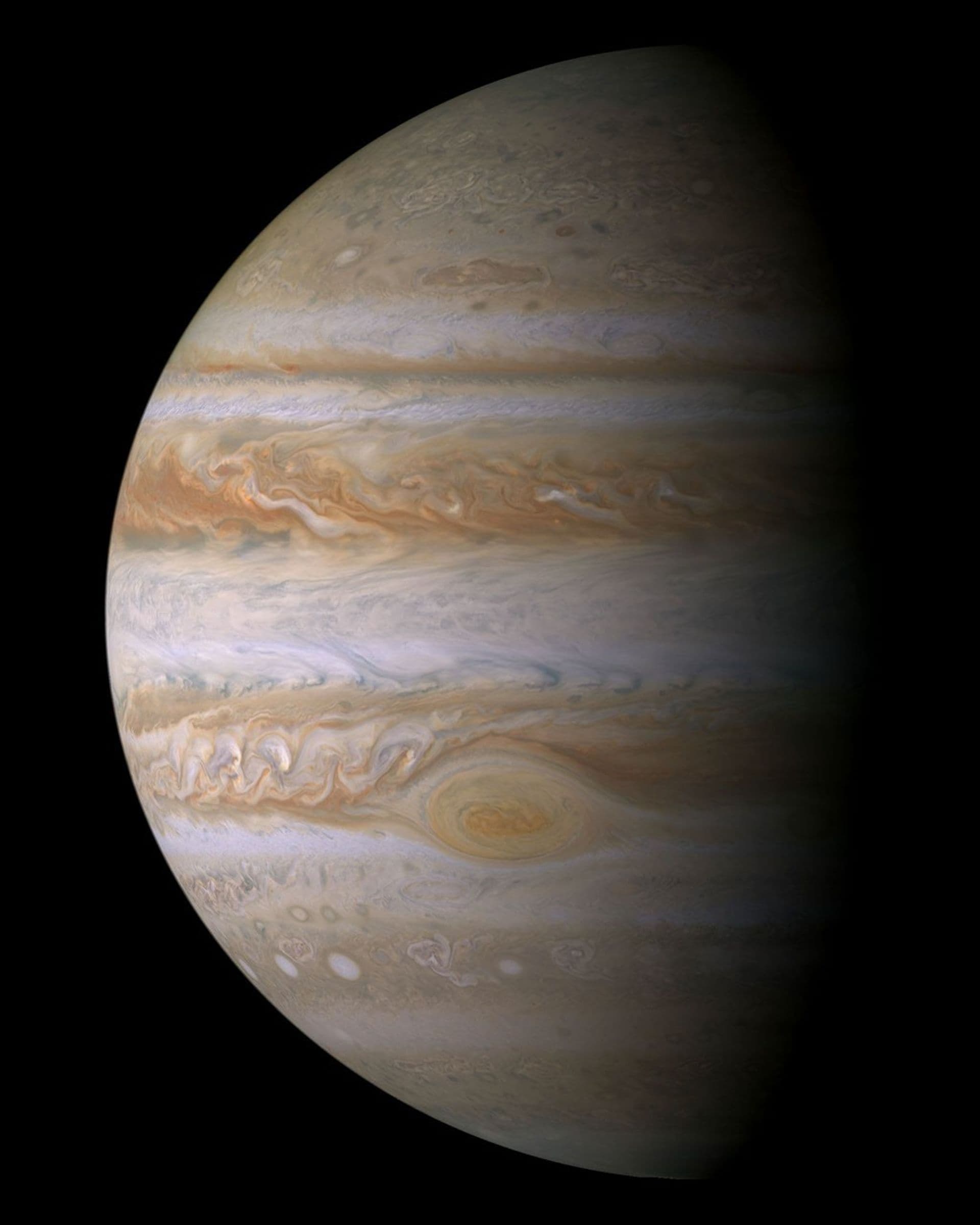 Direct observation
Processed spacecraft mosaic, not one exposure. Images from multiple filters and pointings were combined; colours were designed to remain close to human vision, and the display is not a distance scale.
NASA/JPL/Space Science Institute ↗What this world is
Jupiter is not a scaled-up Earth. The visible bands are cloud tops in a vast hydrogen-helium atmosphere. Descending would bring increasing pressure and temperature, with gas gradually becoming dense fluid. There is no solid surface where a spacecraft could land.
Why it looks this way now
Jupiter gathered more material than any other planet during Solar System formation. Its gravity compressed the interior, and the planet still releases internal heat. Rapid rotation organizes clouds into bands and jet streams, while deep convection powers long-lived storms.
Where it sits
Jupiter is the fifth planet from the Sun, averaging about 778 million kilometres or 5.2 astronomical units away. A Jupiter year lasts nearly 12 Earth years, while one rotation takes less than 10 hours.
Swipe sideways to inspect the full map
The blue orbit, marker and name locate Jupiter without implying its live position today.
Mars is immediately inside; Saturn is immediately outside. The lower sequence preserves all eight positions.
Read the numbers
Reference values retain their units, context, evidence state and published uncertainty.
Physical measurements
- Mean radiusglobal mean
- 69,911kmCalculated measurementAbout 11 Earth radii.
This is an atmospheric reference radius, not the edge of solid ground.
Published uncertainty: ± 6 km
JPL tabulated uncertainty for an adopted atmospheric reference level; Jupiter has no solid surface.
- Massglobal mean
- 1.898125E27kgCalculated measurementAbout 318 Earth masses.
Most of the planet is hydrogen and helium compressed by immense gravity.
Published uncertainty: ± 8.8E22 kg
Converted from the uncertainty in the JPL 10^24 kilogram table.
- Mean densityglobal mean
- 1.3262g/cm³Calculated measurementOnly about 1.33 times the density of water.
Large size does not imply rock-like density; composition matters.
Published uncertainty: ± 0.0003 g/cm³
Calculated from the adopted mass and volume.
- Reference gravityequatorial reference
- 24.79m/s²Calculated measurementAbout 2.53 times Earth's equatorial gravity at the chosen reference level.
There is no surface to stand on, and gravity changes as depth and rotation matter.
No uncertainty published in this source table
Reference equatorial gravity at an adopted atmospheric level. It is not gravity on solid ground.
- Temperaturevisible cloud level
- -145°CDirect observationA representative value near the visible cloud layer.
Different latitudes, altitudes and weather systems have different temperatures.
Approximate value
Representative visible cloud-level temperature from a NASA educational overview; atmospheric temperature varies with latitude, altitude and time.
- Temperaturedeep interior model
- 24,000°CScientific modelA modeled central-region value hotter than the surface of the Sun.
This is an inference from physics and global observations, not a direct thermometer measurement.
Approximate value
NASA describes the core region as possibly about 24,000 degrees Celsius. This is model-dependent, not a direct thermometer reading.
Orbit and rotation
- Average distancerelative to the Sun
- 778,000,000kmCalculated measurementAbout 5.2 times Earth's average solar distance.
Radio signals between Earth and Jupiter can take tens of minutes one way.
Approximate value
Rounded average distance, about 5.2 astronomical units.
- Rotation periodrelative to distant stars
- 0.41354Earth daysCalculated measurementAbout 9 hours 55 minutes.
The fluid atmosphere rotates differentially, so visible cloud features do not all share one period.
No uncertainty published in this source table
JPL reference sidereal period. Different atmospheric latitudes rotate at different visible rates.
- Orbital periodrelative to distant stars
- 11.862615Earth yearsCalculated measurementNearly 12 Earth years.
Greater solar distance means a much longer path and lower orbital speed.
No uncertainty published in this source table
Sidereal orbital period in Julian years.
Atmosphere and inside
Atmosphere
The outer atmosphere is roughly 90 percent hydrogen and 10 percent helium by volume, with smaller amounts of methane, ammonia, water and other species. The visible colours come from chemistry, altitude, particle size and lighting, not a solid painted surface.
- Hydrogen90%
- Helium10%
- Methane, ammonia, water and trace speciesRelative abundance described; exact fraction not listed
Surface and interior
Clouds are observed directly, but deeper layers are inferred. Pressure turns molecular hydrogen into conducting metallic hydrogen. Juno gravity data support a broad dilute central region, yet composition and boundaries remain model-dependent.
No solid surface: layers transition gradually as pressure and temperature rise.
- 1Dilute core region
Juno gravity data favour models in which heavy elements are spread through a broad central region rather than a neat solid ball.
Scientific model - 2Metallic hydrogen
At immense pressure hydrogen is modeled as an electrically conducting fluid that helps generate Jupiter's magnetic field.
Scientific model - 3Molecular hydrogen envelope
Hydrogen and helium gradually compress from gas-like outer layers into dense fluid with no sharp solid boundary.
Scientific model - 4Cloud decks and weather layer
Ammonia, ammonium hydrosulfide and water clouds are modeled at different depths beneath the visible bands and storms.
Direct observation
How we know
Imaging fits the visible limb at an adopted pressure level. Radio tracking and moon orbits constrain mass and gravity. Infrared and microwave radiometry sample different atmospheric depths, while gravity inversion tests possible interiors.
- 01Calculated measurement
Limb imaging and reference-level fitting
Images trace Jupiter's curved limb. A rotating atmospheric figure is fitted at an adopted pressure level to define radii.
Where this method stops
Clouds move and sit at different heights. The reported radius is a reference figure, not a rocky edge.
- 02Calculated measurement
Radio and moon-orbit tracking
Spacecraft signals and moon motions reveal Jupiter's total gravity, mass, rotation and detailed gravity harmonics.
Where this method stops
Separating Jupiter's field from spacecraft forces and many-body motion requires a fitted dynamical model.
- 03Direct observation
Infrared and microwave sounding
Thermal infrared and microwave brightness reveal atmospheric temperature, composition and structure at different depths.
Where this method stops
Brightness is converted to physical temperature through radiative-transfer models, and different wavelengths sense different pressure levels.
- 04Scientific model
Gravity inversion
Small changes in Juno's velocity map uneven gravity. Interior models are tested against those gravity harmonics.
Where this method stops
Gravity does not yield one unique interior. Composition, temperature and flow assumptions can trade off.
Evidence key
- Direct observation
- An instrument or sample recorded the phenomenon, with processing still disclosed.
- Calculated measurement
- Observed motion or signal is converted into a physical quantity using equations and reference constants.
- Scientific model
- A tested interpretation that fits observations but is not directly imaged or sampled.
- Vastward explanation
- Original beginner-facing synthesis, traceable to the source records but not itself a measurement.
- Artist visualization
- An interpretive image, not observational evidence.
Missions and instruments
Juno
Polar orbits probe Jupiter's gravity, magnetic field, deep atmosphere, auroras, rings and major moons.
Official mission ↗- Juno gravity science systemDoppler shifts in Juno's radio link caused by tiny velocity changes in Jupiter's uneven gravity field.
- Microwave RadiometerMicrowave emission from beneath the visible clouds, constraining water, ammonia and deep atmospheric temperature.
Cassini-Huygens
During its Jupiter flyby Cassini produced a detailed near-natural-color global portrait and atmospheric observations.
Official mission ↗- Cassini Imaging Science SubsystemVisible and near-infrared light used to map clouds, winds and the planet's apparent limb.
- Composite Infrared SpectrometerThermal infrared spectra used to retrieve atmospheric temperatures and composition.
Official source trail
Links below are the exact records used for this profile. Access dates are retained with the content.
- 01
NASA Jet Propulsion Laboratory, Solar System Dynamics · dataset
Planetary Physical Parameters
- Source updated
- No source update date published
- Access checked
- 2026-07-29
- 02
NASA Science · official-page
Jupiter Facts
- Source updated
- 2025-04-21
- Access checked
- 2026-07-29
- 03
NASA/JPL/Space Science Institute · image
Cassini Jupiter Portrait
- Source updated
- 2024-11-01
- Access checked
- 2026-07-29
- 04
NASA Science · official-page
Juno
- Source updated
- No source update date published
- Access checked
- 2026-07-29
- 05
NASA Science · official-page
Cassini-Huygens
- Source updated
- No source update date published
- Access checked
- 2026-07-29
- 06
NASA Jet Propulsion Laboratory · official-page
40-Year Study Finds Mysterious Patterns in Temperatures at Jupiter
- Source updated
- 2022-12-19
- Access checked
- 2026-07-29
- 07
NASA · official-page
What Is Jupiter? Grades 5-8
- Source updated
- No source update date published
- Access checked
- 2026-07-29
Continue exploring
Atlas is a starting point. Use these relationships to move into explanation, experiment and mission thinking.
Challenge the bigger-means-denser idea
Compare Jupiter's enormous mass with a mean density only modestly above water.
academyAvailable nowBuild a twelve-year orbit
Connect distance, orbital speed and the length of a Jovian year.
academyInvert a gravity field
Test several interiors and see why gravity measurements do not produce one unique answer.
lab